Overview
Few animals capture the spirit of the American wilderness quite like the elk. Known scientifically as Cervus canadensis and colloquially referred to as "wapiti" — a term borrowed from the Shawnee and Cree languages meaning "white rump" — the elk is one of the largest members of the deer family, Cervidae, and one of the most recognizable large mammals on the North American continent. Whether you encounter one standing silhouetted against a mountain sunset or hear the haunting bugle of a bull echoing through an autumn valley, the elk commands attention, respect, and admiration from wildlife enthusiasts and hunters alike.
Elk occupy a special place in the cultural and ecological fabric of North America. They have been hunted for sustenance by Indigenous peoples for thousands of years, and today they remain one of the most sought-after big-game animals on the continent. States like Montana — a vast, rugged, and sparsely populated Western state — serve as some of the finest elk country remaining on earth, offering hunters and wildlife observers extraordinary opportunities to connect with this magnificent species in its natural environment.
This guide explores everything you need to know about the elk: its biology, its habitat, its significance to ecosystems and hunting culture, and how conservation efforts continue to ensure that future generations can share in the wonder of encountering this iconic animal.
Biological Traits
The elk, Cervus canadensis, belongs to the order Artiodactyla and the family Cervidae — the same family that includes white-tailed deer, mule deer, moose, and caribou. Despite being closely related to these species, elk are distinctly their own animal, possessing a combination of size, social behavior, and physical attributes that set them apart.
Size and Physical Appearance
Elk are among the largest land mammals in North America. Bulls (males) are substantially larger than cows (females), a characteristic known as sexual dimorphism that is common among cervids. A mature bull can weigh anywhere from 700 to over 1,000 pounds and stand five feet tall at the shoulder. Cows are considerably smaller, typically ranging from 450 to 650 pounds. The body of an elk is built for power and endurance — muscular hindquarters, a deep chest, and long, sturdy legs allow them to navigate steep mountain terrain with surprising agility.
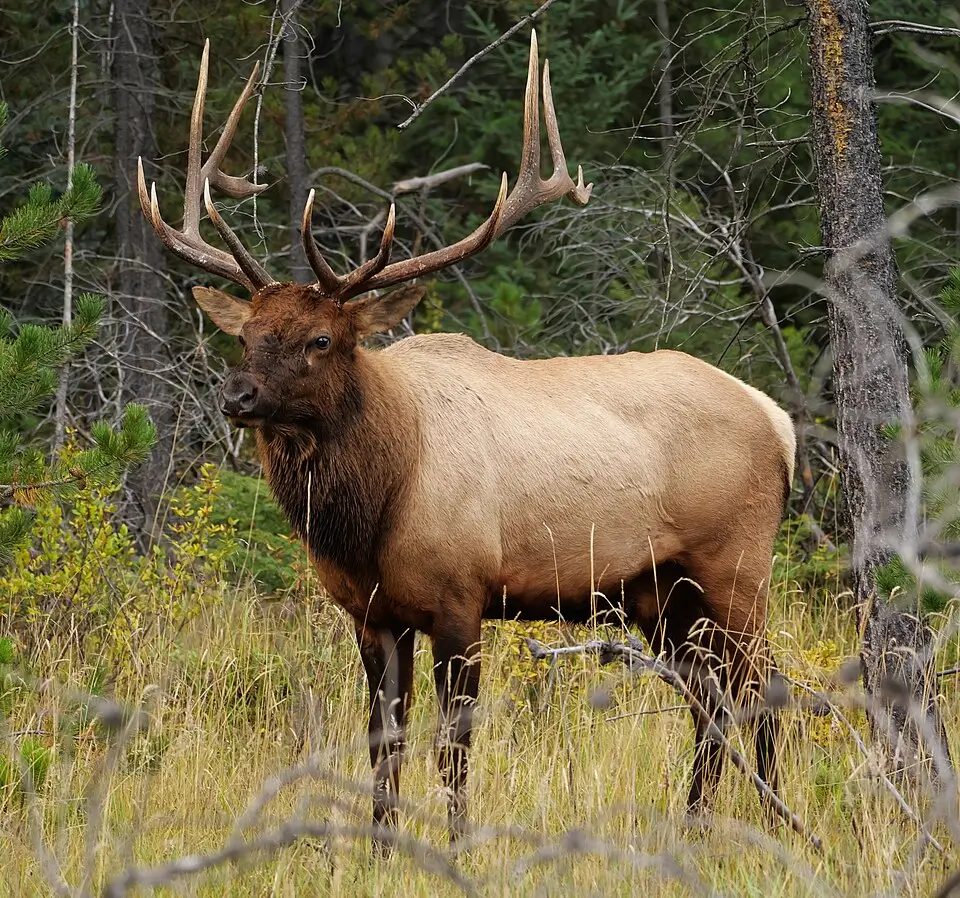
Elk have a distinctive two-toned coat: a lighter, tan or buff-colored body contrasted by a darker brown neck and legs, and the famous pale yellowish rump patch that earned the animal its Shawnee name. Their coats shift seasonally, becoming thicker and darker in winter and shedding to a sleeker summer coat as temperatures rise.
Antlers
Perhaps the most iconic feature of the bull elk is its antlers — massive, branching structures that can span five feet from tip to tip and weigh upwards of 40 pounds. These antlers are grown and shed annually, making them among the fastest-growing tissues in the animal kingdom. Antler growth begins in spring, fueled by rich summer forage, and by late summer the antlers are fully formed and hardened as the velvet covering is shed. A mature bull may carry six or more tines (points) per antler, and trophy-class animals with large, symmetrical racks are among the most prized in all of big-game hunting.
Behavior and the Rut
Elk are highly social animals, typically living in sex-segregated herds for much of the year. Cows, calves, and young bulls form nursery groups, while older bulls tend to travel in bachelor groups or alone outside of the breeding season. This dynamic changes dramatically in the fall, when elk enter their annual rut — the breeding season that typically peaks in September and early October.
During the rut, bulls become intensely competitive and vocal. The bugle of a bull elk — a rising, haunting call that transitions from a low bellow to a high-pitched whistle and ends in a series of grunts — is one of the most thrilling sounds in North American wildlife. Bulls use bugling to attract cows, warn rival males, and assert dominance. They also engage in thrashing vegetation with their antlers and engaging rival bulls in dramatic, antler-clashing battles. A dominant bull may gather a harem of a dozen or more cows, which he defends vigorously throughout the rut.
Calves are born in late spring, typically in May or June, following a gestation period of approximately 240 to 262 days. Most cows give birth to a single calf, which is spotted at birth — a characteristic shared with many deer species that helps with camouflage in dappled light. Calves grow rapidly and are weaned by fall, though they often remain with their mothers through the first winter.
Habitat & Range
Elk are highly adaptable animals, capable of thriving in a wide variety of habitats across North America. Historically, their range extended across much of the continent, from the Atlantic to the Pacific and from northern Canada into Mexico. However, as European settlement expanded and habitat was converted to agriculture and development, elk populations were dramatically reduced and their range contracted significantly.
Today, elk are most abundant in the mountain West, with robust populations existing in states like Montana, Wyoming, Colorado, Idaho, Oregon, and Washington, as well as in parts of Canada and reintroduced populations in several Eastern states. Elk favor a mosaic of habitats — open meadows and grasslands for grazing, adjacent forests for cover and shade, and reliable water sources. In mountainous regions, they are well known for their seasonal migrations, moving to higher elevations in summer to take advantage of lush alpine meadows and descending to lower valleys in winter to escape deep snow.
Montana, in particular, represents some of the most productive elk habitat in the world. The state's combination of vast mountain ranges, river valleys, national forests, and wilderness areas creates ideal conditions for large, healthy elk populations. Montana's size — it is the fourth-largest state in the United States — and its low human population density allow elk to roam across millions of acres of largely undisturbed terrain. The western half of Montana, characterized by the Rocky Mountains and their associated foothills, forests, and river drainages, is especially renowned as premium elk country.
Hunting Information
Elk hunting is one of the most revered traditions in North American outdoor culture, and Montana stands at the very pinnacle of elk hunting destinations. The state's healthy elk herds, combined with its vast public land access and stunning mountain landscapes, draw hunters from across the country and around the world each fall.
Hunting elk is a physically demanding pursuit. The animals are large, alert, and built for rugged terrain. Successful elk hunters must be prepared for demanding backcountry conditions — steep climbs, heavy packs, and the logistical challenge of packing out hundreds of pounds of meat and antlers from remote locations. This physical and mental challenge is part of what makes elk hunting so deeply satisfying for those who pursue it.
The fall rut provides arguably the most exciting hunting opportunities, as bugling bulls are more vocal and less cautious than at other times of year. Hunters employ a variety of calling techniques — using bugles, cow calls, and grunt calls — to locate bulls and draw them within range. Rifle hunting, archery hunting, and muzzleloader hunting each offer their own unique challenges and rewards, and most states offer separate seasons for each method.
Hunters interested in pursuing elk in Montana should consult Montana Fish, Wildlife & Parks (FWF) for the most current and accurate licensing requirements, season dates, and regulations, as these change annually and vary by hunting district. Public land access in Montana is extensive, with millions of acres of national forest, Bureau of Land Management land, and state lands open to hunting. Proper preparation — including scouting, physical conditioning, and familiarity with local regulations — is essential for a safe and successful elk hunt.
Conservation
The story of elk conservation in North America is one of the great wildlife recovery successes of the 20th century. By the late 1800s, relentless hunting pressure and habitat loss had reduced elk numbers to critically low levels across much of their historic range. Recognizing the crisis, conservation-minded hunters, land managers, and government agencies began working together to protect remaining populations and restore elk to portions of their former range.
Today, organizations like the Rocky Mountain Elk Foundation (RMEF) continue to champion elk conservation through habitat protection, land acquisition, and wildlife management advocacy. Regulated hunting itself plays a vital role in elk conservation — license and tag fees generate critical funding for wildlife management agencies, and hunters serve as active stewards of the land and the animals they pursue.
Elk populations across the West remain healthy and, in many areas, robust. Wildlife managers continue to monitor herd sizes, habitat conditions, and population dynamics to ensure sustainable management for both ecological balance and continued hunting opportunity. The ongoing partnership between hunters, conservation organizations, and wildlife agencies represents one of the most effective models of wildlife stewardship in the world.