Overview
Few birds in North America carry as much mystique, legend, and genuine sporting appeal as the common snipe. Long the subject of jokes and tall tales — the infamous "snipe hunt" being a rite of passage for many a young camper — the common snipe (Gallinago gallinago) is, in fact, a very real, very challenging, and utterly fascinating bird. Far from being a fictional creature conjured to send gullible newcomers stumbling through the woods at night, the common snipe is a legitimate migratory gamebird that commands deep respect from seasoned wingshooters and wildlife enthusiasts alike.
For those who have watched a flushed snipe explode from a wet meadow in a zigzagging, unpredictable flight pattern, there is no question about why this bird has inspired both frustration and admiration for generations of hunters. The word "sniper" — referring to a skilled marksman — is itself derived from the bird's name, a tribute to just how difficult it is to bring one down cleanly. To consistently hunt snipe is to be among the most skilled of all upland and wetland bird hunters.
In Montana, a vast and wild state stretching across the Mountain West, the common snipe finds both breeding grounds and migratory stopover habitat across its diverse and largely undeveloped landscape. Whether you are a wildlife watcher, a biologist, or a hunter looking to test your shooting skills against one of nature's most accomplished aerial acrobats, this guide will walk you through everything you need to know about the common snipe.
Biological Traits
The common snipe is a medium-sized shorebird belonging to the family Scolopacidae — the same family that includes woodcocks, sandpipers, and dowitchers. Its scientific name, Gallinago gallinago, is derived from the Latin gallina, meaning hen or chicken, though the bird bears little resemblance to domestic poultry in behavior or ecology.
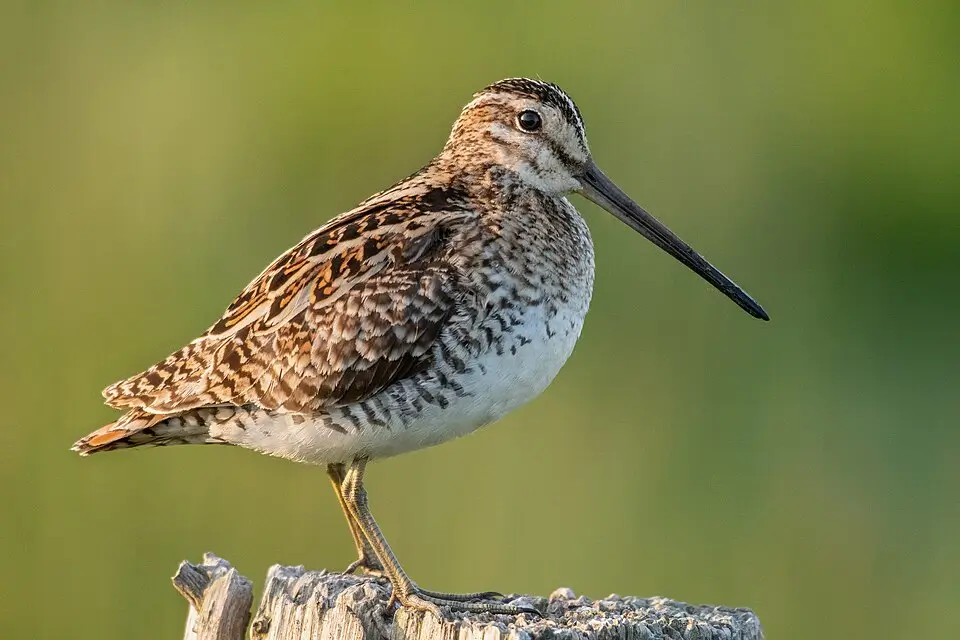
One of the most immediately recognizable features of the common snipe is its extraordinarily long bill, which can measure roughly one-third of the bird's total body length. This bill is not merely for show. It is a highly specialized feeding instrument packed with nerve endings near the flexible tip, allowing the bird to probe deep into soft mud and soil and detect invertebrates by touch. The snipe can actually open just the tip of its bill while it remains inserted in the ground — a remarkable anatomical adaptation known as rhynchokinesis — to seize and swallow prey without ever withdrawing the bill fully from the substrate.
The plumage of the common snipe is a masterwork of camouflage. The bird's back, wings, and crown are streaked and barred in rich browns, tawny oranges, black, and cream — a pattern so closely matched to the dead grasses, sedges, and leaf litter of its preferred habitat that a roosting or feeding snipe can be nearly invisible even to sharp eyes at close range. A distinctive pale supercilium (eyebrow stripe) and dark lateral crown stripes give the head a strongly patterned appearance, which along with the long bill helps observers make a confident field identification.
In terms of size, common snipe are relatively compact birds, typically measuring around 25 to 27 centimeters in body length, with a wingspan of approximately 44 to 47 centimeters. They are stocky for shorebirds, with relatively short legs suited to wading in shallow water and walking through dense marsh vegetation rather than the long-distance wading of taller shorebird species.
The flight of the common snipe is one of its most defining characteristics. When flushed, a snipe launches itself nearly vertically with a harsh, raspy call — often described as a "scaipe" or "skaip" — before launching into a rapid, erratic zigzagging flight that makes it one of the most difficult birds in the world to shoot on the wing. This evasive flight pattern is believed to be a predator-avoidance strategy refined over thousands of years of natural selection.
Perhaps the most spectacular behavioral display of the common snipe is its "winnowing" or "drumming" during the breeding season. In this courtship flight, the male climbs high into the air and then dives steeply, causing the outermost tail feathers to vibrate in the rushing air and produce a haunting, resonant humming or bleating sound. This sound, sometimes compared to the call of a goat (earning the snipe the old folk name "heather bleater" in parts of Europe), carries surprisingly far across open wetland and moorland. It is one of the most evocative sounds of wild, undisturbed wetland ecosystems.
The diet of the common snipe consists primarily of invertebrates — earthworms, insect larvae, beetles, flies, small crustaceans, and occasionally seeds and plant matter. Their feeding behavior is most active during dawn, dusk, and nighttime hours, making them somewhat crepuscular to nocturnal in their foraging patterns.
Habitat & Range
The common snipe has a remarkably broad global range, breeding across a wide swath of the Northern Hemisphere from Iceland and the British Isles in the west, across Europe and Russia, and into Central Asia. In North America, the species breeds from Alaska across Canada and into the northern tier of the contiguous United States, including states like Montana, Minnesota, and the Great Lakes region. During migration and winter, the bird moves south into the southern United States, Central America, and beyond.
The species is inextricably linked with wetland habitats. It favors wet meadows, bogs, fens, marshes, wet agricultural fields, river floodplains, and the grassy margins of lakes and ponds. The key requirement is soft, moist soil into which the bird can probe for invertebrates, combined with dense, low vegetation that provides cover from predators. Snipe are rarely found far from water.
In Montana, the common snipe has ample opportunity to find suitable habitat. The state's vast and varied landscape — from the glacially carved wetlands of the Hi-Line country in the north, to the richly watered river valleys and mountain meadows of the western ranges, to the prairie potholes of the eastern plains — provides both nesting habitat during the summer months and critical migratory stopover habitat during spring and fall. Montana's largely intact wetland systems and relatively low human population density make it an important stronghold for snipe and many other wetland-associated bird species.
Hunting Information
The common snipe has a long and storied history as a gamebird across both Europe and North America. In the 19th and early 20th centuries, snipe hunting was enormously popular, particularly in Britain and Ireland, where the bird was considered one of the premier sporting quarries. The challenge of shooting a zigzagging snipe in flight elevated skilled "snipe shooters" to a position of great esteem among hunters, and the difficulty of the shot — as noted earlier — gave the English language its modern word for a long-range marksman.
Today, the common snipe remains a legal and managed gamebird across much of North America. It is classified as a migratory bird and is therefore regulated by both federal and state authorities in the United States. Hunters pursuing snipe must comply with migratory bird regulations, which typically require a valid hunting license and, in many jurisdictions, a federal Migratory Bird Hunting and Conservation Stamp (commonly known as the Duck Stamp).
In Montana specifically, hunters interested in pursuing common snipe should consult the Montana Fish, Wildlife & Parks (FWF) for the most current season dates, bag limits, and licensing requirements, as these regulations can change from year to year and the source data available for this article does not specify current season parameters. Montana's rich wetland habitats — particularly during the fall migration period — can offer outstanding snipe hunting opportunities for those willing to put in the miles and wade the wet meadows where these birds congregate.
Hunting snipe successfully requires patience, appropriate footwear (waterproof boots are essential), a well-trained flushing dog, and a shotgun choked relatively open — improved cylinder or skeet choke is commonly recommended given the close flushes and erratic flight patterns involved. Many experienced snipe hunters favor smaller shot sizes, such as No. 8 or No. 7½, given the bird's relatively small body size. The most productive snipe hunting typically occurs during the cooler months of fall when migrating birds are pushing through on their way south.
Because snipe hold extremely tight before flushing and rely heavily on camouflage, a hunting dog with a good nose — particularly a flushing spaniel or a pointing breed — can make the difference between a frustrating outing and a rewarding one. Walking slowly and methodically through likely habitat, paying close attention to wet depressions, sedge clumps, and muddy margins, is the key to finding birds.
For those new to snipe hunting, it is worth approaching the experience with realistic expectations. Even experienced hunters frequently miss snipe, and a modest bag after a full morning's work is a mark of genuine skill. This difficulty is, for many hunters, precisely the appeal.
Conservation
The common snipe is currently classified as a species of Least Concern by the International Union for Conservation of Nature (IUCN), reflecting its broad range and relatively large global population. However, like many wetland-associated bird species, it faces ongoing pressures from habitat loss — particularly the drainage of wetlands for agriculture and urban development. Wetland conservation efforts, which benefit a wide suite of migratory and breeding birds, are therefore directly beneficial to snipe populations.
In North America, the regulatory framework governing migratory bird hunting — including regular population surveys, harvest data collection, and adaptive management of season structures — helps ensure that hunting pressure remains sustainable relative to snipe population levels. Conservation programs that protect and restore wet meadows, prairie potholes, and riparian wetlands contribute meaningfully to snipe habitat across the continent.
Montana's commitment to maintaining healthy wetland ecosystems — through state conservation programs, land trust activity, and partnerships with federal agencies — helps preserve the habitat on which snipe and many other species depend. For hunters and wildlife enthusiasts alike, supporting wetland conservation is one of the most direct ways to ensure that the common snipe remains part of Montana's rich natural heritage for generations to come.