Overview
Few birds capture the imagination of wildlife enthusiasts, birdwatchers, and hunters quite like the Wood duck (Aix sponsa). Often regarded as one of the most visually stunning waterfowl species in the world, the Wood duck is a beloved resident of North American waterways, woodlands, and wetlands. Its iridescent plumage, unique nesting habits, and remarkable conservation comeback story make it one of the most fascinating birds on the continent.
In Michigan — a state defined by its extraordinary relationship with water, boasting more than 11,000 inland lakes, thousands of miles of rivers and streams, and bordered by four of the five Great Lakes — the Wood duck holds a special place in both the natural landscape and the hearts of outdoor enthusiasts. Whether you are a waterfowl hunter seeking a colorful trophy, a wildlife photographer hoping to capture that perfect shot, or simply a nature lover paddling a quiet backwater river, encountering a Wood duck in the wild is an experience that stays with you.
This article explores the biology, habitat, hunting traditions, and conservation significance of the Wood duck, with a particular focus on what makes Michigan such an exceptional place to observe and pursue this extraordinary species.
Biological Traits
The Wood duck, known scientifically as Aix sponsa, belongs to the family Anatidae — the large and diverse family of birds that includes all ducks, geese, and swans. The species name sponsa is derived from Latin, meaning "betrothed" or "bride," a fitting name that speaks to the bird's ornate and almost ceremonial appearance.
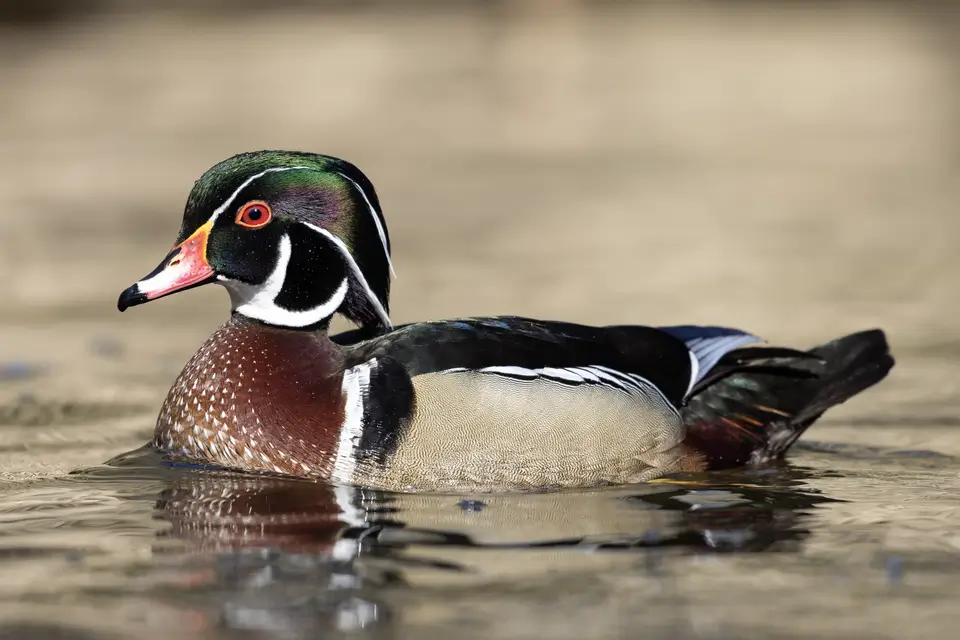
The male Wood duck is widely considered one of the most spectacularly plumaged birds in North America, if not the entire world. During breeding season, the drake displays an extraordinary combination of iridescent green and purple on the head, accented by bold white facial markings, a rich chestnut breast, golden flanks, and a sweeping, crested head that seems almost too dramatic to belong to a wild bird. The eyes of the male are a vivid, fiery red, further adding to his otherworldly appearance. In contrast, the female is more subtly colored in muted grays and browns, with a distinctive white teardrop-shaped eye ring and a blue-purple speculum on the wing — elegant in her own right, and beautifully adapted for camouflage while nesting.
One of the most remarkable biological features of the Wood duck is its adaptation to life in forested wetland environments. Unlike most ducks, which nest on the ground, Wood ducks are cavity nesters. They seek out natural tree hollows or abandoned woodpecker cavities — particularly those of the Pileated Woodpecker — in which to lay their eggs. This behavior makes them highly dependent on mature, wooded riparian corridors near water. Females line their nests with soft down feathers and can lay anywhere from six to fifteen eggs per clutch.
Perhaps the most dramatic moment in a Wood duck's life comes just one to two days after hatching. The newly born ducklings, though unable to fly, must make a daring leap from their nest cavity — which can be located high up in a tree — down to the forest floor or directly into the water below. The mother calls to her young from the ground, encouraging them to jump. The ducklings' small, lightweight bodies and sharp claws allow them to survive this extraordinary fall with minimal harm. This behavior is one of the most iconic spectacles in North American wildlife.
Wood ducks are also known to engage in "brood parasitism," where a female will sometimes lay eggs in the nest of another Wood duck. This behavior, known as "dump nesting," can result in nests containing far more eggs than a single female could incubate effectively.
The species is a perching duck — a member of a group sometimes called "dabbling and perching ducks" — and its strong, curved claws allow it to grip tree branches and navigate woodland environments with an agility that most waterfowl species simply do not possess. Wood ducks are omnivorous, feeding on a wide variety of plant material including acorns, seeds, berries, aquatic vegetation, and invertebrates such as insects and small crustaceans. Acorns, in particular, are a critically important food source during the fall season.
Habitat & Range
The Wood duck is native to North America and is found across much of the continent, from southern Canada down through the United States, with populations present in both the eastern and western portions of the country. The species is most abundant in the eastern United States, where mature bottomland hardwood forests, beaver ponds, swamps, and wooded river corridors provide ideal habitat.
Wood ducks strongly prefer slow-moving or still freshwater environments surrounded by or interspersed with mature trees. Wooded swamps, flooded timber stands, oxbow lakes, forested riverbanks, and shrubby wetlands are among their favored haunts. The presence of large, old trees with cavities suitable for nesting is a non-negotiable habitat requirement, which is why the preservation of mature riparian forests is so critical to the species' long-term health.
Michigan, with its remarkable abundance of water in every form — rivers, lakes, wetlands, marshes, and Great Lakes shorelines — provides some of the finest Wood duck habitat anywhere in the species' range. The state's extensive hardwood forests, particularly in the Lower Peninsula, are home to large populations of mature oaks, maples, and other mast-producing trees that provide essential food and nesting opportunities. The numerous beaver ponds scattered throughout Michigan's forested landscape are especially attractive to Wood ducks, offering both food and shelter in an intimate, wooded wetland setting.
Wood ducks are migratory, though they do not travel as far as many other waterfowl species. Birds that breed in Michigan and throughout the northern portions of the range typically winter in the southern United States, particularly in the Mississippi Alluvial Valley, the Gulf Coast states, and other warm southern wetlands. Spring migration brings them back to their northern breeding grounds as soon as open water becomes available.
Hunting Information
The Wood duck is one of the most sought-after waterfowl species among hunters in North America, prized not only for its spectacular appearance but also for the engaging and often challenging nature of hunting in the wooded, intimate environments that Wood ducks call home. Unlike hunting large open-water marshes for diving ducks, hunting Wood ducks typically involves setting up along a wooded creek, backwater slough, beaver pond, or flooded timber stand — environments that demand careful scouting, stealth, and patience.
Wood duck hunting in Michigan has a long and storied tradition. The state's abundant wooded wetlands, beaver ponds, and river bottoms provide outstanding habitat, and Michigan hunters enjoy opportunities to pursue Wood ducks during the annual waterfowl season. Because Wood ducks are early migrants, they are often most available to hunters in the early portion of the duck season, before cold weather pushes the bulk of the local population southward.
Hunters pursuing Wood ducks often use natural concealment along wooded shorelines rather than traditional open-water blind setups. Calling Wood ducks involves mimicking the distinctive, rising whistle-like call of the female — a sound that is quite different from the familiar quack of a Mallard. Decoy spreads are often smaller and more intimate than those used for other species, placed in flooded timber or along wooded creek banks to attract birds flying through the trees at first light.
Because hunting regulations, bag limits, season dates, and licensing requirements vary by state and are updated annually, hunters in Michigan are strongly encouraged to consult the Michigan Department of Natural Resources (DNR) and the U.S. Fish & Wildlife Service for the most current and accurate information before heading afield. Compliance with all applicable federal and state regulations is essential, as Wood ducks are protected migratory birds under the Migratory Bird Treaty Act.
Conservation
The Wood duck's conservation story is one of the most inspiring chapters in North American wildlife management history. By the late nineteenth and early twentieth centuries, unregulated market hunting and the widespread destruction of old-growth forest habitat had pushed the Wood duck to the brink of extinction across much of its range. The species was considered one of the most endangered waterfowl in North America at that time.
The passage of the Migratory Bird Treaty Act in 1918 provided critical federal protections that helped halt the catastrophic decline. Over subsequent decades, the work of wildlife managers, conservation organizations, and dedicated volunteers helped restore Wood duck populations through habitat protection, the installation of artificial nest boxes, and the careful management of hunting seasons.
The nest box program deserves particular recognition. Because Wood ducks depend on tree cavities for nesting — cavities that become scarcer as forests are cleared or managed — the provision of artificial nest boxes proved to be a remarkably effective conservation tool. Nest boxes installed along waterways, pond edges, and wetland margins across North America have allowed Wood duck populations to rebound dramatically. Today, the Wood duck is one of the most abundant duck species in the eastern United States, a testament to what thoughtful, science-based conservation can achieve.
In Michigan, conservation efforts continue through the work of the Michigan DNR, Ducks Unlimited, local conservation clubs, and countless individual landowners and volunteers who install and maintain nest boxes, protect riparian habitat, and support wetland restoration initiatives. The health of Michigan's wetlands and forested waterways is directly tied to the long-term prosperity of the Wood duck and dozens of other species that depend on these vital ecosystems.