Overview
Few creatures embody the wild spirit of North America's boreal forests quite like the American marten (Martes americana). Sleek, agile, and endlessly curious, this small but formidable carnivore has captivated naturalists, hunters, and wildlife enthusiasts for centuries. Known by various regional names — including the pine marten, American pine marten, or simply marten — this member of the weasel family (Mustelidae) is one of the most charismatic mammals found across the northern reaches of the continent.
In states like Michigan, where vast stretches of the Upper Peninsula remain cloaked in old-growth and second-growth forest, the American marten holds a special place in both the ecological community and the cultural heritage of the region. Understanding this remarkable animal — its biology, behavior, habitat needs, and conservation history — offers a window into the broader story of North American wildlife management and the delicate balance between human activity and wild places.
Biological Traits
The American marten is a member of the family Mustelidae, which also includes otters, weasels, minks, wolverines, and fishers. Within this family, martens belong to the genus Martes, a group of medium-sized, semi-arboreal carnivores found across the Northern Hemisphere. The American marten's closest relatives include the European pine marten (Martes martes) and the stone marten (Martes foina), reflecting a shared evolutionary history across northern latitudes.
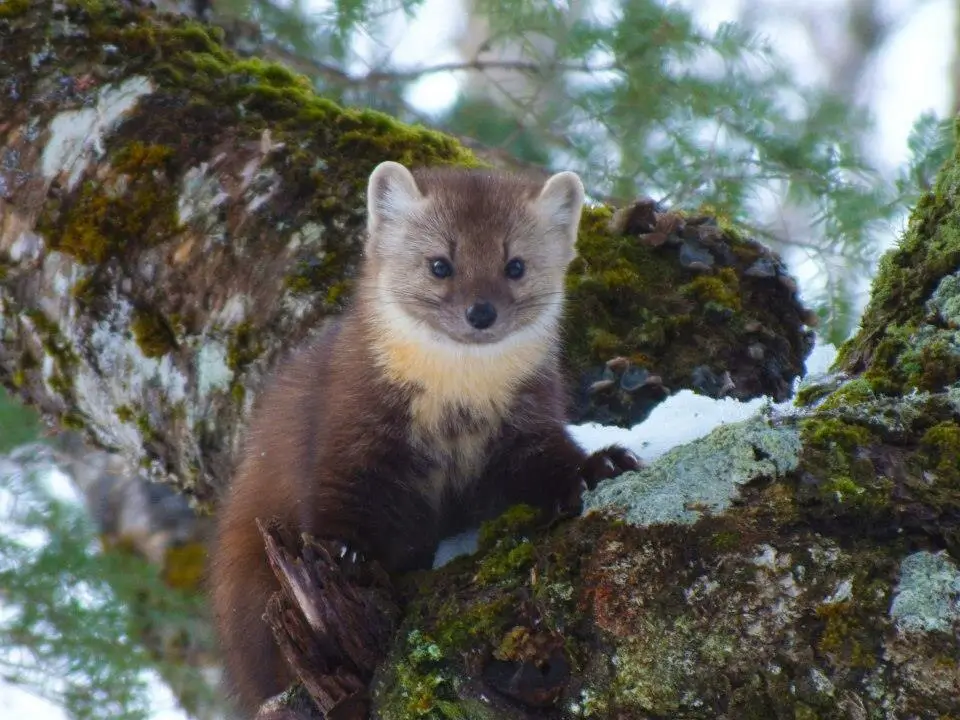
In terms of physical appearance, the American marten is a strikingly attractive animal. Its body is long and slender — typical of mustelids — with relatively short legs, a bushy tail, and a pointed snout adapted for hunting in tight spaces. The fur is typically a warm, golden-to-dark-brown color along the back and sides, while the underside tends to be paler. One of the marten's most distinctive features is its throat and chest patch, which ranges from pale yellow to vivid orange and serves as a reliable field identification mark. The ears are large and rounded, giving the animal an alert, attentive appearance.
Like most mustelids, the American marten is sexually dimorphic, meaning males are noticeably larger than females. Males tend to be considerably heavier and longer than their female counterparts, a pattern seen across many carnivorous mammals where competition among males drives the evolution of larger body size.
Martens are well adapted to cold climates. Their dense, luxurious fur provides excellent insulation against the harsh winters of the boreal zone, and their semi-plantigrade feet — which contact the ground across a broader surface area — help distribute weight when moving across snow. This adaptation allows martens to travel efficiently in deep winter snowpack, giving them an advantage over some prey species that may struggle in the same conditions.
As carnivores, American martens are opportunistic predators with a broad diet. Small mammals, particularly voles and other rodents, form the backbone of their diet throughout much of the year. However, martens are adaptable hunters and foragers, readily consuming red squirrels, birds, bird eggs, insects, berries, and other plant matter when the opportunity arises. This dietary flexibility is a key reason for the species' success across such a wide geographic range.
Martens are also notable for their climbing ability. Unlike many terrestrial predators, martens are highly skilled tree climbers, capable of pursuing squirrels and birds into the forest canopy with impressive speed and agility. This semi-arboreal lifestyle sets them apart from many of their mustelid relatives and makes old-growth forests — with their complex structures of standing dead trees, fallen logs, and interlocking canopies — ideal habitat.
Reproductively, American martens employ a strategy known as delayed implantation, or embryonic diapause. Mating typically occurs in summer, but the fertilized embryo does not implant in the uterine wall immediately. Instead, development is suspended for several months, with active gestation resuming in late winter. Young are born in early spring, typically in a den site located in a hollow tree, log, or rock crevice. Litter sizes are generally small, reflecting the energetic costs of raising young in challenging northern environments. The young are altricial at birth — helpless and dependent on their mother — but develop quickly, becoming independent by late summer or early fall.
Habitat and Range
The American marten is fundamentally a creature of northern forests. Its range spans a broad arc across the continent, from the Pacific Coast ranges of Alaska and British Columbia, eastward through the boreal forests of Canada, and south into the northern United States. In the lower 48 states, marten populations are found in the forests of the Rocky Mountains, the Sierra Nevada, the Cascades, the Great Lakes region, and portions of New England.
Within this range, the American marten shows a strong preference for mature coniferous and mixed forests. Old-growth stands are particularly valuable, as they provide the structural complexity — downed logs, snags, dense understory cover — that martens rely on for denning, hunting, and thermal cover in winter. The species is considered a reliable indicator of forest ecosystem health; where old-growth or late-successional forest persists in good condition, marten populations tend to thrive.
In Michigan, the American marten is primarily associated with the Upper Peninsula, where the landscape retains large blocks of mature forest habitat. The Upper Peninsula's boreal character — with its conifer swamps, upland spruce-fir forests, and mixed hardwood stands — provides conditions broadly suitable for marten. The species has a complex history in Michigan tied closely to forest management, logging history, and reintroduction efforts, making it an important symbol of conservation progress in the Great Lakes region.
Martens are generally solitary animals with well-defined home ranges. Males typically maintain larger home ranges than females, and territories of different individuals may overlap to varying degrees depending on habitat quality and prey availability. Martens use scent marking extensively to communicate with conspecifics and to advertise territorial boundaries.
Hunting Information
The American marten has historically been one of the most sought-after furbearers in North America. Its dense, silky fur was prized by the fur trade from the earliest days of European exploration and settlement, and marten pelts commanded high prices in European and North American markets for centuries. The Hudson's Bay Company and other fur trading enterprises built substantial portions of their operations on the trade in marten fur, particularly from Canada's boreal forests.
In many parts of its range today, the American marten remains a legal furbearer species, with regulated trapping seasons managed by state and provincial wildlife agencies. However, the specific regulations governing marten harvest vary considerably by jurisdiction, reflecting local population status, habitat conditions, and management priorities.
Important note for Michigan hunters and trappers: Based on the source data available for this article, specific current season dates, license requirements, and harvest regulations for American marten in Michigan are not confirmed. Hunters and trappers with interest in pursuing this species in Michigan should consult the Michigan Department of Natural Resources (DNR) directly for the most up-to-date and accurate regulatory information. Regulations can change from year to year, and it is the individual hunter's responsibility to ensure full compliance with all applicable state laws before pursuing any furbearer species.
What is broadly known is that Michigan has a complex and fascinating history with the American marten. The species was largely extirpated from the state during the era of extensive logging in the late 19th and early 20th centuries, when the great forests of the Upper Peninsula were dramatically reduced. Subsequent reintroduction efforts helped re-establish marten populations in portions of the Upper Peninsula, and wildlife managers have worked carefully to monitor the species' recovery and ensure that any harvest, if permitted, remains sustainable.
For those interested in marten trapping as a traditional pursuit, the species is typically targeted using standard mustelid trapping techniques, including body-gripping traps and box traps set along runways, near den sites, or at locations with evidence of marten activity. As with all trapping, ethical and effective technique is paramount, and prospective trappers are encouraged to seek mentorship from experienced practitioners and to pursue formal trapper education courses.
Conservation
The conservation story of the American marten in the Great Lakes region is one of both challenge and genuine success. As mentioned above, populations across Michigan and other parts of the upper Midwest were severely depleted by the combination of intensive logging and unregulated trapping during the 19th and early 20th centuries. The loss of mature forest habitat was the primary driver of decline, underscoring the species' dependence on structurally complex old-growth and late-successional forest ecosystems.
Reintroduction programs, combined with improved forest management practices and regulated harvest, have allowed marten populations to recover in portions of their former range. In Michigan, reintroduction efforts in the Upper Peninsula represent one of the region's notable wildlife restoration achievements. Conservation of the American marten today is closely linked to broader forest conservation priorities — protecting and restoring old-growth forest characteristics, maintaining large connected blocks of habitat, and managing timber harvest in ways that retain the structural features martens depend on.
The species is currently listed as a species of least concern by the International Union for Conservation of Nature (IUCN) at the global level, reflecting the overall health of marten populations across Canada and Alaska. However, localized populations in the contiguous United States, including those in the Great Lakes region, require continued attention and careful management.
Wildlife watchers and outdoor enthusiasts who spend time in Michigan's Upper Peninsula forests may be fortunate enough to encounter a marten during their travels — a fleeting glimpse of russet fur among the conifers, or the curious gaze of bright eyes peering from a log pile. These moments serve as a reminder of what is possible when wildlife and habitat conservation are taken seriously over the long term.