Overview
Few animals in North America command as much immediate recognition — and respectful distance — as the striped skunk (Mephitis mephitis). With its bold black-and-white coloration and legendary chemical defense system, the striped skunk has carved out a unique niche in the natural world and in the cultural imagination of the continent. Found from southern Canada through the contiguous United States and into northern Mexico, this fascinating mustelid-relative is far more than just its infamous odor. It is a keystone predator of insects and small rodents, a resilient survivor across diverse landscapes, and an animal whose biology and behavior offer remarkable insights into the wonders of evolutionary adaptation.
In Michigan — a state defined by its Great Lakes shorelines, dense hardwood forests, sprawling wetlands, and agricultural patchwork — the striped skunk is a familiar and ecologically important resident. Whether encountered on a quiet rural road at dusk or detected by its unmistakable scent drifting through a summer night, the striped skunk is woven into the fabric of Michigan's wildlife community. Understanding this animal more deeply allows hunters, naturalists, and outdoor enthusiasts alike to appreciate its role in the ecosystem and its place in the sporting heritage of the Great Lakes region.
Biological Traits
The striped skunk, Mephitis mephitis, belongs to the family Mephitidae — a group of animals whose Latin family name quite literally means "bad odor" or "noxious vapor." Despite a long-standing classification alongside weasels and otters in the family Mustelidae, genetic research has confirmed that skunks deserve their own distinct family, Mephitidae, separating them from their former relatives based on deeper evolutionary differences.
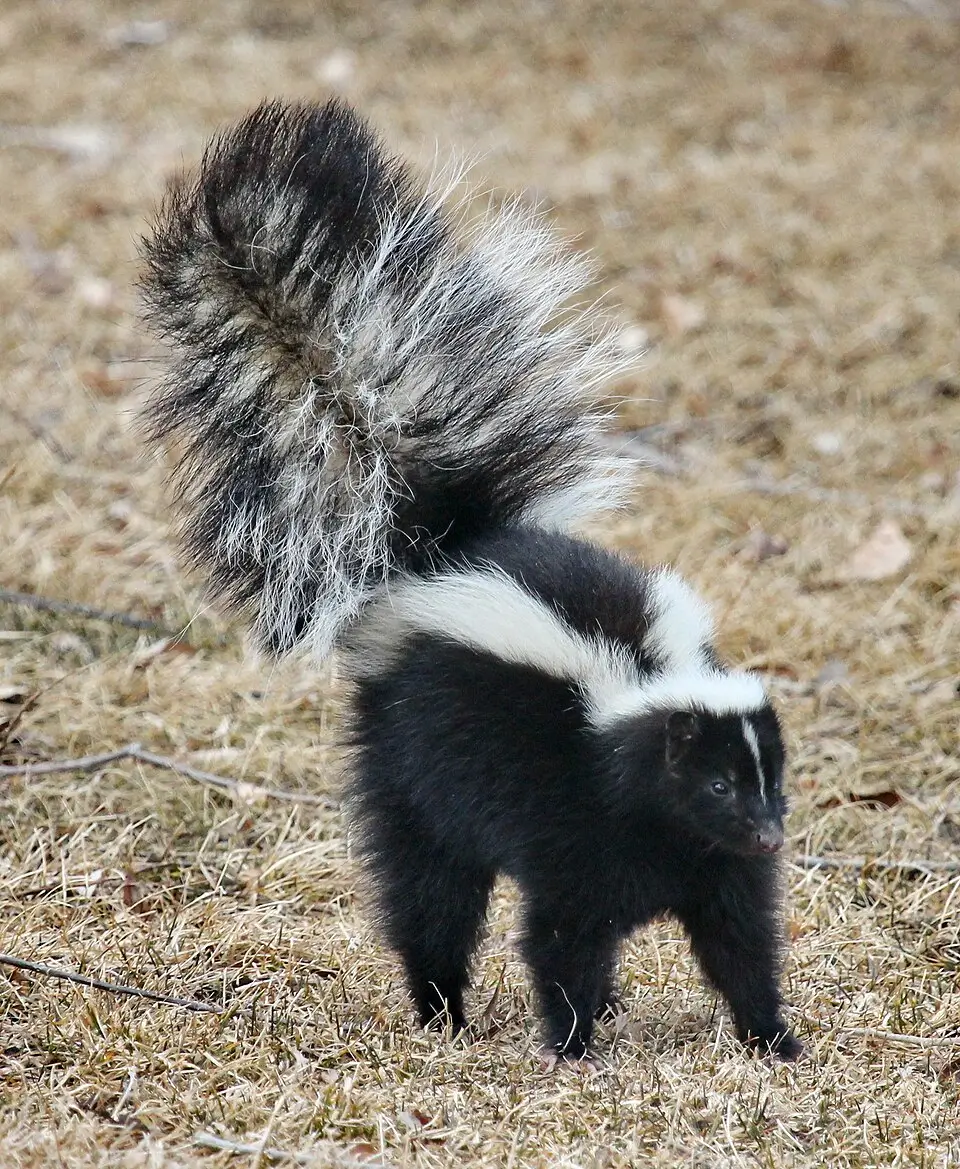
The striped skunk is a medium-sized mammal. Its most iconic feature is its coat: a deep, glossy black base adorned with two broad white stripes that run from the top of the head down the back, typically meeting at the nape of the neck before diverging along either side of the spine toward the tail. The tail itself is a magnificent plume of black and white fur. Individual animals can vary in the width and extent of their white markings, and some individuals display a single broad white stripe rather than the classic twin-stripe pattern. A thin white stripe typically runs down the center of the face as well.
The skunk's most formidable biological feature is its musk-producing anal scent glands. These paired glands can project a sulfur-containing chemical compound — primarily composed of thiols (also known as mercaptans) — with surprising accuracy at distances of up to ten feet or more. Before spraying, a skunk typically issues a series of clear warning signals: stomping its front feet, raising its tail, and performing a characteristic handstand in some species. The striped skunk's warning display usually involves the raised tail and an arched back posture before releasing the spray. This spray is not only intensely malodorous but can cause temporary eye irritation and even momentary blindness in close encounters, making it one of the most effective non-violent deterrents in the animal kingdom.
Skunks are omnivores with a broad and flexible diet. They are especially valuable as consumers of insects, including grubs, beetles, crickets, and wasps — making them natural pest controllers in agricultural and garden settings. They also feed on small mammals, bird eggs, frogs, crayfish, berries, seeds, and carrion. This dietary flexibility allows the striped skunk to thrive in a wide variety of environments and food conditions.
Striped skunks are not true hibernators, but they do enter a state of torpor during the coldest winter months, particularly in the northern parts of their range like Michigan. During this period, they remain in their dens — often borrowed from other animals like groundhogs or dug beneath structures — surviving on stored body fat. Multiple skunks, often females, may share a den during winter months, though they are generally solitary animals outside of the mating season.
Breeding typically occurs in late winter, often in February or March in northern states. After a gestation period of approximately 60 to 75 days, females give birth to litters of four to seven young, known as kits. The kits are born blind and helpless but develop rapidly. By about three weeks of age, they are already capable of producing musk, a fact that reflects just how central this chemical defense is to their survival strategy. Young skunks typically disperse in the fall of their first year to establish their own home ranges.
The striped skunk is primarily nocturnal, becoming most active after sunset and before dawn. Its eyesight is considered poor by mammalian standards, but it compensates with a well-developed sense of smell and adequate hearing. Home ranges vary considerably depending on habitat quality and food availability but are generally modest in size, reflecting the skunk's relatively sedentary lifestyle.
Habitat & Range
The striped skunk is one of the most habitat-tolerant mammals in North America. It occupies a remarkable spectrum of environments, including mixed woodlands, grasslands, agricultural fields, suburban neighborhoods, wetland edges, and brushy areas. It tends to prefer habitat mosaics — areas where open foraging ground meets woodland cover — allowing it to exploit both feeding and denning opportunities effectively.
In Michigan, skunks are found across both the Upper and Lower Peninsulas, adapting easily to the state's diverse landscape. Michigan's mix of hardwood and conifer forests, agricultural regions, river bottomlands, and suburban sprawl provides excellent habitat for striped skunks year-round. The state's Great Lakes shorelines, inland lake districts, and wetland complexes also offer productive foraging grounds where invertebrates and amphibians are abundant.
Skunks den in a variety of locations, including abandoned burrows, rock piles, brush piles, hollow logs, and beneath buildings or decks. In agricultural Michigan, they are frequently associated with farmsteads, fence rows, and grain fields where insect prey is plentiful. In suburban and urban areas — including communities surrounding Detroit, Grand Rapids, and Lansing — skunks have proven highly adaptable to human-altered environments, sometimes becoming nuisance animals when they take up residence beneath porches or outbuildings.
The species ranges broadly across North America, from southern Canada through most of the contiguous United States south into northern Mexico. Within this range, the striped skunk is absent only from arid desert interiors and high mountain elevations where conditions are extreme.
Hunting Information
The striped skunk has a modest but legitimate history as a furbearer in North America. Historically, skunk pelts were harvested for the fur trade, and skunk fur — sometimes marketed under alternative commercial names — was used in garments and trim. While the commercial fur market for skunk has declined significantly in the modern era, skunks remain classified as furbearers in many states, including Michigan, where hunting and trapping regulations govern their take.
In Michigan, the striped skunk falls under the state's furbearer management framework, overseen by the Michigan Department of Natural Resources (MDNR). Hunters and trappers interested in pursuing skunks in Michigan should consult the most current MDNR hunting and trapping guides, as season dates, licensing requirements, and legal methods of take can change from year to year. Because specific current season dates and license requirements were not available in the source data reviewed for this article, all prospective hunters and trappers are strongly encouraged to visit the official MDNR website or contact a local MDNR office for up-to-date, accurate regulatory information before pursuing skunks in the field.
Trapping has historically been the primary method used to harvest skunks, given the obvious practical challenges associated with other forms of take. Live trapping for nuisance control is also common in suburban settings. Anyone handling live or dispatched skunks should exercise appropriate precautions, as skunks are one of the primary vectors for rabies in the United States — a well-established public health consideration that all trappers and hunters should be aware of.
Michigan's outdoor heritage celebrates a wide range of furbearer harvest traditions, and the striped skunk, though perhaps unglamorous by some standards, represents a genuine part of that heritage. As with all wildlife pursuits in Michigan, ethical, legal, and safety-conscious practices are the foundation of responsible participation.
Conservation
The striped skunk is currently listed as a species of Least Concern by the International Union for Conservation of Nature (IUCN), reflecting its wide distribution, adaptability, and stable populations across most of its range. Unlike many wildlife species that have struggled in the face of habitat loss and human encroachment, the striped skunk has in many ways benefited from the landscape changes humans have made — finding abundant food and denning opportunities in agricultural and suburban settings.
That said, skunks face real pressures in the modern landscape. Road mortality is among the leading causes of skunk deaths, as their nocturnal habits and slow movement patterns make them vulnerable to vehicle collisions. Predation by great horned owls — one of the few predators unbothered by skunk musk due to their limited sense of smell — also plays a meaningful role in population regulation. Other predators include coyotes, foxes, and bobcats, which occasionally take skunks particularly when other prey is scarce.
Disease, especially rabies, is a significant mortality factor in skunk populations. Skunks are considered a primary reservoir species for the rabies virus across much of North America, and periodic outbreaks can substantially reduce local populations. Canine distemper and leptospirosis are additional diseases that affect striped skunks.
From a conservation management standpoint, maintaining habitat diversity — including woodland edges, wetlands, grasslands, and undeveloped buffer zones — supports healthy skunk populations and the broader ecological communities they inhabit. Michigan's robust land conservation programs, state and national forests, and active wildlife management by the MDNR all contribute to maintaining the conditions in which striped skunks and hundreds of other species continue to thrive.
The striped skunk's role as an insectivore makes it a quietly valuable ally for farmers and gardeners across Michigan and the broader Midwest. By consuming enormous quantities of grubs, beetles, and other pest insects, skunks provide a natural pest management service whose economic value, while difficult to quantify, is real and meaningful.