Overview
Few birds capture the imagination of wildlife enthusiasts quite like the Sandhill crane (Grus canadensis). With its tall, elegant stature, ash-gray plumage, and unmistakable bugling call that can carry for miles across open marshlands, the Sandhill crane is one of the most recognizable and beloved birds in North America. These ancient birds have wandered the continent for millions of years, with fossil records suggesting they are among the oldest living bird species on Earth. Their annual migrations, particularly the great staging events along major flyways, are considered one of the most spectacular wildlife phenomena anywhere in the world.
For outdoor enthusiasts in Michigan and across the Great Lakes region, the Sandhill crane has become an increasingly familiar sight in recent decades. Once dramatically reduced in numbers, the species has made one of the most remarkable conservation comebacks in North American wildlife history. Today, the sight of cranes flying overhead in long V-formations or the haunting sound of their calls echoing over a misty marsh at dawn is a treasured experience for birders, photographers, and hunters alike.
This article explores the biology, habitat preferences, range, hunting context, and conservation story of the Sandhill crane, with special attention to its status and presence in the state of Michigan.
Biological Traits
The Sandhill crane belongs to the family Gruidae, the cranes, an ancient lineage of large, long-legged wading birds found on nearly every continent. Its scientific name, Grus canadensis, reflects both its classification within the genus Grus and its association with North America, where it is one of only two native crane species (the other being the much rarer Whooping crane).
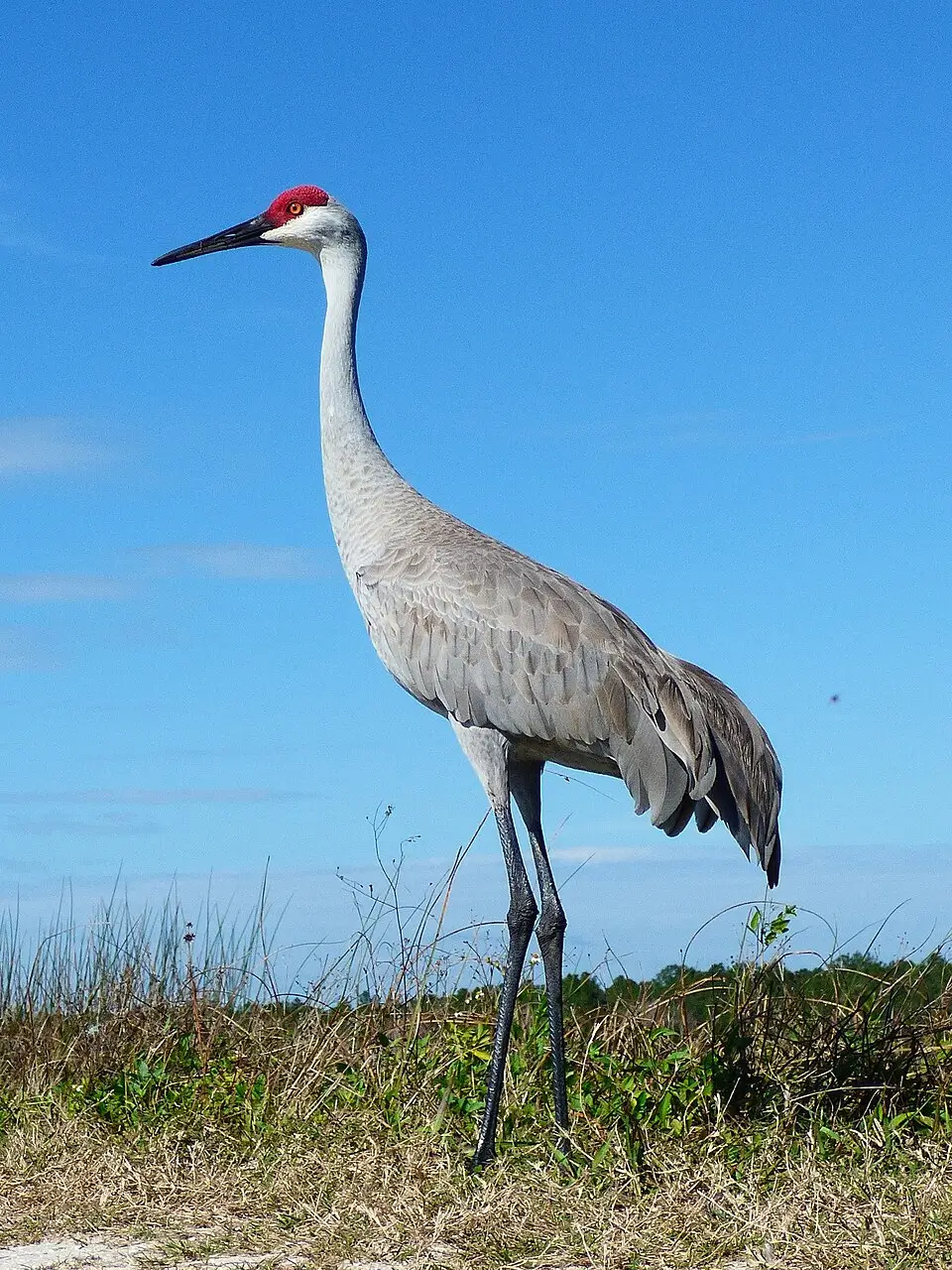
Adult Sandhill cranes are tall, stately birds, typically standing between three and four feet in height with wingspans that can exceed six feet. Their plumage is predominantly slate gray, though many individuals appear rusty or brownish during the breeding season because of a unique behavior known as "painting." Cranes deliberately preen iron-rich mud into their feathers, staining them with a reddish-brown patina that may help with camouflage on the nest. The head features a striking patch of bare red skin on the crown, contrasted by white cheeks and a long, pointed dark bill.
Several subspecies of Sandhill crane are recognized, generally divided into migratory and non-migratory populations. The Lesser, Greater, and Canadian Sandhill cranes are the migratory forms, while the Florida, Mississippi, and Cuban Sandhill cranes are non-migratory and far more restricted in range. Size varies considerably among these subspecies, with the Greater Sandhill crane being the largest.
Cranes are long-lived birds. Individuals in the wild can live well into their twenties, and captive birds have been known to exceed thirty years of age. They form monogamous pair bonds that often last for life, and pairs reinforce their bonds through elaborate courtship dances featuring leaps, bows, wing-spreads, and tossed vegetation. These dances are not limited to mating season and can be observed at staging grounds and on wintering territories.
Sandhill cranes are omnivorous and opportunistic feeders. Their diet includes grains, seeds, tubers, berries, insects, snails, small reptiles, amphibians, and occasionally small mammals or the eggs and nestlings of other birds. In agricultural landscapes, they readily feed on waste grain in harvested fields, which has been an important factor in their population recovery and expansion.
Their vocalizations are among the most distinctive features of the species. A crane's trumpeting call is produced by an elongated trachea that coils within the bird's sternum, acting like a natural musical instrument. This anatomical feature gives the call its resonance and remarkable carrying power. Pairs often perform "unison calls," in which the male and female vocalize together in tightly coordinated duets.
Habitat & Range
Sandhill cranes inhabit a wide variety of open landscapes across North America. While the Wikipedia source for this article does not detail specific habitat parameters, the species is generally associated with freshwater wetlands, wet meadows, prairies, river valleys, bogs, and agricultural fields. Shallow wetlands and marshes are particularly important for nesting and roosting, providing both food resources and protection from predators.
The breeding range of migratory Sandhill cranes stretches from the upper Midwest and Great Lakes region through Canada and into Alaska and even eastern Siberia. The Greater Sandhill crane is the subspecies most commonly encountered in Michigan, where it nests in shallow marshes, sedge meadows, and bog wetlands. After breeding, cranes gather in large staging flocks before migrating south to wintering grounds in the southern United States and northern Mexico.
In Michigan, Sandhill cranes are now widespread across both the Lower and Upper Peninsulas, particularly in areas with abundant wetlands such as state game areas, federal wildlife refuges, and the agricultural-wetland mosaic of southern Michigan. The state's combination of glacially formed wetlands, protected lands, and adjacent farm fields offers nearly ideal conditions for nesting pairs and migrating flocks. Fall staging concentrations in Michigan can number in the thousands, providing exceptional viewing opportunities for the public.
Michigan itself, as a peninsular state in the Great Lakes region of the Upper Midwest, offers an unusually rich array of wetland habitats. With an area of approximately 96,716 square miles and extensive shoreline along multiple Great Lakes, the state hosts a diverse cross-section of habitats that support not only cranes but a wealth of other migratory waterbirds.
Hunting Information
Sandhill cranes have a long history as a game bird in parts of their range. In several U.S. states and Canadian provinces, regulated hunting seasons have been established for migratory Sandhill crane populations once their numbers proved capable of sustaining harvest. Hunters pursue cranes both for sport and for the table; the breast meat is often described in culinary terms as resembling fine red meat more than typical waterfowl, earning the bird the colloquial nickname "ribeye of the sky."
It is important to note that hunting opportunities, season dates, license requirements, and bag limits for Sandhill cranes vary significantly by jurisdiction and change from year to year. The source data referenced for this article does not include specific season dates or license information, and as of the time of writing, official state-published hunting information for Sandhill cranes in Michigan was not available for citation here. Readers interested in the current legal status of Sandhill crane hunting in Michigan should consult the Michigan Department of Natural Resources directly for the most accurate and up-to-date information.
In states where Sandhill crane hunting is permitted, hunters typically employ tactics similar to those used for geese: decoy spreads in harvested grain fields, layout blinds, and careful concealment. Cranes have excellent eyesight and are notoriously wary, making them a challenging quarry that rewards skilled scouting, calling, and concealment.
Conservation
The conservation story of the Sandhill crane is one of the brightest in North American wildlife management. In the early twentieth century, populations were severely reduced by unregulated hunting, habitat loss, and wetland drainage. In some midwestern states, including Michigan, breeding populations were reduced to just a handful of pairs.
Through decades of careful protection, wetland conservation, and habitat restoration, Sandhill crane numbers have rebounded dramatically. Today, the mid-continent population of Sandhill cranes is estimated in the hundreds of thousands and is generally considered stable or increasing. The International Union for Conservation of Nature lists the species as Least Concern, reflecting the success of these recovery efforts.
Nevertheless, certain non-migratory subspecies, especially the Mississippi and Cuban Sandhill cranes, remain rare and the focus of intensive conservation programs. Habitat protection, particularly of wetlands and adjacent uplands used for nesting and feeding, remains a priority across the crane's range.
In Michigan, Sandhill cranes have become a conservation success story visible to the general public. Annual gatherings at state game areas, wildlife refuges, and nature preserves draw thousands of visitors who come to witness the spectacle of staging cranes in autumn. Continued wetland conservation, agricultural cooperation, and science-based wildlife management will help ensure that future generations continue to hear the bugling calls of these magnificent birds echoing across North American skies.