Overview
Few birds capture the imagination of upland hunters and wildlife enthusiasts quite like the ruffed grouse (Bonasa umbellus). Known for its explosive, heart-stopping flush and its remarkable ability to vanish into dense forest cover, the ruffed grouse stands as one of North America's most iconic game birds. Across the forests of the northeastern United States, Canada, and the Great Lakes region, this secretive woodland bird has earned a devoted following among hunters who prize the challenge it presents, as well as among birders and naturalists who marvel at its fascinating behaviors and adaptations.
In Michigan, a state richly endowed with vast stretches of hardwood and mixed forest across both the Upper and Lower Peninsulas, the ruffed grouse occupies a special place in the outdoor heritage. Michigan's landscape — shaped by the Great Lakes, ancient glaciation, and centuries of ecological succession — provides some of the finest ruffed grouse habitat in the United States. The bird's connection to this landscape is deep, and understanding the ruffed grouse means understanding the forests it calls home.
This guide offers a comprehensive look at the ruffed grouse: its biology, its preferred habitats, its range across North America, and the traditions surrounding its pursuit in the field. Whether you are a seasoned grouse hunter planning your next outing in the Michigan northwoods or a curious naturalist eager to learn more about this remarkable bird, read on to discover what makes Bonasa umbellus one of the continent's most celebrated wildlife species.
Biological Traits
The ruffed grouse is a medium-sized bird belonging to the family Phasianidae, the same broad family that includes pheasants, turkeys, and other well-known game birds. The genus name Bonasa is derived from a Latin word relating to the bison, possibly referencing the drumming sound the male produces, while the species name umbellus refers to the umbrella-like ruff of feathers around the bird's neck — one of its most distinctive physical features.
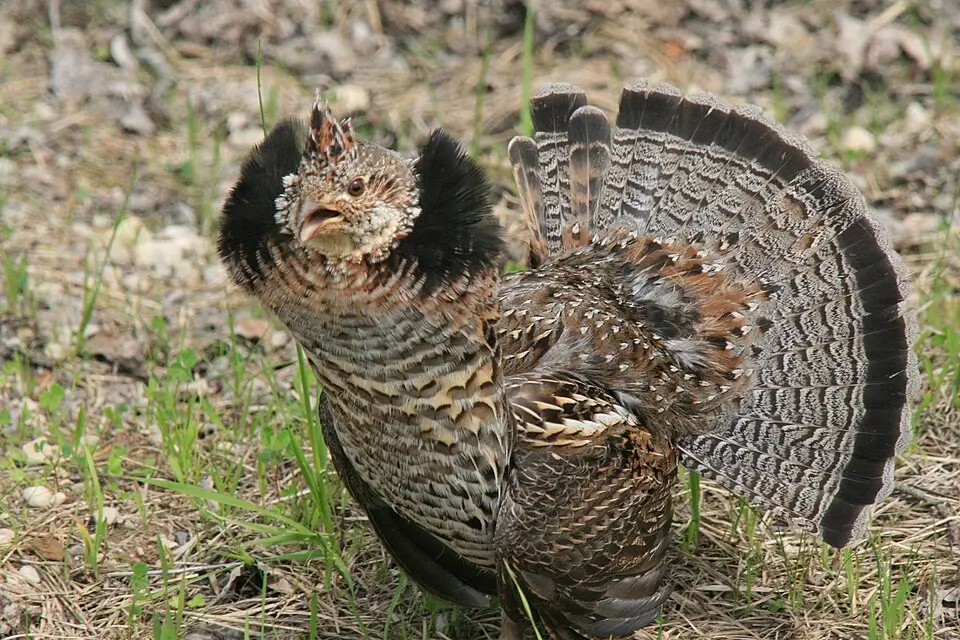
Ruffed grouse display two primary color morphs: a gray phase and a brown (or red) phase. In the gray phase, the bird's plumage is dominated by cool silver and charcoal tones, providing excellent camouflage against the bark and leaf litter of hardwood forests. In the brown phase, warmer reddish-brown tones predominate. Both morphs feature intricate barring and mottling across the body, making the bird extraordinarily difficult to spot when it remains still. A prominent dark band near the tip of the tail is another hallmark of the species and is often the most visible field mark when a bird flushes and spreads its tail fan.
The black or dark brown ruff feathers on either side of the neck, from which the bird takes its common name, are typically held flat against the body but are raised dramatically during courtship and threat displays, creating an impressive, almost collar-like appearance.
One of the most extraordinary behaviors of the ruffed grouse is the drumming display performed by males. Typically executed while the male stands on a favored log, rock, or other elevated surface, drumming involves the bird rapidly beating its wings against the air — not against its body or the log — to produce a series of deep, resonant thumps that accelerate into a rapid blur of sound. This drumming serves to attract females and warn rival males, and it can be heard from considerable distances in the quiet spring forest. The drumming log itself becomes a territory marker, often used year after year by successive males.
Ruffed grouse are largely herbivorous, feeding on a diverse diet of buds, catkins, leaves, berries, seeds, and insects. Aspen (genus Populus) is arguably the most critical food source for ruffed grouse across much of their range, particularly during winter months when the nutritious flower buds of male aspen trees provide a reliable, high-energy food source. In summer, the diet diversifies to include soft fruits, green vegetation, and invertebrates, which are especially important for growing chicks.
The species is non-migratory, remaining in its territory throughout the year. Ruffed grouse have evolved a remarkable cold-weather adaptation: in winter, they grow small, comb-like projections called pectinations along the sides of their toes, effectively creating natural snowshoes that allow them to walk across snow more easily. They also frequently plunge into soft, deep snow to roost, using the insulating properties of the snowpack to stay warm during frigid nights.
Ruffed grouse are known for well-documented population cycles, with numbers typically peaking and crashing on roughly a 10-year cycle across much of their northern range. These cycles are studied by wildlife biologists and have been linked to various ecological factors, including changes in habitat quality, predator-prey dynamics, and disease.
Habitat and Range
The ruffed grouse is a bird of young, dense forests and forest edges. Across its broad North American range — stretching from Alaska and the Yukon in the northwest, across Canada, and south through the Appalachian Mountains, the Great Lakes states, and into the upper Midwest — the species consistently favors early successional forest habitat. This means areas where trees are young and dense, understory vegetation is thick, and openings provide diverse food sources.
Aspen forests, alder thickets, birch stands, and regenerating clearcuts are among the most productive ruffed grouse habitats. The birds seek dense cover for protection from predators, which include a wide range of raptors such as goshawks and great horned owls, as well as mammalian predators like foxes, coyotes, and fishers.
In Michigan, the grouse finds an ideal home across much of the Upper Peninsula and the northern Lower Peninsula. Michigan's forests include extensive aspen stands, mixed hardwoods, conifer swamps, and the brushy edges that grouse thrive in. The state's size — covering nearly 97,000 square miles including its Great Lakes waters — and the diversity of its forested landscapes make it a premier destination for ruffed grouse hunting in the Midwest. Both the Upper Peninsula's vast wilderness areas and the managed forests of the northern Lower Peninsula support healthy grouse populations.
Forest management practices, including timber harvesting that creates young regenerating stands, are critically important to maintaining quality grouse habitat. Without periodic disturbance, forests mature and develop closed canopies that reduce the dense understory cover grouse require.
Hunting Information
The ruffed grouse is one of the most beloved upland game birds in North America, and hunting for "partridge" — as grouse are affectionately called throughout much of Michigan and the Great Lakes region — is a deeply rooted tradition. The pursuit of ruffed grouse is widely considered one of the most challenging and rewarding forms of upland bird hunting, demanding physical fitness, woodsmanship, a well-trained bird dog, and fast shooting reflexes.
Grouse hunters typically work through thick cover — alder runs, aspen stands, and brushy woodland edges — often with pointing or flushing dogs. When flushed, a grouse rockets away with explosive wingbeats, frequently twisting and dodging through branches and foliage at high speed, giving the hunter only a brief window for a shot. This combination of demanding terrain and fast, unpredictable flight makes grouse hunting an art form that hunters spend entire careers perfecting.
In Michigan, grouse hunting is a popular autumn tradition, with hunters venturing into the northwoods alongside woodcock hunters, as both species often inhabit similar cover types. The state's Department of Natural Resources manages grouse hunting seasons and regulations; hunters are encouraged to consult the current Michigan DNR Hunting Guide for up-to-date season dates, bag limits, and any applicable licensing requirements before heading afield. Regulations can change from year to year based on population surveys and conservation objectives.
A quality pointing breed — such as a German Shorthaired Pointer, English Setter, or Brittany — or a skilled flushing dog like a Labrador or English Springer Spaniel can make a significant difference in locating and recovering birds in thick cover. However, grouse hunting without a dog, known as "walk-up" hunting, is also practiced and can be productive in the right habitat.
Conservation
The ruffed grouse is currently listed as a species of least concern, reflecting its broad range and substantial overall population. However, like many wildlife species tied to specific habitat conditions, ruffed grouse populations can decline locally when forest habitats mature and young, dense growth becomes scarce.
Conservation efforts for ruffed grouse center primarily on habitat management. Organizations such as the Ruffed Grouse Society work with private landowners, state agencies, and federal forestry programs to promote active forest management, including timber harvests and controlled burns, that maintain and create young forest habitats. These efforts benefit not only ruffed grouse but a whole community of wildlife species — including American woodcock, white-tailed deer, snowshoe hare, and many songbirds — that depend on early successional forest.
In Michigan, ongoing forest management on state and federal lands plays a vital role in sustaining grouse populations. Hunters, through license fees and excise taxes on firearms and ammunition collected through the Federal Aid in Wildlife Restoration Act (Pittman-Robertson Act), contribute directly to the funding of wildlife management and habitat conservation programs across the state.
The long-term future of ruffed grouse in Michigan and across their range depends on the continued commitment to active, science-based forest management, thoughtful harvest regulations, and the broad public support that comes from a community of engaged hunters and wildlife enthusiasts who value this extraordinary bird.