Overview
Few sounds evoke the spirit of the American countryside quite like the clear, whistled "bob-WHITE!" call that echoes across grasslands, brushy field edges, and pine savannas during spring and early summer. That signature call belongs to the Northern bobwhite (Colinus virginianus), a small, plump ground bird that has captured the imagination of naturalists, farmers, and hunters for generations. Often simply called "bobwhite," "bobwhite quail," or just "quail" across much of its range, this species is widely regarded as one of North America's most iconic game birds.
The Northern bobwhite has long held cultural and ecological importance throughout the eastern and central United States. It is a bird closely tied to traditional agricultural landscapes, native grasslands, and the heritage of upland wing shooting. Although its populations have shifted over the past century in response to changes in land use, the bobwhite remains a beloved species — both as a subject of wildlife observation and as a target of carefully managed hunting traditions.
This article explores the biology, habitat, behavior, hunting context, and conservation of the Northern bobwhite, with additional notes on what hunters and wildlife enthusiasts in Michigan should consider.
Biological Traits
The Northern bobwhite is a member of the New World quail family, Odontophoridae. Its scientific name, Colinus virginianus, was assigned by Carl Linnaeus, with the species epithet referencing Virginia, one of the first places where European naturalists documented the bird.
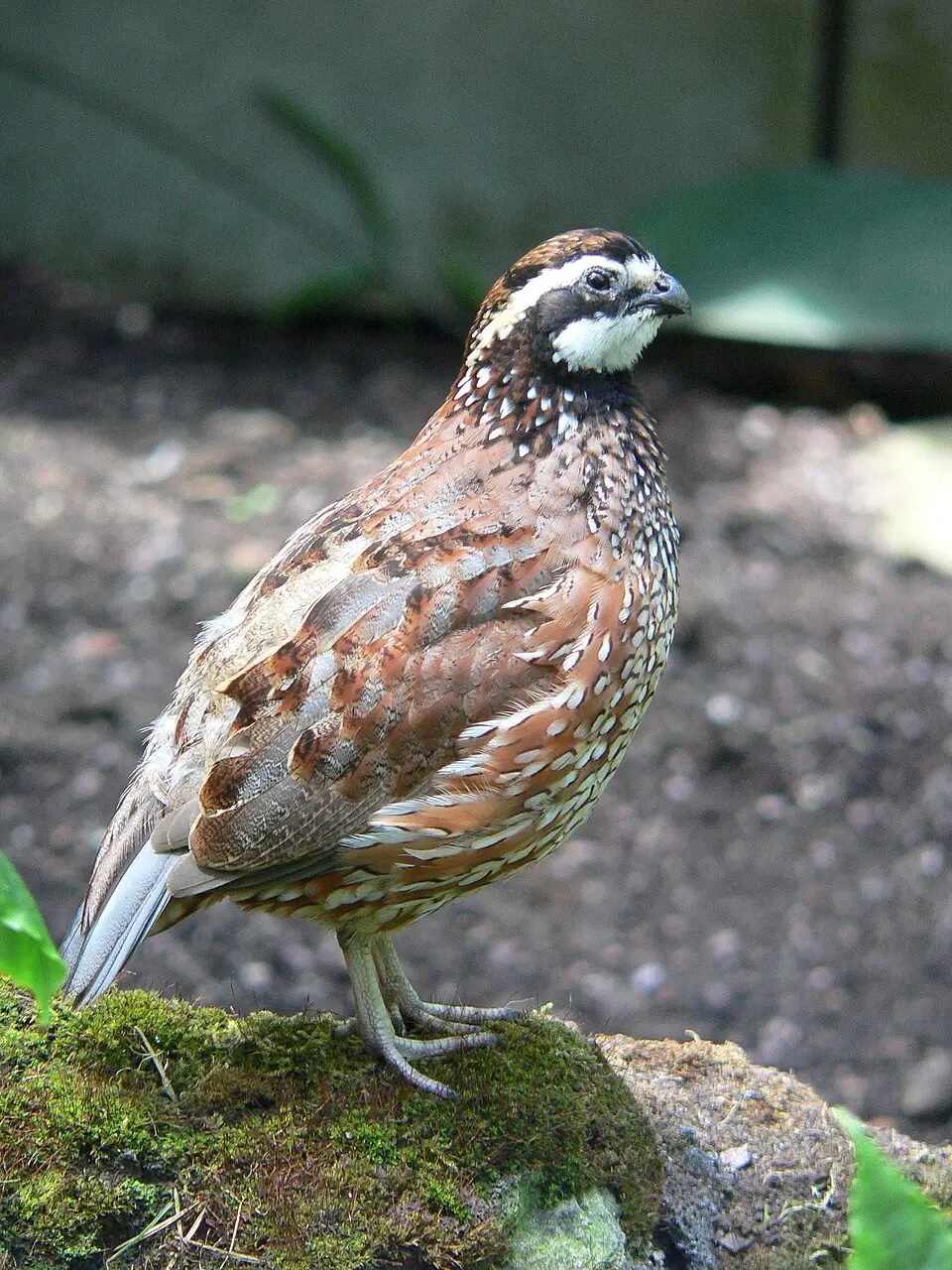
Size and appearance. Bobwhites are small, compact birds, generally measuring between 8 and 11 inches in length, with a wingspan of roughly 13 to 15 inches. They typically weigh just under half a pound. Their bodies are rounded and chunky, with short tails and short, strong legs adapted for running and scratching on the ground. The plumage is intricately patterned in rich browns, chestnuts, buff, black, and white — a cryptic coloration that allows the birds to disappear into grass and leaf litter.
Males and females are similar in body shape but show distinct facial markings. Males have a bold white throat and a white stripe above the eye, bordered by black. Females show the same patterns in softer buff and brown tones. This sexual dimorphism makes identifying males and females relatively easy in the field, especially during the breeding season.
Voice. The species is named after the male's distinctive whistled territorial call, often transcribed as "bob-WHITE!" or "poor-bob-WHITE!" This call is most commonly heard in spring and summer as males establish breeding territories. Bobwhites also use a wide variety of softer contact calls, assembly calls (to regroup a scattered covey), and alarm notes.
Diet. Northern bobwhites are omnivorous, with a diet that shifts seasonally. They eat seeds of grasses, legumes, weeds, and crops; soft mast such as berries; green leafy material; and a significant amount of insects, especially in spring and summer when protein needs are high for breeding adults and growing chicks. Chicks rely heavily on insects in their first weeks of life, making insect-rich habitats critical for population success.
Behavior and social structure. One of the most distinctive features of the bobwhite is its formation of coveys — tight social groups of usually 10 to 20 birds that form in autumn and persist through winter. At night, covey members often roost together on the ground in a circle, tails pointed inward and heads facing outward, a posture believed to conserve warmth and provide 360-degree vigilance against predators. When flushed, coveys explode into flight in a rapid, noisy burst — a thrilling moment for any hunter or birdwatcher who has experienced it.
Reproduction. Bobwhites are prolific breeders. After pairing in spring, hens scrape shallow nests on the ground, typically hidden in clumps of grass or weedy cover, and may lay clutches of a dozen or more eggs. Both parents can be involved in incubation and brood-rearing, and double-brooding is possible. This high reproductive potential allows local populations to rebound quickly when habitat conditions are favorable.
Habitat & Range
Northern bobwhites are birds of open, early-successional landscapes. Classic bobwhite country includes native grasslands, weedy old fields, brushy fencerows, agricultural edges, pine savannas with grassy understories, and shrubland mosaics. They thrive where a patchwork of bare ground, herbaceous cover, woody escape cover, and seed-producing plants exists in close proximity — the kind of "messy" habitat that supports both feeding and protection from predators.
The species' historical range extends across much of the eastern and central United States, from the Atlantic seaboard west into the Great Plains, and south into Mexico and parts of Central America and the Caribbean. There are multiple recognized subspecies across this broad range, varying somewhat in plumage and size.
In the northern portions of the range, including states like Michigan, bobwhites historically occurred in suitable habitat, particularly in the southern Lower Peninsula where agriculture, brushy field borders, and warm-season grasslands provided cover and food. Harsh winters, deep snow cover, and the loss of brushy edge habitat can limit bobwhite populations in northern states, making local distribution patchy.
Michigan itself is a Great Lakes state characterized by a diverse landscape of forests, farmlands, wetlands, and waterways. While the state is best known for species like white-tailed deer, ruffed grouse, and waterfowl, areas of southern Michigan with appropriate grassland and brushland habitat have historically supported bobwhite. Habitat restoration efforts focused on native grasses, food plots, and shrubby cover can benefit local quail populations as well as a wide range of other grassland wildlife.
Hunting Information
The Northern bobwhite has been a cornerstone of American upland bird hunting for generations. Across much of the South and lower Midwest, "quail hunting" is essentially synonymous with pursuing bobwhites. Traditional hunting involves walking through promising habitat behind pointing dogs — English pointers, English setters, Brittanys, and German shorthaired pointers are classic choices. When a covey is located, dogs lock up on point, hunters move in, and the birds erupt into flight, presenting a fast and challenging wingshooting opportunity.
Light, fast-handling shotguns — often 20- or 28-gauge over-and-unders or side-by-sides — are favored for bobwhite hunting because of the close-range, quick shots typical in thick cover. Hunters typically use small shot sizes appropriate for small upland birds.
Beyond the shooting itself, bobwhite hunting carries a rich cultural tradition: the work of skilled bird dogs, the camaraderie of hunting partners, the careful reading of cover, and the importance of leaving "seed birds" in a covey to ensure future populations. Many hunters voluntarily limit how many birds they take from a single covey, reflecting a strong conservation ethic embedded in the sport.
Hunting in Michigan. Because hunting regulations vary by state and can change from year to year, hunters interested in pursuing bobwhite or any other game bird in Michigan should always consult the official Michigan Department of Natural Resources (DNR) hunting digest and licensing information for the current season. The DNR publishes annual guides covering legal seasons, bag limits, license requirements, and any species-specific restrictions. Specific season dates, bag limits, and licensing for Northern bobwhite in Michigan are not provided in the source data for this article, and prospective hunters should rely on the state's official publications for the most accurate and current rules.
Regardless of location, ethical bobwhite hunting depends on identifying birds correctly, respecting private property, hunting safely with companions and dogs, and supporting habitat conservation through licenses, stamps, and participation in conservation organizations.
Conservation
Across much of its historic range, the Northern bobwhite has experienced long-term population changes tied largely to habitat loss. Modern, clean farming practices — large monoculture fields, removal of brushy fencerows, and fewer fallow areas — have reduced the diverse, weedy edge habitat that bobwhites need. Fire suppression in southern pine forests has also reduced the open, grassy understory historically maintained by frequent low-intensity fires.
Conservation efforts for bobwhite center on restoring and managing high-quality early-successional habitat. Key practices include:
- Planting and maintaining native warm-season grasses such as little bluestem, big bluestem, and Indiangrass.
- Promoting weedy field borders, hedgerows, and shrubby cover.
- Using prescribed fire to maintain open understories in pine and oak woodlands.
- Conducting strip-disking and light tillage to encourage annual seed-producing plants and bare ground for chick mobility.
- Partnering with private landowners through programs that support habitat improvements on working farms.
Organizations such as Quail Forever, the National Bobwhite Conservation Initiative, and state wildlife agencies have spearheaded large-scale efforts to reverse declines. These programs benefit not only bobwhite but also a host of other grassland-dependent species, including songbirds, pollinators, and small mammals.
For hunters and outdoor enthusiasts, supporting bobwhite conservation is a meaningful way to give back. Even small habitat projects on private land — a few acres of native grass, a brushy buffer along a creek, or a managed fallow field — can make a real difference for local quail populations.