Overview
Few animals capture the spirit of the American West quite like the mule deer. With its oversized, mule-like ears, distinctive bounding gait, and commanding presence across some of North America's most dramatic landscapes, Odocoileus hemionus has earned a place of reverence among wildlife enthusiasts, conservationists, and hunters alike. Known affectionately as "muleys" by those who pursue them, mule deer represent one of the most widely recognized and ecologically significant big game species on the continent.
Unlike their close cousins, the white-tailed deer (Odocoileus virginianus), mule deer are primarily animals of the open country — creatures built for rugged terrain, sweeping vistas, and the kind of wide-open spaces that define the Rocky Mountains, the Great Basin, and the desert Southwest. Their adaptability, combined with their remarkable physical characteristics, makes them one of the most studied and celebrated deer species in the world.
Whether you are a dedicated big game hunter planning a western expedition, a wildlife photographer hoping to capture that perfect shot at golden hour, or simply a nature enthusiast eager to learn more about this magnificent animal, this guide offers a thorough look at the biology, habitat, hunting opportunities, and conservation status of the mule deer.
Biological Traits
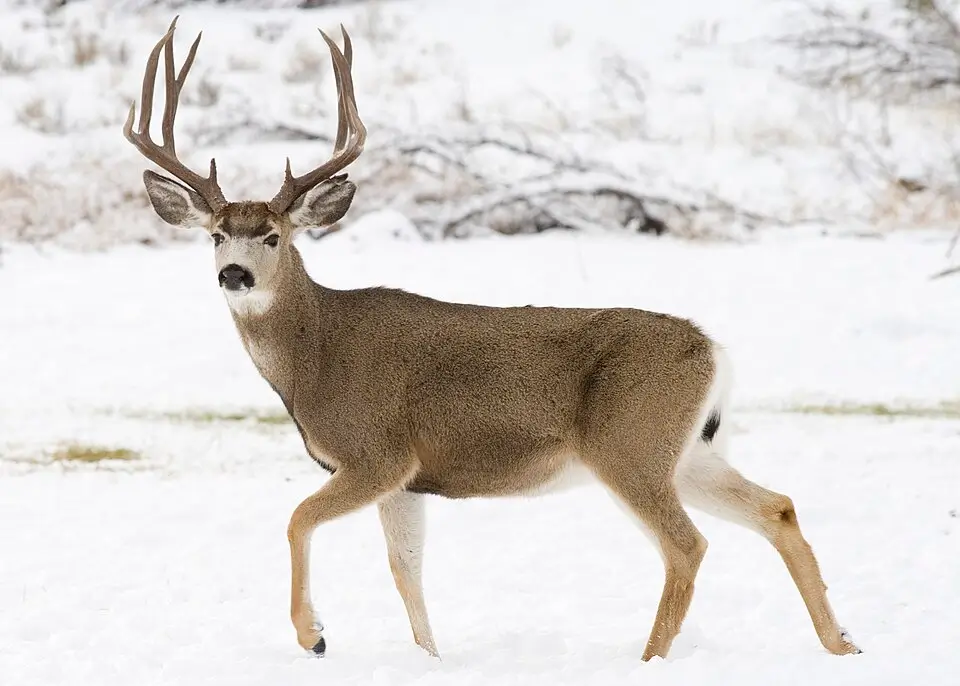
The mule deer (Odocoileus hemionus) is a medium-to-large ungulate belonging to the family Cervidae. The species gets its common name from its ears, which are notably large and mule-like in proportion to its head — a defining feature that makes the animal instantly recognizable in the field and easy to distinguish from other deer species.
One of the most distinctive physical characteristics of the mule deer is its antler structure. Unlike white-tailed deer, whose antlers grow in a single main beam with tines projecting upward, mule deer antlers bifurcate — meaning they fork repeatedly into roughly equal branches. This forked antler configuration is one of the clearest visual differences between mule deer and whitetails, and it is something every hunter or wildlife observer should learn to recognize.
Mule deer are also known for their unique method of locomotion called "stotting" or "pronking." When alarmed, rather than bolting in a straight line like a whitetail, mule deer often move in a series of stiff-legged, bouncing leaps in which all four feet leave and return to the ground simultaneously. This distinctive gait, while it may appear slower than a full sprint, is remarkably effective for navigating steep, rocky terrain where agility and balance are more important than raw speed.
The species also displays notable sexual dimorphism. Bucks are generally larger than does, carrying impressive antler racks that they shed and regrow annually. During the rut — typically occurring in late fall — bucks become highly active, traveling widely in search of receptive does and engaging in sparring and dominance displays with competing males.
Mule deer are also characterized by a distinctive tail: short and thin with a black tip, quite different from the large, white, flag-like tail of the whitetail deer. Their coat tends to be a reddish-brown in summer, transitioning to a grayish-brown in winter, providing effective camouflage across the seasons. A pale rump patch is another easily identifiable feature.
Several subspecies of mule deer have been recognized, including the Rocky Mountain mule deer (O. h. hemionus), the Sitka black-tailed deer (O. h. sitkensis), the Columbian black-tailed deer (O. h. columbianus), and the desert mule deer (O. h. eremicus), among others. Each subspecies is adapted to its specific regional environment.
Habitat & Range
Mule deer are native to western North America. Their range extends broadly from the coastal ranges of the Pacific Northwest, across the Rocky Mountains, through the Great Plains, and into the desert regions of the Southwest and Mexico. They are also found in portions of Canada, particularly in British Columbia, Alberta, Saskatchewan, and Manitoba.
These deer are highly adaptable when it comes to habitat selection, but they are most commonly associated with semi-arid shrublands, open forests, mountain meadows, rimrock canyons, and sagebrush flats. They tend to prefer edge habitats — areas where different vegetation types meet — which offer both food resources and cover.
Mule deer are migratory in many parts of their range, making seasonal movements between higher elevation summer ranges and lower elevation winter ranges. These migrations can cover dozens or even hundreds of miles and represent some of the most impressive ungulate movements in North America. Research has increasingly highlighted the importance of protecting migration corridors, as development and fencing can disrupt these vital seasonal movements.
In terms of diet, mule deer are browsers, feeding primarily on shrubs, forbs, and woody plants rather than grasses. Favorites include sagebrush, bitterbrush, mountain mahogany, and various forbs depending on the season and location. Their diet shifts significantly between seasons, with succulent forbs making up a larger portion of their intake in spring and summer, while shrubs become more critical during fall and winter.
It is worth noting that mule deer are not native to Michigan or the broader Great Lakes region. Michigan's native deer species is the white-tailed deer, which thrives across the state's forests, farmlands, and wetlands. Mule deer are not established in Michigan's wild populations, and the state does not have a regulated mule deer hunting season. Michigan hunters looking to pursue mule deer must travel west to states where these animals are abundant, such as Colorado, Wyoming, Montana, Idaho, or New Mexico.
Hunting Information
Mule deer hunting is a cherished tradition across the American West, drawing hundreds of thousands of hunters each year to some of the most spectacular landscapes in North America. Pursuing a mature mule deer buck — particularly a high-country buck living above the timberline in late September or October — is considered by many to be one of the ultimate challenges in North American big game hunting.
Hunting strategies for mule deer vary by terrain and season. In open country, spot-and-stalk hunting is the dominant technique. Hunters use high-quality optics to glass vast expanses of terrain from elevated vantage points, locate a target buck, then execute a careful stalk to within shooting range. This style of hunting rewards patience, physical fitness, and sharp marksmanship.
Archery, muzzleloader, and rifle seasons are available in most western states, each offering a different experience and level of challenge. Archery hunters must close the distance significantly, demanding careful wind management and precise shooting. Muzzleloader seasons often coincide with the early rut, offering exciting opportunities to call or rattle in bucks.
States such as Colorado, Wyoming, Utah, Montana, Idaho, Nevada, and Arizona are among the premier mule deer destinations. Many of these states manage mule deer through tag systems, with some units requiring hunters to apply for limited-entry licenses through a draw system. Non-resident hunters are encouraged to research regulations carefully through each state's fish and wildlife agency well before the season opens.
As for Michigan hunters interested in pursuing mule deer: while mule deer are not found in Michigan, the state's passionate hunting community has a strong tradition of traveling west for big game adventures. Michigan hunters in good physical condition and equipped with solid long-range shooting skills are well-prepared for the demands of western mule deer hunting. No specific Michigan regulations govern mule deer hunting because the species does not reside within the state's borders. Any Michigan resident wishing to hunt mule deer would need to obtain the appropriate license and tags from the western state in which they plan to hunt.
Conservation
Mule deer populations across the West have experienced fluctuations over the decades, driven by a variety of factors including habitat change, drought, severe winters, disease, predation, and development pressure on migration corridors. Conservation organizations, state wildlife agencies, and federal land management bureaus have worked collaboratively on habitat restoration, migration corridor protection, and population monitoring programs.
Hunter-conservationists have played a meaningful role in mule deer conservation through funding generated by license sales and excise taxes on hunting equipment, as established by the Federal Aid in Wildlife Restoration Act (Pittman-Robertson Act). Organizations dedicated to mule deer conservation continue to advocate for science-based management and the preservation of the open landscapes these animals depend on.