Overview
Few ducks inspire the admiration of waterfowl hunters and birders quite like the Greater scaup (Aythya marila), a hardy and elegant diving duck that travels thousands of miles each year between its remote breeding grounds and its wintering areas across North America. Known affectionately among hunters as the "bluebill" — a nod to the distinctive pale blue-gray bill that sets this species apart — the Greater scaup is a staple of open-water waterfowl hunting and a prized sighting for anyone lucky enough to encounter a large, rafting flock on a cold winter morning.
In Michigan, a state defined by its extraordinary relationship with freshwater and its proud tradition of waterfowl hunting, the Greater scaup holds a special place in the hearts of duck hunters who work the Great Lakes shorelines, bays, and connecting waterways. Understanding this bird — its biology, its migratory patterns, and its place in the ecosystems it inhabits — enriches the experience of every hunter and wildlife enthusiast who encounters it.
This article takes a deep dive into the world of the Greater scaup, exploring everything from its fascinating biological traits to its importance in the waterfowl hunting tradition of the Great Lakes region.
Biological Traits
The Greater scaup is a medium to large-sized diving duck, belonging to the genus Aythya, which also includes familiar species like the Lesser scaup, canvasback, and redhead. The scientific name Aythya marila derives from Greek and Latin roots, with marila referring to charcoal or coal dust — a possible reference to the bird's dark coloring.
Plumage and Physical Appearance
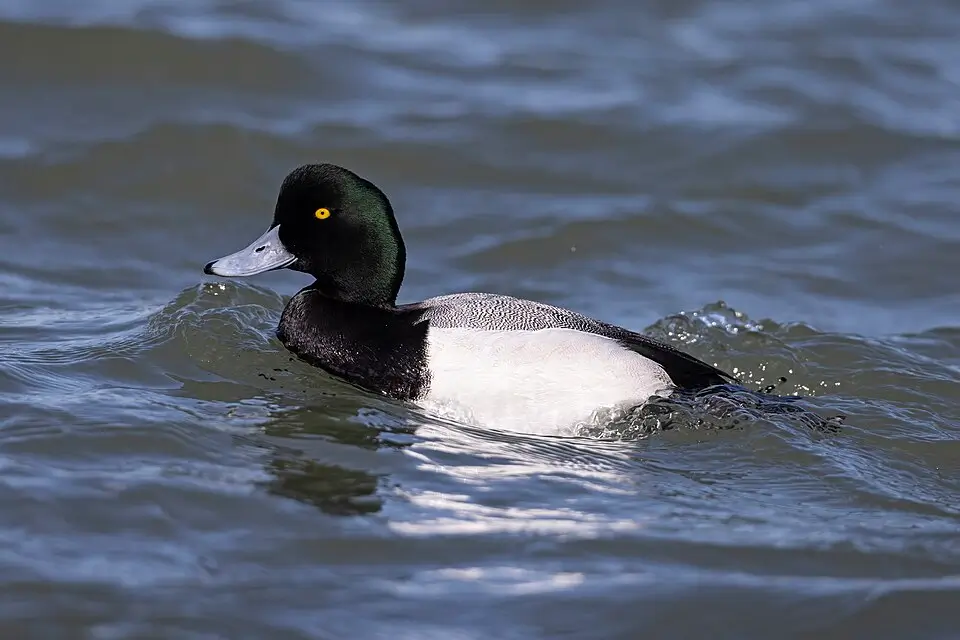
Adult male Greater scaup are striking birds. Their heads display a rich, glossy green-purple iridescence that can appear almost black in low light. The breast is a deep, sooty black, which transitions sharply into a clean white body on the flanks and belly. The back is finely vermiculated in gray and white, giving it a frosty, salt-and-pepper appearance. The tail coverts are black, and the wings display a bold white wing stripe that extends notably further toward the wingtip than in the closely related Lesser scaup — a useful field identification feature.
Female Greater scaup are more subtly colored, dressed in warm brown tones across the head, breast, and back. They share the pale blue-gray bill of the males and display a distinctive white patch at the base of the bill that varies in size and is useful for distinguishing females from other diving duck species.
Both sexes share the namesake pale blue bill, which is broad, slightly spatulate, and tipped with a small black nail — a feature that is perfectly adapted for filtering aquatic invertebrates and plant material from the water.
Size and Weight
The Greater scaup is the larger of the two scaup species found in North America. Adults typically measure between 15 and 22 inches in length, with a wingspan that can reach up to 33 inches. These dimensions make the Greater scaup a solidly-built diving duck, well-suited to the demands of open-water life.
Diving and Feeding Behavior
True to its classification as a diving duck, the Greater scaup is a powerful and proficient underwater swimmer. It uses its large, lobed feet to propel itself below the surface in search of food, capable of diving to considerable depths to access aquatic invertebrates, mollusks, crustaceans, aquatic insects, and various aquatic plants and seeds. In marine and coastal environments, mussels and other bivalves can make up a significant portion of their diet. In freshwater environments, they are known to feed heavily on aquatic invertebrates and submerged vegetation.
This diving ability makes the Greater scaup particularly adept at exploiting food resources that dabbling ducks simply cannot reach, giving it a competitive edge on deep, open bodies of water.
Vocalizations
Greater scaup are not particularly vocal birds outside of the breeding season. Males produce a soft, cooing whistle, while females give a harsh, growling arrr call. During the breeding season, males engage in elaborate courtship displays that include head-throwing, neck-stretching, and vocalization.
Lifespan and Reproduction
Greater scaup typically nest on the ground, often near water and in areas of dense vegetation. Females lay between six and eleven eggs per clutch, and incubation lasts approximately 24 to 28 days. The ducklings are precocial — meaning they are mobile and capable of feeding themselves shortly after hatching — a common trait among waterfowl. The Greater scaup's lifespan in the wild can extend to over ten years, though most birds do not reach this age due to predation and other mortality factors.
Habitat and Range
Breeding Grounds
The Greater scaup is a bird of the far north. Its primary breeding range spans the boreal and arctic regions of North America and Eurasia, making it a truly circumpolar species. In North America, Greater scaup nest across Alaska, northern Canada, and parts of the subarctic zone, preferring tundra lakes, ponds, and wetlands surrounded by grassy or sedge-dominated vegetation. The remote, largely undisturbed nature of these breeding grounds has helped insulate the species from many of the habitat pressures that affect waterfowl in more developed regions.
Wintering Areas
When winter approaches and northern waters freeze, Greater scaup move south along both coasts and through the interior of North America. They are notably coastal in their wintering habits, with significant concentrations found along the Atlantic Coast, the Pacific Coast, and the Gulf of Mexico. However, the Great Lakes — those vast inland seas that define Michigan's geography — serve as critically important wintering habitat for Greater scaup. The open, deep waters of Lakes Michigan, Huron, Erie, and Superior provide exactly the kind of environment this species thrives in: wide open water with access to aquatic food resources.
Michigan and the Great Lakes
Michigan's unique geography makes it one of the most important waterfowl states in the nation. Surrounded on three sides by Great Lakes waters and home to thousands of inland lakes, rivers, and wetlands, Michigan sits squarely along major migratory flyways. Greater scaup can be found in impressive numbers along Michigan's Great Lakes shorelines, particularly during migration in fall and spring, as well as during winter when open water remains available.
Large rafts of scaup — sometimes numbering in the thousands — gather on bays, harbors, and nearshore Great Lakes waters, presenting spectacular wildlife viewing opportunities and significant hunting prospects for waterfowlers willing to brave cold, open-water conditions.
Hunting Information
The Greater scaup is a legal and sought-after game bird across much of its North American wintering range, including in Michigan. Hunters who target Greater scaup — often hunting them alongside their close relatives, the Lesser scaup — pursue what is locally known as "bluebill hunting," a tradition with deep roots in Great Lakes waterfowl culture.
Hunting Methods
Hunting Greater scaup demands adaptation to open-water environments. Layout boats — low-profile crafts designed to sit nearly flush with the water's surface — are a classic tool of the bluebill hunter, allowing them to set up among large decoy spreads in open lake conditions. Scull boats, shore blinds positioned at strategic points, and boat blinds anchored in bays and coves are all effective approaches depending on conditions.
Decoy spreads for scaup are typically large, as these birds are accustomed to congregating in big flocks and are often attracted by the sight of numerous birds gathered on the water. Bluebill decoys are standard, though many hunters incorporate goldeneye, canvasback, or other diving duck decoys to build out a realistic spread.
Scaup respond well to calling, though it is used more subtly than with some other waterfowl. The open-water conditions where Greater scaup are typically hunted demand attention to wind direction, boat positioning, and safety — cold water hunting carries inherent risks that every waterfowler should prepare for with appropriate safety gear and planning.
Regulations in Michigan
Hunting seasons and bag limits for Greater scaup in Michigan are established annually by the Michigan Department of Natural Resources (MDNR) in coordination with the U.S. Fish and Wildlife Service and in alignment with frameworks set for the Atlantic and Mississippi Flyways. Hunters are strongly encouraged to consult the current Michigan Waterfowl Hunting Guide published each season for up-to-date season dates, bag limits, and licensing requirements, as these details are subject to change from year to year based on population surveys and management priorities.
A valid Michigan hunting license and applicable waterfowl stamps (state and federal) are standard requirements for waterfowl hunting in Michigan, as they are across the United States.
Conservation
The Greater scaup, like many diving duck species, has faced population pressures over the past several decades. Conservation organizations, wildlife managers, and researchers continue to monitor scaup populations carefully through annual breeding surveys and wintering population counts.
Habitat conservation on both the breeding grounds — particularly the preservation of boreal and arctic wetland ecosystems — and the wintering areas, including the Great Lakes, is a central priority in scaup conservation efforts. Organizations such as Ducks Unlimited, the U.S. Fish and Wildlife Service, and various state agencies have been active in protecting and restoring aquatic habitats critical to the species.
Water quality in the Great Lakes is another important conservation consideration for Greater scaup. The health of the invertebrate communities on which scaup depend during winter is closely tied to overall lake ecosystem health, making broad Great Lakes conservation efforts directly beneficial to this species.
The waterfowl hunting community has historically been among the strongest supporters of wetland conservation, contributing hundreds of millions of dollars annually through licensing fees, excise taxes on sporting equipment (under the Federal Aid in Wildlife Restoration Act, also known as the Pittman-Robertson Act), and voluntary contributions to conservation organizations. This funding has played a vital role in protecting the habitats that sustain species like the Greater scaup.
Conclusion
The Greater scaup is a remarkable bird — a world traveler that connects the remote boreal and arctic north to the vast waters of the Great Lakes and beyond. For Michigan waterfowlers, it represents one of the finest traditions of open-water hunting, demanding skill, preparation, and respect for both the bird and the challenging environments it inhabits. Whether encountered in a massive wintering raft on Lake Michigan or taken cleanly over a well-set decoy spread on a crisp November morning, the Greater scaup earns its celebrated place in North American waterfowl culture.