Overview
Few animals capture the imagination quite like the cougar. Known by more names than almost any other mammal in the Western Hemisphere — mountain lion, puma, panther, catamount — this powerful and elusive predator has roamed the Americas for millennia. Scientifically classified as Puma concolor, the cougar stands as the most widely distributed wild land mammal in the Western Hemisphere, ranging from the Canadian Yukon all the way down to the southern tip of South America. Its adaptability, stealth, and sheer physical prowess have made it one of nature's most successful large predators.
In North America, the cougar occupies a unique place in both the ecosystem and in the cultural consciousness of hunters, wildlife enthusiasts, and conservationists alike. Often referred to as the "ghost cat" due to its secretive nature and ability to move through vast territories without being detected, the cougar commands respect from everyone who ventures into wild country. For residents of Michigan and the broader Great Lakes region, the cougar represents a fascinating chapter in both natural history and ongoing wildlife conversation. While its presence in the eastern United States has become increasingly rare over the centuries, occasional confirmed sightings and the possibility of natural recolonization keep the topic alive and relevant for Midwesterners.
This article explores the biology, habitat, historical range, hunting context, and conservation status of Puma concolor — one of the most iconic wild cats on Earth.
Biological Traits
The cougar is a large felid belonging to the family Felidae. Despite its impressive size, Puma concolor is more closely related to smaller cats than to the "big cats" of the genus Panthera, such as lions and tigers. Unlike lions and leopards, cougars cannot roar; instead, they communicate through whistles, chirps, hisses, purrs, and a distinctive, haunting scream that has startled many a hiker and hunter in the backcountry.
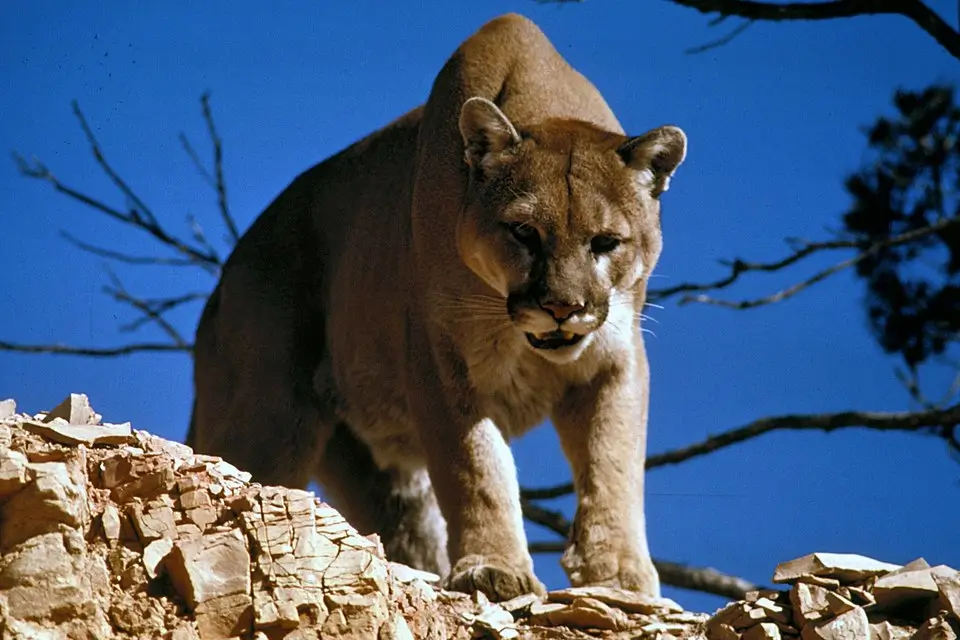
Adult male cougars are typically much larger than females, a characteristic known as sexual dimorphism. Males generally weigh between 115 and 220 pounds, while females tend to range from 64 to 141 pounds, though size can vary significantly across their wide geographic range. The cougar's body is long and muscular, built for explosive bursts of speed and powerful leaping ability. Their hind legs are notably larger and more muscular than their front legs, giving them tremendous jumping power — cougars are capable of leaping horizontally up to 40 feet and vertically up to 18 feet in a single bound.
The coat of a cougar is typically a uniform tawny or tan color, often lighter on the underparts, with dark markings on the muzzle, ears, and tip of the tail. Cubs are born with spotted coats that fade as they mature. The species name concolor — Latin for "one color" — reflects this characteristic uniformly colored adult coat. The head is round and relatively small compared to the muscular body, with large forward-facing eyes that provide excellent binocular vision, well-suited for low-light hunting conditions.
Cougars are obligate carnivores, relying entirely on meat for nutrition. Deer make up the primary prey species across most of their North American range, but they are highly adaptable hunters and will take a wide variety of prey including elk, bighorn sheep, pronghorn, smaller mammals, and occasionally livestock. They employ an ambush hunting strategy, stalking prey silently before launching a powerful and precise attack, typically targeting the back of the neck or skull to dispatch prey quickly.
Females reach sexual maturity between one and a half to three years of age. After a gestation period of approximately 91 days, a female typically gives birth to a litter of one to six kittens, with two to three being the most common litter size. The young remain dependent on their mother for up to two years, learning the critical hunting and survival skills they will need to establish their own territories.
Cougars are solitary animals, with the exception of mothers raising cubs. Males maintain large home ranges that can span hundreds of square miles, and they actively mark and defend these territories from rival males. The cougar's ability to traverse enormous distances makes it one of the most wide-ranging predators in the Americas.
Habitat & Range
One of the most remarkable things about Puma concolor is its extraordinary ecological versatility. Across its range, the cougar inhabits tropical rainforests, arid deserts, high mountain ranges, grasslands, swamp lands, and boreal forests. This adaptability is a major reason why the species has survived and thrived across such a vast geographic area while many other large predators have seen their ranges dramatically reduced.
Historically, the cougar was one of the most widespread land mammals in the Western Hemisphere, with a range stretching from the Atlantic to the Pacific and from northern Canada to Patagonia at the tip of South America. In North America, their stronghold today is largely in the western United States, western Canada, and Florida, where a critically endangered subspecies known as the Florida panther persists.
In the eastern United States, including the Great Lakes region, cougars were largely extirpated by the late 19th and early 20th centuries, primarily due to hunting, habitat loss, and the reduction of prey species. Michigan, with its vast forested landscapes across both the Upper and Lower Peninsulas and abundant white-tailed deer populations, historically provided ideal habitat for cougars. The Upper Peninsula in particular — with its remote wilderness, low human population density, and expansive boreal and mixed forest ecosystems — would be capable of supporting cougar populations if the animals were present in sufficient numbers.
In recent decades, there have been occasional confirmed cougar sightings in Michigan and other Midwestern states. Wildlife biologists generally attribute these sightings to dispersing young males — primarily from the established western population — that travel tremendous distances in search of unoccupied territory. Whether a breeding population will ever naturally reestablish itself in Michigan remains an open and intriguing question.
Hunting Information
The cougar holds a significant and complex place in North American hunting tradition. In many western states where cougar populations are established, regulated hunting seasons exist and are managed by state wildlife agencies as an important tool for maintaining healthy population levels and reducing conflicts with livestock and human communities. In these states, cougar hunting most commonly involves tracking with trained hounds, which tree the animal and allow the hunter to make a selective harvest.
In Michigan, however, there is currently no established cougar hunting season, and no official hunting regulations for cougars exist in the state. This is consistent with the species' status in the region: cougars are not considered to have a resident breeding population in Michigan, and any animals that are documented in the state are typically classified as protected or as animals of special concern. As with all wildlife in Michigan, any activity involving cougars is subject to state and federal wildlife laws, and hunters and outdoor enthusiasts are encouraged to contact the Michigan Department of Natural Resources (DNR) for the most current and accurate information regarding regulations.
For hunters interested in pursuing cougars legally, western states such as Idaho, Montana, Colorado, Utah, and Wyoming offer regulated hunting opportunities, with specific licensing requirements, season dates, and bag limits set by each respective state wildlife agency. Anyone interested in a cougar hunt should work with a licensed outfitter familiar with local regulations and terrain.
Conservation
The conservation status of Puma concolor as a whole species is listed as "Least Concern" by the International Union for Conservation of Nature (IUCN), a reflection of its broad distribution and relatively stable global population. However, this overall assessment masks significant regional variation. In the eastern United States, cougar populations are either entirely absent or exist only as small, isolated remnants. The Florida panther (Puma concolor coryi) is one of the most endangered mammals in North America, with conservation efforts including genetic rescue programs helping to support that small population.
Across their range, cougars face ongoing pressures from habitat fragmentation, road mortality, retaliatory killing related to livestock depredation, and the long-term effects of being excluded from large portions of their historical range. Wildlife corridors — protected landscape linkages between suitable habitat patches — have emerged as one of the most important conservation tools for maintaining connectivity between cougar populations and allowing for natural dispersal and genetic exchange.
In states like Michigan, the potential return of cougars is viewed by many wildlife biologists as a positive indicator of ecosystem health and connectivity. As apex predators, cougars play a critical role in regulating prey populations, which in turn influences vegetation communities and overall ecosystem dynamics in a cascade of effects sometimes called a "trophic cascade."
Public education, responsible wildlife reporting, and science-based management will all be essential components of any future cougar recovery in the Great Lakes region. Whether as a subject of wildlife watching, hunting pursuit, or conservation effort, Puma concolor remains one of the most compelling and important wildlife species in the Americas.