Overview
Few animals are as deeply woven into the fabric of American outdoor tradition as the cottontail rabbit. Whether glimpsed at dawn nibbling clover along a field edge, or flushed from a brushpile on a crisp autumn morning by a pack of eager beagles, the cottontail occupies a unique and cherished place in the hearts of hunters, wildlife enthusiasts, and nature lovers alike. Belonging to the genus Sylvilagus, cottontail rabbits represent one of the most widespread and recognizable groups of mammals in the Western Hemisphere. From dense suburban backyards to sprawling agricultural landscapes, from brushy river bottoms to the rolling hardwood forests of the Great Lakes region, these small, fleet-footed animals have adapted with remarkable success to an enormous variety of environments.
In Michigan — a state rich in wildlife heritage, bordered by the Great Lakes, and home to millions of acres of diverse habitat — the cottontail rabbit holds a particularly special status. It is one of the state's premier small game species, offering accessible, affordable, and deeply enjoyable hunting opportunities to both seasoned veterans and first-time hunters. For many Michigan hunters, chasing cottontails through snow-dusted thickets with a shotgun in hand and a beagle baying in the distance is not just a pastime — it is a cherished rite of passage and a beloved annual tradition.
This article explores the biology, habitat, behavior, and hunting traditions associated with the cottontail rabbit, with a particular focus on what makes this remarkable animal such an enduring part of Michigan's outdoor culture.
Biological Traits
The cottontail rabbit belongs to the genus Sylvilagus, which is part of the family Leporidae — the broader family that includes all rabbits and hares. The name Sylvilagus is derived from Latin and Greek roots meaning "forest rabbit," a fitting descriptor for animals that frequently rely on dense cover for shelter and escape. In North America, the genus Sylvilagus includes more than a dozen recognized species, though the Eastern cottontail (Sylvilagus floridanus) is by far the most widespread and the species most commonly encountered across the eastern United States, including Michigan.
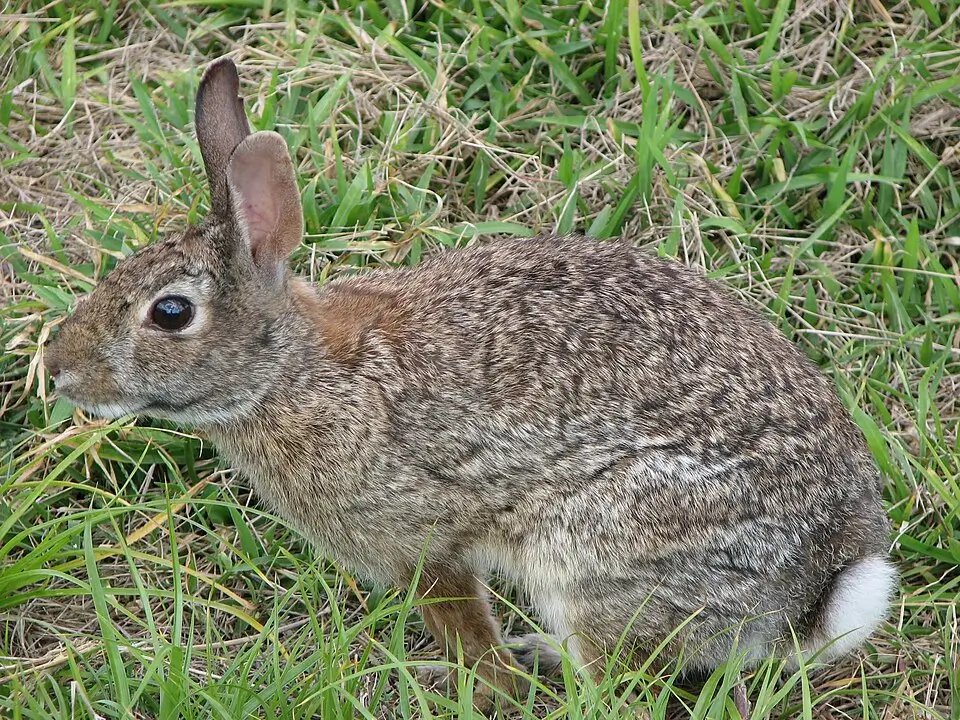
The cottontail's most immediately recognizable feature is, of course, its tail — a small, rounded puff of white fur that resembles a cotton ball and gives the animal its common name. When a cottontail flees from a predator, this bright white tail bobs and flashes in a characteristic zigzagging run that can make it surprisingly difficult to track or catch. This visual signal may also serve as a warning to other rabbits nearby.
Cottontails are compact, muscular animals built for speed and agility. Adults typically weigh between two and four pounds, with a body length ranging from roughly fourteen to eighteen inches. Their hind legs are proportionally large and powerful, enabling explosive bursts of speed and the ability to change direction rapidly — an essential survival trait for an animal that sits near the base of nearly every food chain it inhabits. Their large, expressive eyes are positioned on the sides of their head, providing an exceptionally wide field of vision that helps them detect approaching predators from nearly any angle.
Cottontail fur is dense and soft, typically a mottled brownish-gray on the back and sides, providing excellent camouflage against leaf litter and brush. The underside is paler, and of course, the distinctive white tail rounds out the animal's coloring. Their large ears serve a dual purpose: exceptional hearing that can detect the faintest rustle of an approaching fox or hawk, and a thermoregulatory function that helps the animal manage body temperature.
One of the most remarkable aspects of cottontail biology is their reproductive capacity. These animals are famously prolific breeders. Females, known as does, can produce multiple litters per year, with each litter containing several young. Newborn cottontails, called kittens, are born in a shallow nest lined with grass and the mother's own fur. They are born with eyes closed and with very little fur, but develop rapidly. Within a few weeks, young cottontails are weaned and beginning to explore the world on their own. This extraordinary reproductive rate allows cottontail populations to recover quickly from hunting pressure and natural mortality, making them one of the most sustainable small game species in North America.
Cottontails are herbivores with a broad and adaptable diet. During warmer months, they feed heavily on grasses, clovers, wildflowers, garden plants, and agricultural crops. As winter settles in and herbaceous vegetation becomes scarce, they shift to woody browse — gnawing on the bark and twigs of shrubs and young trees. This dietary flexibility is a key factor in their widespread success across diverse landscapes.
Habitat & Range
The genus Sylvilagus is native to the Americas, with species found throughout North America, Central America, and parts of South America. In the United States, the Eastern cottontail is the most commonly encountered species and ranges across virtually the entire eastern half of the country, extending into the Midwest, the Great Plains, and parts of the Southwest.
Cottontails are quintessential edge-habitat specialists. They thrive in areas where different vegetation types meet — where agricultural fields border woodlots, where overgrown fence rows divide pastures, or where early successional shrubby growth transitions into mature forest. These edge zones provide the two things cottontails need most: food and cover. Dense, brushy escape cover is especially critical. Cottontails are not burrowers in the traditional sense; unlike European rabbits, they do not dig elaborate underground warrens. Instead, they rely on above-ground cover — thickets of multiflora rose, dense brush piles, briar patches, tall grass clumps, and similar dense vegetation — for protection from the many predators that pursue them.
In Michigan, cottontails are found throughout the Lower Peninsula and in portions of the Upper Peninsula where suitable habitat exists. The state's diverse landscape — which includes agricultural land, second-growth forest, wetland edges, suburban green spaces, and river corridors — provides ample habitat for healthy cottontail populations. Michigan's geography, shaped by the retreating glaciers of the last Ice Age and bounded by the vast waters of the Great Lakes, creates a mosaic of habitats that supports a broad diversity of wildlife, and the adaptable cottontail thrives within this varied landscape.
Hunting Information
Cottontail rabbit hunting is one of the most accessible and enjoyable forms of small game hunting available to Michigan hunters. It requires relatively modest equipment — a shotgun, a small game license, and a pair of boots capable of handling brushy terrain — and the hunting grounds are plentiful across much of the state. For new hunters or young hunters just beginning their outdoor journeys, cottontail hunting represents an ideal entry point into the world of small game, offering action-filled outings without the demanding logistical complexity of big game pursuits.
One of the most time-honored traditions in cottontail hunting is the use of beagles. These small, energetic hounds have been bred for centuries to trail rabbits by scent, and watching a well-tuned pack of beagles work a brushy thicket — noses to the ground, voices ringing through the cold air — is one of the great pleasures of the American hunting tradition. Beagles push cottontails in their characteristic circular routes, as rabbits typically do not run in straight lines for long distances but instead loop back toward familiar cover. This behavior gives waiting hunters the opportunity to intercept the rabbit as it circles back.
Hunters pursuing cottontails without dogs can still enjoy excellent success by still-hunting through dense cover, pushing brush piles and briar thickets and being ready for the explosive flush when a hidden rabbit decides to bolt. Jump-shooting cottontails in this manner demands quick reflexes and sharp shooting skills, making it a genuinely challenging and rewarding endeavor.
For specific season dates, bag limits, and licensing requirements in Michigan, hunters should always consult the Michigan Department of Natural Resources (DNR) directly, as regulations can change from year to year. Obtaining the appropriate small game license before heading afield is essential, and hunters are encouraged to review the current Michigan Hunting & Trapping Guide for the most up-to-date and accurate regulatory information.
Conservation
The cottontail rabbit occupies a foundational role in virtually every ecosystem it inhabits. As a prey species, it supports an extraordinary diversity of predators — red foxes, coyotes, bobcats, hawks, owls, and many others depend on cottontails as a primary food source. The abundance of cottontails in a given landscape often directly influences the health and diversity of the broader predator community.
From a conservation standpoint, cottontail populations are generally considered stable across much of their range, in large part due to their remarkable reproductive capacity. However, habitat loss — particularly the loss of brushy edge habitat and early successional cover to development and modern agricultural practices — represents the most significant long-term challenge facing cottontail populations. As hedgerows are removed, brushy field borders are cleaned up, and early successional habitats are lost to development, cottontails lose the cover they depend upon for survival.
Hunters, wildlife managers, and conservation organizations have long recognized the importance of maintaining and creating quality cottontail habitat. Conservation practices such as leaving brushy fence rows intact, establishing wildlife food plots, managing for early successional vegetation, and creating brush piles can all significantly benefit cottontail populations. In Michigan and across the country, hunter-conservationists have played a vital role in advocating for and funding habitat conservation efforts that benefit not only cottontails but the full spectrum of wildlife that depends on healthy, diverse landscapes.
The cottontail rabbit is a testament to nature's resilience — a small animal with an outsized role in the ecosystems it calls home. Whether pursued by hunters, watched by wildlife enthusiasts, or simply admired as a common sight in a backyard garden, the cottontail enriches the natural world in countless ways.