Overview
Few birds in North America inspire the kind of mixed reputation that the common snipe carries with it. On one hand, it is the subject of a time-honored practical joke — the infamous "snipe hunt" — in which unsuspecting newcomers are sent into the dark woods with a bag to catch a creature some claim doesn't exist. On the other hand, the common snipe is a very real, fascinating, and highly respected game bird that has challenged skilled hunters for centuries. In Michigan and across the Great Lakes region, this secretive wader represents one of the most rewarding and underappreciated hunting opportunities available to waterfowl and upland game enthusiasts alike.
The common snipe (Gallinago gallinago) is a medium-sized shorebird belonging to the family Scolopacidae, which also includes woodcocks, sandpipers, and curlews. Its reputation as a difficult bird to hunt is well-earned, and the very word "sniper" — used to describe a skilled long-range marksman — is derived directly from the challenge of hunting this elusive, erratically flying bird. Understanding the common snipe's biology, behavior, habitat preferences, and seasonal movements is the key to appreciating this remarkable animal, whether you pursue it with a shotgun or simply a pair of binoculars.
Biological Traits
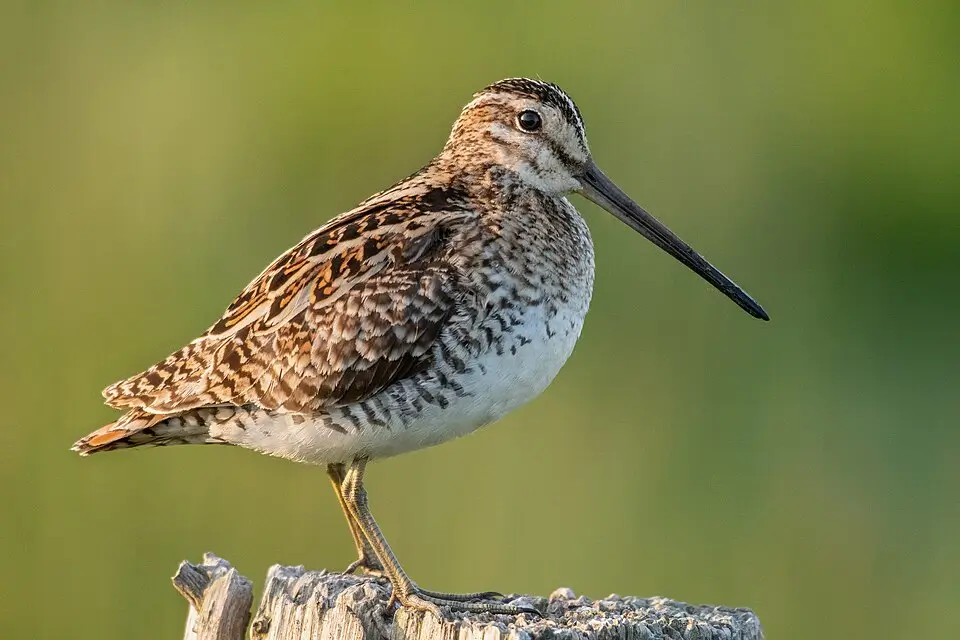
The common snipe is a compact, well-camouflaged bird built for life in wet, marshy environments. It is stocky in build relative to many other shorebirds, with short legs and a disproportionately long, straight bill that is one of its most defining physical features. This bill, which can measure roughly one-quarter to one-third of the bird's total body length, is a precision tool evolved specifically for probing soft, muddy substrates in search of food. The tip of the bill contains a flexible, nerve-rich region that allows the snipe to detect and grasp invertebrates underground without having to open its entire bill — a remarkable feeding adaptation known as rhynchokinesis.
The bird's plumage is a masterwork of natural camouflage. Its upperparts are a rich mixture of brown, buff, black, and chestnut, with pale cream-colored stripes running along the crown and back. This cryptic patterning makes the common snipe extraordinarily difficult to spot when it is crouched among dead reeds, sedges, or wet grassland vegetation. The underparts are generally paler, with streaking on the breast that fades toward the belly. When flushed, the snipe bursts into the air with a distinctive zig-zagging, towering flight — a behavior that has humbled countless hunters and is thought to be an evolved escape response to predators.
One of the most extraordinary behaviors of the common snipe is its aerial display, known as "drumming" or "winnowing." During the breeding season, males perform dramatic diving flights at dusk and dawn, producing a haunting, pulsating sound as air rushes over their specially stiffened outer tail feathers. This sound — often described as a quavering hum or bleat — carries long distances across open marshland and serves as both a territorial declaration and a courtship signal. It is a sound that, once heard, is instantly recognizable and deeply evocative of wild, open wetlands.
The common snipe feeds primarily on invertebrates, including earthworms, insect larvae, beetles, and small crustaceans. It is predominantly crepuscular and nocturnal in its feeding habits, becoming most active at dawn and dusk. During daylight hours, it tends to remain hidden in dense cover, relying on its camouflage to avoid detection.
In terms of size, the common snipe typically measures between 25 and 27 centimeters in length, with a wingspan ranging from approximately 44 to 47 centimeters. Body weight generally falls between 80 and 140 grams, though individuals can vary. Males and females are similar in appearance, making field sexing difficult without close examination.
Habitat & Range
The common snipe has an impressively broad global range, breeding across much of the Palearctic region — from Iceland and the British Isles eastward through Scandinavia, Russia, and into Siberia — as well as portions of North America. In North America, the common snipe breeds across Canada and the northern United States, including the Great Lakes region. Michigan, with its vast stretches of wetlands, river bottomlands, marshes, and boggy meadows, provides ideal habitat for both breeding and migrating snipe.
Snipe are intimately tied to wetland ecosystems. They prefer areas with soft, probing-friendly soils, shallow standing water, and dense vegetative cover. Prime habitats include freshwater marshes, wet meadows, alder thickets along stream margins, bog edges, flooded agricultural fields, and sedge fens. The bird requires both open areas for foraging and nearby dense cover for roosting and escape. Michigan's extensive network of wetlands — shaped by thousands of years of glacial activity — makes it one of the better states in the Midwest for encountering common snipe during migration.
Migration is a significant aspect of the common snipe's annual life cycle. Birds that breed in Canada and the northern United States move southward in the fall, passing through states like Michigan on their way to wintering grounds in the southern United States, Central America, and the Caribbean. Spring migration brings birds back through Michigan as they return to northern breeding grounds. During these migration windows, wetland habitats across the state can hold concentrations of snipe that represent excellent opportunities for both observation and hunting.
Hunting Information
The common snipe has a rich and storied history as a game bird. In 19th-century Britain, snipe hunting was considered the ultimate test of a wingshooter's skill, and the birds were pursued with tremendous enthusiasm. That tradition has carried forward into the modern era, and snipe hunting remains a legitimate and rewarding pursuit in Michigan and many other states.
Hunting common snipe requires patience, persistence, and a willingness to work challenging terrain. Because these birds favor wet, marshy environments, hunters must be prepared to wade through soggy ground, navigate dense stands of cattails and sedges, and endure the unpredictable weather that often accompanies fall migration. Sturdy, waterproof boots are an absolute necessity, and hunters should be prepared to cover significant ground in search of birds.
The classic approach to snipe hunting involves walking slowly through appropriate habitat — wet meadows, marsh edges, and flooded fields — to flush birds into the air. When flushed, common snipe typically burst upward in a rapid, twisting, zig-zagging flight that makes them one of the most challenging targets in wing shooting. This erratic escape flight is the origin of the snipe's reputation, and experienced hunters often advise allowing the bird to straighten out slightly before attempting a shot, rather than trying to track its initial evasive maneuvers.
Pointing dogs and flushing spaniels can be highly effective tools for snipe hunting, as their ability to work dense cover and locate holding birds dramatically increases both the number of flushes and the overall enjoyment of the hunt. Because common snipe are migratory birds, hunting regulations are managed at the federal level in the United States under the authority of the U.S. Fish and Wildlife Service, in cooperation with individual states. Hunters in Michigan should always consult the current year's Michigan DNR Hunting Digest and relevant federal migratory bird regulations for up-to-date season dates, bag limits, and licensing requirements before heading afield, as these details can change from year to year. No specific season dates or license details were available at the time of publication.
Snipe are considered excellent table fare by those who have prepared them. The meat is dark, rich, and flavorful — often compared favorably to woodcock — and lends itself well to traditional preparations.
Conservation
The common snipe is currently listed as a species of Least Concern by the International Union for Conservation of Nature (IUCN), reflecting a relatively stable global population. However, like virtually all wetland-dependent species, the common snipe faces ongoing pressure from habitat loss, particularly the drainage and conversion of wetlands for agricultural and urban development.
In Michigan, wetland conservation efforts led by organizations such as Ducks Unlimited, the Michigan DNR, and various land trusts have helped preserve and restore critical habitat for snipe and countless other wetland-dependent species. Hunters who purchase federal duck stamps and state licenses directly contribute to these conservation efforts through a funding model that has protected millions of acres of North American wetlands since the passage of the Migratory Bird Hunting Stamp Act in 1934.
Michigan's position within the Mississippi and Atlantic flyways makes it a strategically important state for migratory bird conservation. Maintaining healthy wetland ecosystems across the state benefits not only common snipe but also a rich diversity of waterfowl, shorebirds, amphibians, and other wildlife. Continued investment in wetland restoration and protection is essential to ensuring that future generations of hunters and wildlife observers have the opportunity to experience the thrill of a snipe bursting from a riverside marsh on a crisp October morning.
The common snipe is a bird that rewards attentiveness, persistence, and a genuine appreciation for wild places. Whether you are a seasoned hunter pursuing the ultimate wingshooter's challenge or a naturalist hoping to hear the ethereal winnowing of a displaying male on a May evening, the common snipe has something remarkable to offer.