Overview
Few game birds are as instantly recognizable, or as deeply woven into the heritage of upland hunting, as the common pheasant (Phasianus colchicus). With its long, sweeping tail, fiery copper plumage, and unmistakable cackling flush from a brushy fencerow, the rooster pheasant has become one of the most celebrated upland species in the world. Originally native to Asia, the common pheasant has been introduced to nearly every continent and now thrives across vast stretches of agricultural land, including the rolling farm country of the American Midwest.
In Michigan, the pheasant occupies a special place in the memories of generations of hunters. The bird's vivid appearance, explosive flight, and reliable presence in mixed habitats of corn stubble, grasslands, and brushy edges have made it a staple of autumn pursuits. This article takes a closer look at the common pheasant — its biology, habitat preferences, place in North American hunting tradition, and its conservation outlook — with special attention to its role in Michigan's outdoor culture.
Biological Traits
The common pheasant belongs to the family Phasianidae, the same family that includes turkeys, grouse, partridges, and quail. Its scientific name, Phasianus colchicus, reflects an ancient association with the region of Colchis on the eastern shore of the Black Sea, a name passed down through classical antiquity.
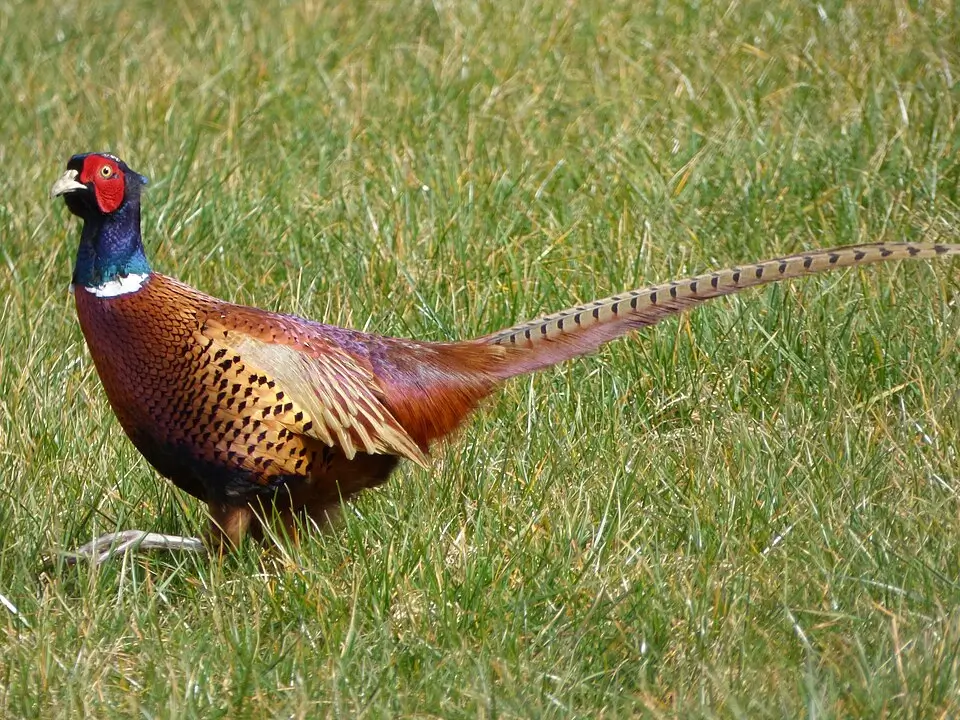
Pheasants are among the most strikingly dimorphic of all common game birds. Adult males — known as roosters or cocks — display an iridescent body plumage that can shift from coppery bronze to deep emerald green and even purple, depending on the angle of light. The head and neck are typically a glossy bottle green, accented by bright red facial wattles and small ear tufts. Most birds in North America carry a distinct white neck ring, a feature inherited from the Chinese ringneck subspecies (P. c. torquatus) that figured heavily in early introductions. The rooster's long, barred tail can account for more than half of his total body length.
Hens, by contrast, are clothed in mottled browns, tans, and blacks. This cryptic coloration is ideal for a ground-nesting bird that must remain hidden while incubating eggs and tending chicks. Their tails are shorter than those of males, but still proportionally long compared to most other upland birds.
Pheasants are strong runners and prefer to escape danger on foot when possible. When pressed, however, they explode into flight with a startling burst of wingbeats, often accompanied by the rooster's loud crowing call. They are capable of short, fast bursts of flight but are not long-distance flyers, generally gliding to cover within a few hundred yards.
Their diet is opportunistic and varied. Throughout the year pheasants consume waste grain such as corn, wheat, and soybeans, as well as weed seeds, berries, green shoots, and a wide variety of insects. Chicks, in particular, rely heavily on protein-rich invertebrates during their first weeks of life, which has important implications for habitat management.
The breeding system is polygynous, with dominant roosters defending crowing territories in spring and gathering small harems of hens. Nests are simple scrapes lined with grass, usually concealed in dense herbaceous cover. Clutches typically contain a dozen or so buff-colored eggs, and chicks are precocial — leaving the nest within hours of hatching and able to feed themselves under the hen's watchful care.
Habitat & Range
The native range of the common pheasant stretches across a broad band of Asia, from the Caucasus eastward through Central Asia and into China and Korea. Through centuries of introductions, the species now has a near-global distribution and is established across much of Europe, parts of North America, and other temperate regions.
In North America, the common pheasant became firmly established in the late 19th century, with introductions in the Pacific Northwest and the Upper Midwest gaining particular traction. The bird is well adapted to landscapes shaped by agriculture, particularly mosaics of grain fields, hayfields, weedy ditches, brushy fencelines, wetland edges, and grassland set-asides.
Quality pheasant habitat generally includes four key elements:
- Nesting cover: dense, undisturbed grasslands or hayfields where hens can conceal nests through the spring and early summer.
- Brood-rearing cover: weedy, insect-rich areas with bare ground beneath, allowing chicks to forage easily.
- Winter cover: cattail marshes, dense shrub thickets, and woody draws that offer shelter from snow, wind, and predators.
- Food sources: waste grain, weed seeds, and green vegetation, often supplied by nearby crop fields.
Michigan, with its blend of agricultural land, grasslands, wetlands, and woodlots, has long offered conditions suitable for pheasants, particularly in the southern Lower Peninsula and the Thumb region. The state's farm country, interspersed with brushy edges and wetlands, has historically supported strong populations. As land use patterns have shifted, pheasant numbers have varied across the state, but the species remains a beloved part of Michigan's upland tradition.
Hunting Information
The common pheasant is one of the most pursued upland game birds in the world. Its combination of size, table quality, dramatic flush, and association with classic farm-country landscapes has made it the centerpiece of upland hunting culture, especially across the American Midwest.
A traditional pheasant hunt often involves walking through standing crops, grassy strips, brushy ditches, and shelterbelts — frequently with the help of trained bird dogs. Pointing breeds such as English setters, German shorthaired pointers, and Brittanys are popular for locating hidden birds, while flushing breeds such as Labradors, springer spaniels, and golden retrievers excel at pushing birds into the air and retrieving downed game. Pheasants are notorious for running ahead of dogs and hunters, sometimes for long distances, which adds to the challenge and enjoyment of the pursuit.
In most jurisdictions where pheasants are hunted, regulations focus on the harvest of rooster (male) birds, leaving hens to support reproduction. Hunters typically use shotguns loaded with appropriate upland shot sizes, and blaze orange clothing is generally required or recommended for safety in fields shared by multiple parties.
For hunters interested in pursuing common pheasants in Michigan, the Michigan Department of Natural Resources (DNR) is the authoritative source for season dates, bag limits, license requirements, and any special area regulations. Because rules can change from year to year and may differ between public lands, game bird hunting areas, and licensed hunting preserves, hunters should always consult the current Michigan hunting digest before heading afield. Specific season dates, license details, and bag limits were not included in the source data referenced for this article, so prospective hunters should verify those directly with the Michigan DNR.
Michigan also has a tradition of state-supported pheasant release programs on selected public hunting areas, which can provide additional opportunities, especially for newer hunters or those introducing youth to upland hunting. Hunter education courses, mentor programs, and walk-in hunting access initiatives are all valuable resources for anyone looking to add pheasant hunting to their outdoor pursuits.
Conservation
The conservation status of the common pheasant on a global scale is considered secure, owing in part to its wide introduced range and its ability to thrive in human-modified landscapes. However, regional populations can fluctuate significantly based on land use, weather patterns, and habitat quality.
In the American Midwest, pheasant numbers are closely tied to the availability of grassland and small-grain habitats. Practices such as leaving undisturbed nesting cover, planting native warm-season grasses, maintaining brushy fencerows and wetland edges, and delaying mowing until after peak nesting can all benefit pheasant populations. Programs like the federal Conservation Reserve Program (CRP) have historically been important in maintaining habitat across pheasant range.
Organizations such as Pheasants Forever work alongside state agencies, private landowners, and hunters to enhance habitat through plantings, cost-share programs, and educational outreach. In Michigan, partnerships among the DNR, conservation nonprofits, agricultural producers, and volunteers continue to play a key role in supporting pheasant habitat in the southern Lower Peninsula and Thumb region.
Hunters themselves contribute substantially to pheasant conservation through license fees, excise taxes on firearms and ammunition (via the Pittman-Robertson Act), and direct support of habitat organizations. In this way, those who enjoy the autumn flush of a rooster pheasant from a frosty cornfield also help ensure that future generations will have the same opportunity.