Overview
Few birds command the attention of waterfowl enthusiasts quite like the Common merganser (Mergus merganser). Known for its striking appearance, remarkable diving ability, and wide distribution across the Northern Hemisphere, this large diving duck has earned a respected place in both the natural world and the traditions of waterfowl hunting. Whether you encounter one gliding effortlessly across a cold, clear river in the Upper Midwest or observe a flock riding the wind over a vast Great Lake, the Common merganser is a bird that consistently impresses those lucky enough to witness it in its natural environment.
In Michigan, a state defined by its extraordinary relationship with freshwater — bordered by four of the five Great Lakes and laced with thousands of inland rivers, streams, and lakes — the Common merganser is a familiar and ecologically significant presence. Understanding this species more deeply enriches not only the experience of hunters and bird watchers but also deepens our appreciation for the broader ecosystem that makes Michigan one of the most celebrated waterfowl destinations in North America.
Biological Traits
The Common merganser is the largest member of the merganser family in North America and belongs to the tribe Mergini, the sea ducks, within the family Anatidae. It is a sexually dimorphic species, meaning males and females display distinctly different plumage — a characteristic that makes identification in the field relatively straightforward for experienced observers.
Male Appearance
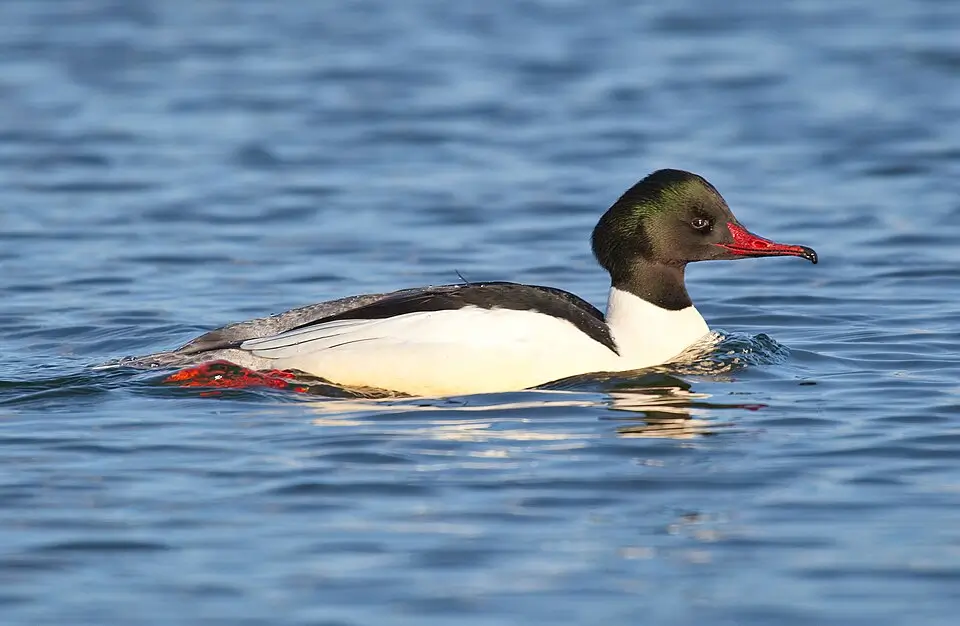
The adult male is a particularly handsome bird. He sports a deep, iridescent green head that can appear almost black in certain lighting conditions, a feature that distinguishes him from many other diving ducks. His body is predominantly white with salmon-pink or cream tones on the flanks and breast, creating a clean, elegant silhouette on the water. The bill is long, serrated, and bright red-orange — a key anatomical adaptation that sets mergansers apart from most other ducks. This serrated bill, sometimes referred to as a "sawbill," is perfectly engineered for gripping slippery fish underwater.
Female Appearance
The female, or hen, presents a more subdued but equally distinctive appearance. She features a rich reddish-brown head with a slightly shaggy crest, sharply contrasting with her gray body. Her white chin patch is a useful field mark, and she too possesses the characteristic serrated red-orange bill.
Size and Weight
The Common merganser is a large duck by any measure. Adults typically range from approximately 22 to 27 inches in length, with a wingspan that can stretch from 31 to 37 inches. Body weight generally falls between 2.5 and 4.5 pounds, though individuals can vary. These dimensions place the Common merganser firmly among the larger waterfowl species encountered by hunters in the Great Lakes region.
Adaptations for Diving
One of the most fascinating aspects of the Common merganser's biology is its extraordinary adaptation to an aquatic, fish-eating lifestyle. Unlike dabbling ducks that feed near the surface, mergansers are powerful underwater swimmers capable of diving to significant depths in pursuit of fish. Their legs are positioned far back on their bodies — an arrangement that maximizes propulsive power underwater but gives them a somewhat awkward gait on land. Their eyes are adapted to see clearly beneath the water's surface, and their serrated bills provide the mechanical grip necessary to secure wriggling, slippery prey.
Diet
The Common merganser is primarily piscivorous — that is, fish-eating — a dietary specialization that sets it apart from the vast majority of North American waterfowl. Fish such as trout, salmon, perch, and various minnow species form the backbone of its diet. The species is an active and highly efficient predator, using underwater pursuit rather than surface-feeding to secure meals. Invertebrates, amphibians, and occasionally plant material may supplement the diet, particularly in areas where fish are less abundant.
Reproduction
Common mergansers are cavity nesters, a relatively uncommon trait among ducks. Females seek out natural tree cavities, rock crevices, or large nest boxes positioned near clean, productive waterways. Clutch sizes typically range from 6 to 17 eggs, with incubation lasting approximately 30 to 35 days. The hen incubates the eggs and raises the brood largely on her own. Shortly after hatching, the downy chicks make an impressive leap from the nest cavity — sometimes from considerable heights — before following their mother to the water. Common merganser hens are well known for forming large cooperative "creches," where multiple broods are tended by one or a few females, a fascinating behavioral adaptation that improves chick survival.
Vocalizations
The Common merganser is not a particularly vocal species, especially when compared to dabbling ducks. Females may produce a series of hoarse, croaking calls, while males tend toward quieter, softer vocalizations during courtship displays.
Habitat & Range
The Common merganser boasts one of the most expansive ranges of any North American waterfowl species. It breeds across much of the boreal and temperate zones of the Northern Hemisphere, including large portions of Canada, the northern United States, Europe, and Asia. In North America, breeding populations concentrate in the forested regions of Canada and the northern tier of the United States, wherever clean, clear, fish-rich waters are present.
The species demonstrates a strong preference for rivers, streams, and lakes with clear water and rocky or gravelly substrates. These conditions support the healthy fish populations on which the merganser depends. Cold, fast-moving rivers associated with forested landscapes represent prime habitat. During winter months, Common mergansers may move to larger open water bodies, including coastal areas, larger reservoirs, and the Great Lakes themselves, wherever ice-free water persists.
Michigan and the Great Lakes Region
Michigan's geography makes it an outstanding home and migratory stopover for Common mergansers. The state's extraordinary freshwater resources — including Lakes Superior, Michigan, Huron, and Erie, along with thousands of inland lakes and river systems — provide ideal habitat across all seasons. The Upper Peninsula in particular, with its vast stretches of cold, clear rivers draining ancient forests, supports significant breeding populations. During fall and winter migration, large concentrations of Common mergansers are regularly observed on the Great Lakes and on major river systems throughout both peninsulas.
Hunting Information
The Common merganser holds a place in the traditions of waterfowl hunting across its range, though it is not universally pursued with the same enthusiasm as puddle ducks or diving species such as canvasbacks and bluebills. Its sawbill nature and fish-heavy diet mean that the table quality of merganser is often described as stronger and more robust in flavor than that of grain-fed ducks — a characteristic that some hunters relish while others address with specific preparation techniques, such as marinating or careful trimming of fat.
In Michigan, waterfowl hunting is a deeply ingrained cultural tradition supported by the state's remarkable diversity of wetland and aquatic habitats. Michigan hunters pursuing diving ducks on the Great Lakes, inland lakes, and river systems have opportunities to encounter Common mergansers throughout the hunting season. However, it is important for all hunters to note that specific season dates, bag limits, and licensing requirements for waterfowl hunting in Michigan — including regulations pertaining to mergansers — are set annually by the Michigan Department of Natural Resources (MDNR) in coordination with the U.S. Fish & Wildlife Service under the framework of the Migratory Bird Treaty Act. Hunters are strongly encouraged to consult the most current Michigan Waterfowl Hunting Guide, available through the MDNR, before pursuing any waterfowl species.
Common mergansers are legal quarry for waterfowl hunters where seasons are open, and they are frequently encountered in mixed bags alongside other diving duck species. Hunting them often involves the same decoy spreads, calling strategies, and layout or boat-blind setups employed for other diving ducks on open water. Their tendency to travel in small groups along river corridors also makes them a target for hunters who set up along productive waterways.
Michigan requires hunters to possess a valid Michigan hunting license and the appropriate federal and state waterfowl stamps or licenses. As with all migratory birds, regulations are subject to annual revision, and compliance with current rules is both a legal obligation and an ethical responsibility.
Conservation
The Common merganser is currently classified by the International Union for Conservation of Nature (IUCN) as a species of Least Concern, reflecting the fact that global populations are considered stable and relatively robust. This positive conservation status is a testament to the species' adaptability and the importance of ongoing habitat protection efforts.
The health of Common merganser populations is closely tied to water quality. Because the species depends on clear, clean water with abundant fish populations, it serves as a valuable indicator species for freshwater ecosystem health. Declines in water quality, fish populations, or riparian forest habitat can negatively affect merganser populations in localized areas.
Conservation efforts that benefit the Common merganser include the protection and restoration of riparian corridors, the maintenance of clean waterways, the management of invasive species that threaten native fish communities, and the installation of nest boxes in appropriate habitats. Federal and state migratory bird management programs, including those coordinated through the North American Waterfowl Management Plan, play a critical role in ensuring that Common merganser populations continue to thrive across the continent.
In Michigan, the stewardship of the Great Lakes and their associated watersheds is a matter of immense cultural, economic, and ecological importance. Hunters, anglers, conservationists, and outdoor enthusiasts share a common interest in keeping Michigan's waters clean and productive — and in doing so, they help ensure that species like the Common merganser remain a vibrant part of the state's natural heritage for generations to come.