Overview
Few birds capture the imagination of wildlife enthusiasts and upland hunters quite like the American woodcock (Scolopax minor). Known by a colorful array of regional nicknames — including "timberdoodle," "bogsucker," "mud snipe," and "Labrador twister" — this rotund, big-eyed shorebird has charmed generations of naturalists and wingshooters alike. Despite its classification as a shorebird within the order Charadriiformes, the American woodcock has made its home not on sandy beaches or open coastlines, but deep within the moist, thicketed forests and alder runs of the eastern United States and Canada. It is a bird of contradiction: a shorebird that hunts the forest floor, a master of camouflage that performs one of nature's most spectacular aerial courtship displays, and a beloved game bird that also serves as a valuable indicator species for the health of young forest ecosystems.
For hunters and wildlife watchers in Michigan and across the Great Lakes region, the woodcock holds a particularly special place. Michigan's vast forests, abundant wetlands, and rich network of alder thickets and young aspen stands make it one of the premier woodcock states in the entire country. Whether you're a seasoned dog handler working a pointing breed through a October covert, a beginning bird hunter stepping into the uplands for the first time, or simply a nature lover hoping to witness the magical "sky dance" on a warm spring evening, the American woodcock offers something truly unforgettable.
Biological Traits
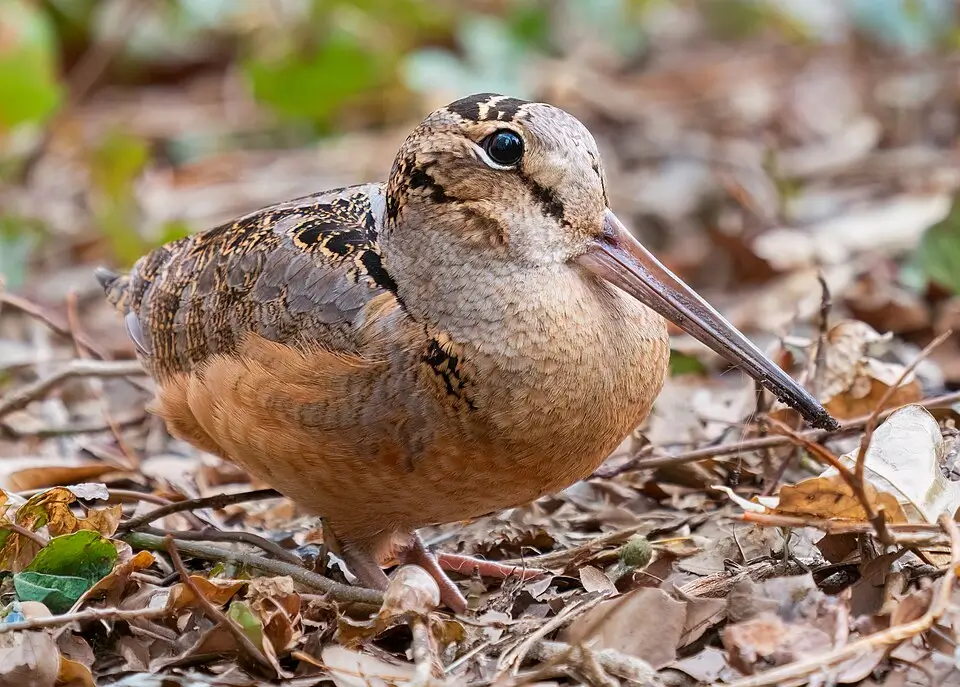
The American woodcock (Scolopax minor) is a compact, heavily built shorebird with a suite of physical adaptations that make it uniquely suited to life on the forest floor. Adults typically display a stocky, rounded body profile with extremely short legs, a large rounded head, and a remarkably long, flexible bill that can measure nearly three inches in length. This bill is one of the woodcock's most defining features — the tip is prehensile, meaning the bird can flex the upper mandible independently while it is inserted into the soil. This remarkable adaptation allows the woodcock to grasp and extract earthworms from soft, moist ground without having to withdraw the bill first.
The woodcock's plumage is a masterwork of natural camouflage. Browns, rusts, blacks, and buffs blend together in an intricate pattern of dead leaves, bark, and forest litter, rendering the bird nearly invisible when it flushes tight to the ground. The back of the head is adorned with distinctive transverse black bars — a field mark that, combined with the bird's enormous dark eyes positioned high on the skull, gives the woodcock an almost otherworldly appearance.
Those large eyes are not merely decorative. Positioned to the sides and high on the head, the woodcock's eyes provide nearly 360-degree vision, allowing the bird to watch for predators even while its bill is probing deep into the soil. This wide field of view extends above as well, enabling the woodcock to watch the sky while feeding — a critical survival advantage in dense cover where aerial predators can strike suddenly.
The woodcock's brain is also anatomically unusual among birds. The cerebellum — the portion of the brain responsible for motor control — is positioned beneath the rest of the brain rather than behind it. Scientists believe this arrangement is an evolutionary adaptation related to the positioning of the bird's eyes and the demands of its specialized foraging behavior.
Male woodcock are notably smaller than females, making the species sexually dimorphic in size. Males average around 5 to 6 ounces, while females can weigh significantly more, sometimes approaching 8 to 9 ounces. This size difference is thought to be related to the energetic demands of egg incubation and brood-rearing, which fall entirely to the female.
One of the most celebrated aspects of woodcock biology is the male's extraordinary courtship display, known popularly as the "sky dance." Beginning in late winter or early spring, male woodcocks gather at traditional display grounds called "singing grounds" at dusk and dawn. The male begins with a series of nasal "peenting" calls from the ground, then launches himself into the air in a spiraling, climbing flight that can take him several hundred feet into the evening sky. At the apex of his flight, he produces a series of liquid, twittering chirps — sounds produced both vocally and by the air rushing through his specially modified outer primary feathers — before tumbling back to earth in a zigzagging descent, landing near the spot from which he departed. This performance, repeated night after night throughout the spring, is one of the most enchanting wildlife spectacles in North America and is eagerly sought by naturalists each year.
Habitat & Range
The American woodcock is found exclusively in the eastern half of North America. Its breeding range extends from the Canadian Maritime provinces and Quebec westward through Ontario and into the upper Midwest, including Michigan, Wisconsin, and Minnesota. Wintering populations concentrate primarily in the southeastern United States, from the Gulf Coast states northward through the Carolinas and into the mid-Atlantic region.
Woodcock are intimately tied to young, early-successional forests — particularly stands of alder, aspen, birch, and similar species with dense understory vegetation and proximity to moist, earthworm-rich soils. These habitats provide both the abundant food supply (primarily earthworms, supplemented by insects and other invertebrates) and the dense overhead cover the woodcock requires for daytime roosting and protection from predators. Older, closed-canopy forests with little understory are generally unsuitable as primary habitat, although woodcock may use them as travel corridors.
Michigan represents some of the finest woodcock habitat in the nation. The state's Upper and Lower Peninsulas are laced with the kinds of young forest, alder runs, and moist bottomlands that woodcock find irresistible. The combination of adequate rainfall, rich soils, and a forest landscape shaped by both natural succession and active timber management creates a patchwork of ideal coverts throughout the state. During the autumn migration, woodcock from across the Great Lakes region and Canada funnel through Michigan on their journey south, concentrating in favorite coverts and staging areas that hunters have cherished for generations.
Hunting Information
American woodcock hunting is a deeply traditional pursuit, particularly in the northeastern and Great Lakes states, where the sport has been practiced for well over a century. The woodcock's preference for dense, tangled cover — the brushy alder runs, young aspen cuts, and overgrown fields that hunters call "coverts" — makes it both challenging and immensely rewarding to hunt.
Woodcock hunting is typically pursued with flushing or pointing dogs, which use their noses to locate tightly holding birds in heavy cover. Breeds such as the English setter, Brittany, Gordon setter, and various spaniel breeds have deep historical associations with woodcock hunting and perform beautifully in the dense habitats these birds prefer. When a dog goes on point or flushes a woodcock, the bird rockets upward through the brush on whistling wings, often disappearing into the canopy almost before the hunter can mount a gun — making for a genuinely demanding shooting proposition.
Because American woodcock are a migratory bird, hunting seasons and bag limits are regulated at the federal level by the U.S. Fish and Wildlife Service, with states setting their own season dates within federally established frameworks. Hunters in Michigan should consult the current Michigan Department of Natural Resources (DNR) hunting guide and the U.S. Fish and Wildlife Service regulations for the most up-to-date season dates, shooting hours, and daily bag limits before heading afield. As a migratory game bird, a valid federal Harvest Information Program (HIP) registration is typically required of all woodcock hunters in addition to a valid state hunting license.
Woodcock are often considered a delicacy at the table, with dark, richly flavored meat that reflects the bird's earthworm-heavy diet. Preparation traditions vary widely, but the woodcock has long been esteemed by those who appreciate fine wild game.
Conservation
The American woodcock has experienced long-term population declines over the past several decades, a trend attributed primarily to the loss and maturation of young forest habitat across the eastern United States and Canada. As forests have grown older and early-successional habitats have become less common, the patchwork of young, shrubby woodlands that woodcock depend upon has diminished considerably.
Conservation efforts on behalf of the woodcock are led by organizations including the American Woodcock Society and the Ruffed Grouse Society, both of which work to promote young forest habitat management through partnerships with private landowners, timber companies, and public land managers. Habitat work — including timber harvests, prescribed fire, and mechanical clearing — that creates and maintains early-successional forest is among the most impactful conservation tools available for woodcock and the many other species that share this habitat type.
The woodcock's status as a popular game bird has actually been a boon to conservation, as hunters and hunting organizations have long served as powerful advocates for the young forest management that benefits the species. Michigan hunters and wildlife enthusiasts can support woodcock conservation by participating in the annual Woodcock Singing Ground Survey, reporting banding recoveries, and supporting organizations dedicated to early-successional habitat work.
Michigan's own diverse landscape — with its mix of public forests, private timberlands, and active wildlife management areas — positions the state as an important stronghold for woodcock conservation in the Great Lakes region.