Overview
Few birds in North America can claim the kind of visual splendor that belongs to the Wood Duck (Aix sponsa). Known colloquially as the "woodies" among waterfowl hunters and birdwatchers alike, this stunning species has long captured the imagination of those who spend time near the water's edge. With iridescent plumage, a distinctive crested head, and a personality as unique as its appearance, the Wood Duck stands apart from virtually every other waterfowl species on the continent. It is a bird that inspires awe in experienced outdoorspeople and newcomers to nature alike, and it holds a special place in the cultural and ecological heritage of states like Maine, where wetlands, forested riverbanks, and quiet beaver ponds provide some of the finest habitat this species could ask for.
The Latin name Aix sponsa translates loosely to "a waterfowl in bridal dress," a poetic nod to the remarkable coloration of the male. This name alone tells you something about the impression this bird makes on those fortunate enough to encounter it. Whether you are a waterfowl hunter positioning decoys along a wooded creek at first light, or a nature enthusiast paddling a canoe through a marsh, the sight of a Wood Duck bursting from the water or gliding through a cathedral of hardwood trees is one that stays with you.
Biological Traits
The Wood Duck is a member of the family Anatidae, the broad family that encompasses all ducks, geese, and swans. It belongs to the subfamily Cairinini, which includes perching ducks — a group well-adapted to life in wooded, forested environments. This classification reflects one of the Wood Duck's most distinctive biological traits: its ability and preference for nesting in tree cavities, sometimes quite high off the ground, far above the waterline.
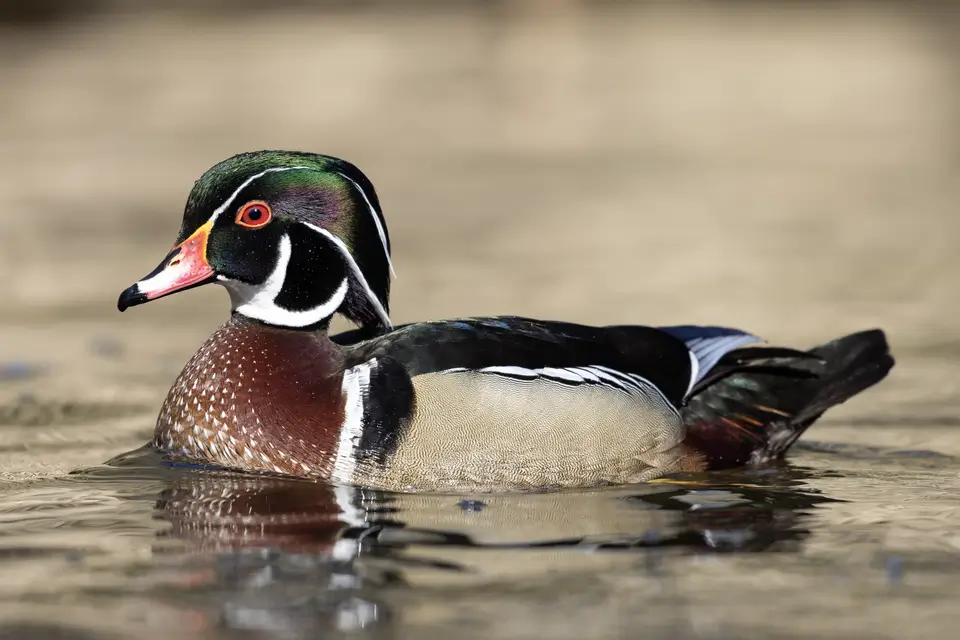
The male Wood Duck in breeding plumage is arguably the most colorful waterfowl species in North America. He sports a crested head of iridescent green and purple, a striking white chin patch, a chestnut-colored breast flecked with white spots, a golden-yellow flank, and rich burgundy tones across the chest and back. His eyes are a vivid red, and his bill is a patterned combination of red, white, and black. By contrast, the female is more subtly colored, featuring soft grays and browns with a distinctive white eye ring and teardrop-shaped white patch around the eye — elegant in its own right, and perfectly suited for camouflage while nesting.
Like most ducks, Wood Ducks are sexually dimorphic, meaning males and females differ visually. Males go through an eclipse plumage during late summer, temporarily losing much of their vivid coloration as they molt. They regain their full breeding plumage by fall, just in time for migration and the early hunting season.
One of the most fascinating aspects of Wood Duck biology is their nesting behavior. Unlike most other duck species, which nest on the ground, Wood Ducks nest almost exclusively in tree cavities — natural hollows formed by decay or excavated by large woodpeckers such as Pileated Woodpeckers. They will also readily adopt nest boxes, which has played an enormous role in the species' recovery from historical population lows. Females are known for the remarkable behavior of "brood parasitism," sometimes laying eggs in other females' nests, a strategy that can result in nests containing well over a dozen eggs.
After hatching, Wood Duck ducklings face one of the most dramatic early-life challenges of any North American bird. Within roughly 24 hours of hatching, the mother calls from below the nest cavity, and the tiny ducklings — equipped with sharp claws and incredible instinct — leap from the nest, sometimes falling dozens of feet to the ground or water below. This extraordinary behavior is one of the most memorable sights in all of natural history, and it speaks to the evolutionary adaptations this species has developed over millennia.
Wood Ducks are omnivorous, feeding on a wide variety of plant material, invertebrates, and aquatic vegetation. Acorns are a particularly important food source, especially in the fall, making forested wetland edges near oak trees prime feeding habitat. They also consume seeds, berries, insects, and aquatic plants throughout the year.
Habitat & Range
The Wood Duck is found across much of North America, with two primary populations: one in the eastern United States and Canada, and another along the Pacific Coast. The eastern population is by far the more numerous of the two. Wood Ducks are year-round residents in portions of the southeastern United States and migrate to breed across the northeastern states and into southern Canada during the warmer months.
The species thrives in a specific type of habitat: wooded swamps, beaver ponds, slow-moving streams and rivers lined with mature trees, marshes adjacent to forested land, and flooded bottomlands. The critical ingredient is the combination of water and mature trees with cavities suitable for nesting. This makes the landscape of states like Maine exceptionally valuable. Maine, characterized by over 17 million acres of working and wild lands including vast stretches of forested wetland, beaver flowages, and winding woodland waterways, offers some of the finest Wood Duck habitat in the northeastern United States.
Maine's geography — with its lakes, rivers, coastal marshes, and interior forested wetlands — provides ideal conditions for Wood Ducks throughout the breeding season and into the early fall migration period. The birds arrive in spring as ice recedes from inland waters and settle into nesting territories along forested stream corridors and beaver ponds. By late summer and early fall, family groups begin gathering and staging for southward migration, making them accessible to waterfowl hunters throughout the state.
Hunting Information
The Wood Duck is a prized game bird for waterfowl hunters throughout its range, and Maine offers meaningful opportunities to pursue this species. Hunting Wood Ducks requires a thoughtful approach — these birds are often encountered in tight, wooded settings rather than open water, and hunters who learn to read the landscape and identify flight corridors through timber can enjoy exceptional action.
Effective Wood Duck hunting in Maine often involves setting up along forested stream corridors, beaver ponds, and marshy edges in early morning when birds are actively moving between roosting and feeding areas. Small decoy spreads featuring Wood Duck decoys can be effective, though many experienced hunters find that calling and simply positioning in a well-chosen spot along a known flight path produces consistent results. Wood Duck calls — particularly the distinctive squealing call of the female — can draw birds in effectively during shooting hours.
As with all migratory waterfowl in the United States, hunting Wood Ducks is regulated at both the federal and state level. In Maine, hunters must comply with regulations set forth by the Maine Department of Inland Fisheries and Wildlife (MDIFW) in coordination with the U.S. Fish and Wildlife Service. Hunters are required to possess the appropriate licenses and stamps, including a federal duck stamp, before pursuing migratory waterfowl. For the most current and specific season dates, bag limits, and licensing requirements, hunters should always consult the Maine Department of Inland Fisheries and Wildlife directly, as regulations may change from year to year.
Conservation
The story of Wood Duck conservation is one of the great success stories in North American wildlife management. By the early 20th century, populations had been drastically reduced due to market hunting and widespread loss of forested wetland habitat. Protective legislation, beginning with the Migratory Bird Treaty Act of 1918, gave the species critical breathing room to recover.
The widespread deployment of nest boxes across the species' range proved transformative. Thousands of nest boxes installed by hunters, conservation organizations, and wildlife agencies created additional nesting sites in landscapes where natural tree cavities had become scarce. Wood Ducks responded enthusiastically, and populations rebounded significantly across their range throughout the latter half of the 20th century.
Today, the Wood Duck is considered a conservation success story, and its population remains healthy across much of North America. Continued stewardship of wetland habitats, responsible harvest management, and the ongoing nest box program all contribute to sustaining this remarkable species for future generations. In Maine, the preservation of forested wetlands, beaver habitat, and riparian corridors is essential to supporting a robust breeding population.
Hunters in Maine and across the country play an active role in Wood Duck conservation through the purchase of federal duck stamps, which directly fund wetland acquisition and habitat protection. Organizations such as Ducks Unlimited have been instrumental in preserving and restoring Wood Duck habitat at a landscape scale. The relationship between hunters, wildlife managers, and conservation organizations has proven to be one of the most effective models for sustaining waterfowl populations in North America.
The Wood Duck's journey from near-extinction to abundance is a testament to what thoughtful, science-based wildlife management can achieve — and a reminder of the responsibility shared by all who enjoy the natural world.