Overview
Few birds capture the spirit of North American wildlife quite like the wild turkey (Meleagris gallopavo). Revered by hunters, celebrated at Thanksgiving tables, and admired by birdwatchers across the continent, the wild turkey stands as one of the most iconic game birds in the United States. Large, intelligent, wary, and breathtakingly beautiful in its own wild way, this bird commands respect from anyone lucky enough to encounter it in its natural habitat.
In Maine — a state renowned for its outdoor heritage and expansive wilderness — the wild turkey has become an increasingly important part of the hunting and wildlife landscape. With over 17 million acres of hunting ground and a reputation as one of the premier destinations for outdoor pursuits in the northeastern United States, Maine offers turkey hunters and wildlife enthusiasts alike a spectacular backdrop for experiencing this remarkable bird. Whether you're a seasoned hunter who has called in dozens of toms or a curious naturalist catching your first glimpse of a strutting gobbler in a spring meadow, the wild turkey never fails to impress.
This article explores the biology, behavior, habitat, and hunting heritage of the wild turkey, with a special focus on what makes Maine such an exciting destination for those who pursue this magnificent bird.
Biological Traits
The wild turkey, Meleagris gallopavo, belongs to the order Galliformes and the family Phasianidae, making it a relative of pheasants, grouse, and peacocks. It is one of only two species in the genus Meleagris, the other being the ocellated turkey (Meleagris ocellata) found in the Yucatán Peninsula of Mexico and parts of Central America.
Wild turkeys are among the largest native birds in North America. Adult males, known as toms or gobblers, are substantially larger than females, which are called hens. Toms can weigh anywhere from 11 to over 24 pounds in their wild form, while hens are typically smaller and more slender in build. The size difference between males and females — a characteristic known as sexual dimorphism — is one of the most pronounced among North American birds.
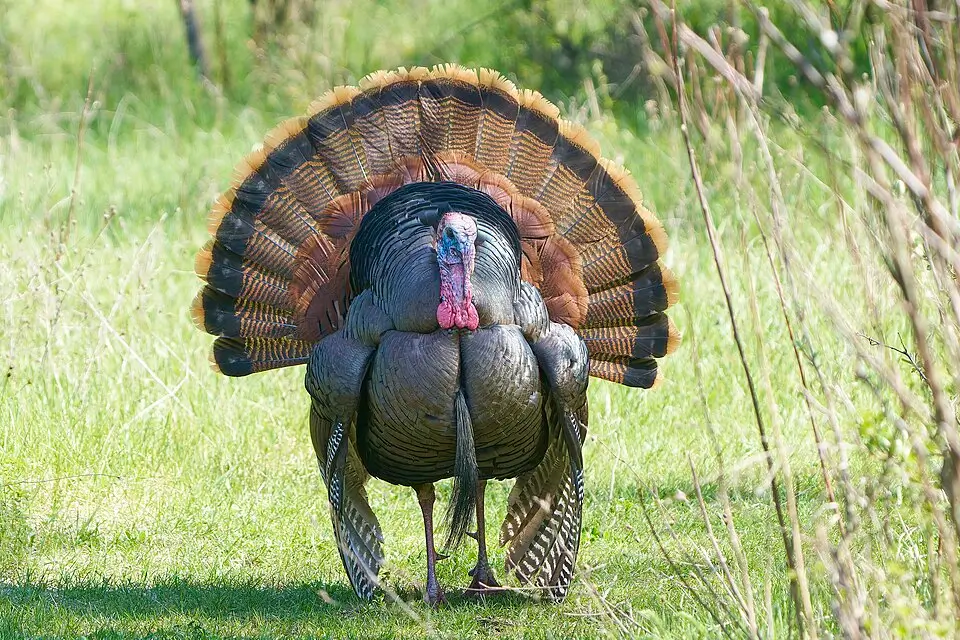
Perhaps the most striking feature of the male wild turkey is its plumage. Gobblers display iridescent feathers that shimmer with bronzes, greens, coppers, and golds in direct sunlight, a visual spectacle that belies the bird's reputation as a drab woodland creature. The head and neck of a tom are largely bare of feathers and can change color dramatically — shifting between red, white, and blue — depending on the bird's mood and level of excitement. This color-changing ability is most pronounced during the spring breeding season when toms strut and display for hens.
Other distinctive physical features of the male wild turkey include the beard — a tuft of coarse, hair-like feathers that protrudes from the chest — and the spurs, bony projections on the lower legs used in combat with rival males. Hens occasionally grow beards as well, though this is less common. The fleshy protrusion above the beak, called the snood, elongates and turns bright red when a gobbler is excited or engaged in display behavior. The dewlap — loose skin hanging beneath the chin — and the caruncles, fleshy bumps on the neck and head, are also characteristic features.
Wild turkeys are highly vocal birds. The gobble of a mature tom, produced to attract hens and announce his presence to rival males, is one of the most iconic sounds in the North American woodland. In addition to the gobble, turkeys communicate through a rich vocabulary of clucks, purrs, yelps, cackles, putts, and kee-kees, each serving a different social purpose. This complex communication system is one of the reasons turkey hunting has become such a deeply engaging pursuit — hunters who can fluently "speak turkey" gain a significant advantage in the field.
Wild turkeys are omnivores with a broad and opportunistic diet. They forage on the ground for acorns, seeds, berries, insects, small reptiles, and amphibians. Their powerful feet and scratching behavior allow them to uncover food buried beneath leaves and snow. Acorns, in particular, are a critical food source in the fall and winter months, and areas with abundant oak trees often serve as important foraging habitat.
Despite their large size, wild turkeys are capable fliers over short distances and roost in trees at night to avoid ground predators. Their eyesight is exceptional — three times sharper than human vision — and they can detect color and movement with remarkable precision, which is one of the many traits that makes hunting them such a challenging and rewarding endeavor.
Habitat and Range
The wild turkey is native to North America and can be found across a broad swath of the continent, from southern Canada through much of the United States and into Mexico. There are six recognized subspecies of Meleagris gallopavo, each adapted to different regional environments: the Eastern wild turkey, Osceola wild turkey, Rio Grande wild turkey, Merriam's wild turkey, Gould's wild turkey, and the South Mexican wild turkey.
In Maine, the relevant subspecies is the Eastern wild turkey (Meleagris gallopavo silvestris), the most widely distributed and arguably the most familiar of the six. The Eastern wild turkey thrives in mixed hardwood and softwood forests interspersed with open fields and agricultural edges — a landscape that describes much of rural Maine perfectly.
Wild turkeys are highly adaptable and can survive in a wide range of environments, from dense forests and swampy bottomlands to open grasslands and agricultural fields. However, they tend to favor habitat that provides a mosaic of forest cover for roosting and shelter, open areas for foraging and breeding displays, and proximity to water sources. Mature hardwood forests with a heavy mast crop — particularly oaks, beeches, and hickories — are especially valuable habitat components.
Maine's vast forested interior, its patchwork of farmlands, wetlands, and river valleys, and its relatively low human population density in many areas create conditions well suited to sustaining and growing wild turkey populations. The birds have expanded their range significantly within the state over recent decades, now occupying areas where they were once absent.
Hunting Information
Turkey hunting occupies a special place in the traditions of American hunting culture, and Maine is no exception. The Maine Department of Inland Fisheries and Wildlife oversees hunting regulations in the state, which describe Maine as offering "some of the best hunting and fishing opportunities in the country" amid its more than 17 million acres of available land.
Spring turkey season is the most popular and widely celebrated turkey hunting season across North America, including in Maine. During the spring, the natural breeding behavior of gobblers — their eagerness to respond to the calls of hens — makes them vulnerable to skilled hunters who can mimic turkey vocalizations convincingly. Using friction calls, box calls, mouth diaphragms, or electronic devices where permitted, hunters attempt to lure toms within shooting range.
Fall turkey hunting is also a tradition in many states, including Maine, offering a different style of pursuit. In the fall, hunters often focus on locating flocks and breaking them up, then calling the scattered birds back together — a technique that requires knowledge of turkey behavior and patience.
Turkey hunting demands a combination of woodsmanship, patience, and skill. The bird's extraordinary eyesight means hunters must remain absolutely still when a turkey is in the vicinity. Camouflage clothing, face masks, and gloves are standard equipment. Hunters typically set up near roosting areas, travel corridors, or food sources, calling periodically to coax birds into range.
For specific season dates, licensing requirements, bag limits, and legal shooting hours in Maine, hunters are strongly encouraged to consult the Maine Department of Inland Fisheries and Wildlife directly, as regulations may change from year to year. Obtaining the appropriate licenses before heading afield is essential, and Maine's wildlife management agency provides up-to-date information through its official website and published hunting guides.
Conservation
The story of the wild turkey is one of the great conservation success stories in North American wildlife management. By the early twentieth century, unregulated market hunting and widespread habitat loss had devastated turkey populations across much of their historic range. In some regions, the birds were nearly extirpated entirely.
Thanks to dedicated conservation efforts led by state wildlife agencies, the National Wild Turkey Federation, and countless individual hunters and landowners, wild turkey populations rebounded dramatically throughout the latter half of the twentieth century. Trap-and-transfer programs, habitat restoration initiatives, and carefully managed hunting seasons allowed turkeys to recolonize much of their former range and expand into new territories.
Today, the wild turkey is considered a conservation success story and a symbol of what thoughtful wildlife management can achieve. Hunter-purchased licenses and excise taxes on sporting equipment — through programs like the Federal Aid in Wildlife Restoration Act (Pittman-Robertson Act) — continue to fund turkey management and habitat conservation efforts across the country, including in Maine.
Maintaining healthy turkey populations requires ongoing attention to habitat quality, predator management, and sustainable harvest levels. Maine's abundant forests and commitment to wildlife stewardship make it a promising landscape for the continued prosperity of the wild turkey for generations of hunters and wildlife enthusiasts to come.