Overview
Few birds command the attention of waterfowl hunters and birdwatchers quite like the surf scoter (Melanitta perspicillata). With its striking appearance, powerful flight, and affinity for the open ocean, this remarkable sea duck has earned a devoted following among those who spend time on coastal waters. Whether crashing through the waves of a rocky Maine shoreline or riding swells offshore, the surf scoter embodies the rugged spirit of the North Atlantic. For hunters and naturalists alike, encountering a flock of surf scoters riding the whitecaps is one of those unforgettable outdoor experiences that keeps people coming back to the coast season after season.
Maine, with its vast and storied coastline stretching for nearly 3,500 miles of tidal shoreline, stands as one of the premier destinations in the northeastern United States for sea duck hunting, and the surf scoter plays a central role in that tradition. The state's unique geography — rocky headlands, sheltered coves, offshore ledges, and productive estuaries — provides ideal wintering habitat for surf scoters and makes the Pine Tree State a bucket-list destination for serious sea duck hunters.
Biological Traits
The surf scoter is a medium-to-large diving duck belonging to the family Anatidae and the genus Melanitta, which it shares with the white-winged scoter and the black scoter — the three scoter species found in North America. The scientific name perspicillata comes from the Latin word for "conspicuous" or "clearly seen," a fitting reference to the bold, colorful markings that distinguish this species.
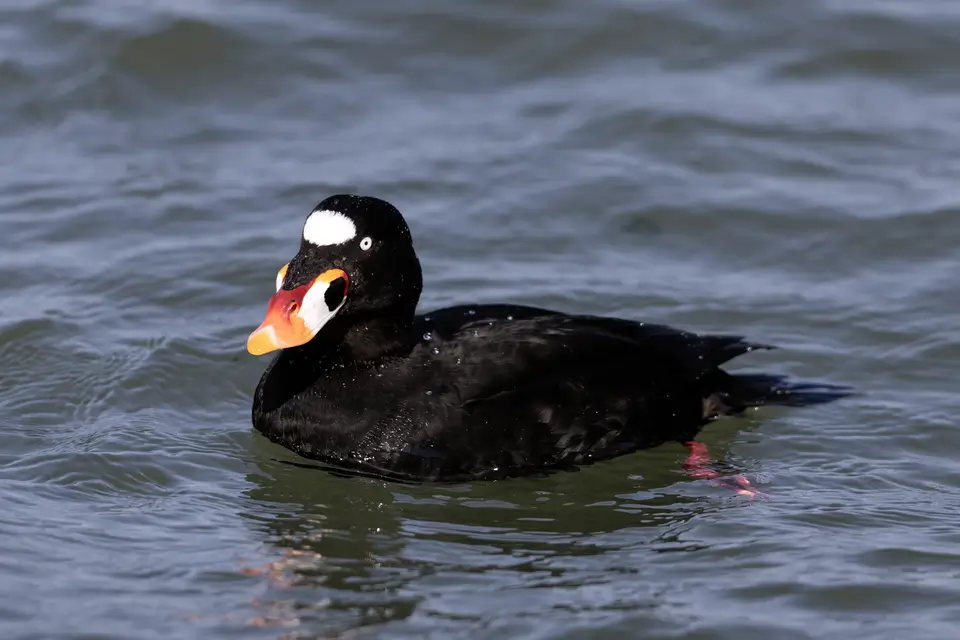
Adult male surf scoters are among the most visually distinctive ducks in North America. They are largely jet black in plumage, set off dramatically by bold white patches on the forehead and the nape of the neck — a marking that has earned them the colorful nickname "skunkhead" among hunters and coastal fishermen. The bill is perhaps the most striking feature of all: large and swollen in appearance, it is brilliantly patterned in orange, red, yellow, and white, with a black spot near the base. The eyes of adult males are pale white, adding further to the bird's exotic appearance.
Female surf scoters are considerably more subdued in coloring, as is common among many duck species. They display a dark brown body with whitish patches on the face — typically one near the base of the bill and another on the cheek — that help distinguish them from the other scoter species. Females also possess a large, somewhat swollen bill, though it lacks the vivid colors of the male.
Like other sea ducks, surf scoters are built for life on the water. Their bodies are compact and sturdy, their wings relatively small and powerful for their body mass, and their legs are positioned far back on the body — a design that makes them exceptional divers but somewhat awkward on land. They dive to forage on the bottom, feeding primarily on mollusks, crustaceans, aquatic insects, and various marine invertebrates. Their powerful bill is well adapted to prying open clams, mussels, and other bivalves. They have also been observed consuming herring eggs and small amounts of aquatic vegetation.
Surf scoters are capable of deep, sustained dives. Their flight style is strong and direct, often low over the water's surface, and flocks typically travel in long, undulating lines that rise and fall with the ocean swells — a spectacular sight from any boat or shoreline blind.
Surf scoters are migratory birds. They breed primarily in the boreal forests and subarctic regions of northern Canada and Alaska, nesting on the ground near freshwater lakes and ponds in remote, sparsely inhabited wilderness areas. Much of the surf scoter's breeding biology remained relatively poorly understood for many years due to the remoteness of its nesting grounds, though research efforts have improved our knowledge in recent decades. Females typically lay a clutch of eggs in a simple nest constructed near water and concealed in vegetation, and they alone are responsible for incubation and early brooding.
Habitat and Range
During the non-breeding season — including the critical fall and winter hunting seasons — surf scoters gather in large numbers along both coasts of North America. On the Atlantic coast, they range from the Canadian Maritime provinces southward through New England and the Mid-Atlantic states, and in some years extend as far south as Florida. On the Pacific coast, they winter from Alaska south through California. Interior sightings are less common but do occur, particularly during migration.
Maine occupies an especially important position within the Atlantic coast's wintering range for surf scoters. The state's rocky coast, with its abundance of productive nearshore and offshore feeding habitat, provides ideal conditions for scoters to build up vital energy reserves during the winter months. Surf scoters are most often found in open coastal waters, around offshore ledges and shoals, in the mouths of estuaries, and in protected bays and harbors where shellfish and other invertebrates are abundant. They tend to gather in mixed flocks with other sea duck species, including white-winged scoters, black scoters, common eiders, long-tailed ducks, and common goldeneyes.
Maine's designation as "Vacationland" extends well beyond summer tourism. Its more than 17 million acres of wild lands and its exceptional coastal resources make it one of the premier hunting and fishing destinations in the entire country, as noted by the Maine Department of Inland Fisheries and Wildlife. Sea duck hunting along the Maine coast is a cherished tradition with deep roots in the state's maritime culture.
Hunting Information
Sea duck hunting, including pursuit of surf scoters, is a beloved tradition in Maine and throughout the Atlantic Flyway. Hunting surf scoters from a boat or a shoreline layout blind, often in challenging weather and heavy seas, is considered by many to be one of the most demanding and rewarding forms of waterfowl hunting. It requires specialized equipment — including cold-weather and waterproof gear, ocean-capable boats, and sturdy decoys designed to handle rough surf — and a respect for the unpredictable nature of open-water hunting.
Surf scoters are typically hunted using decoy spreads set in their feeding areas near shellfish beds and offshore structure. Hunters often combine surf scoters, white-winged scoters, and black scoters in the same decoy spread, as the three species frequently associate together. The birds tend to be less wary than many other ducks, which can make decoying them a rewarding experience.
For specific, current season dates, bag limits, and licensing requirements for surf scoter hunting in Maine, hunters should consult directly with the Maine Department of Inland Fisheries and Wildlife. Regulations for migratory birds, including sea ducks, are set in coordination with the U.S. Fish and Wildlife Service under the framework of the Migratory Bird Treaty Act and can change from season to season. Always verify current rules before heading afield.
Conservation
The surf scoter, like all migratory waterfowl in North America, is managed under the framework of international treaties and cooperative agreements between the United States, Canada, and Mexico. The Migratory Bird Treaty Act provides foundational legal protection, while annual regulatory processes set hunting seasons and harvest limits based on population monitoring data.
Surf scoter populations are monitored through breeding ground surveys, wintering ground counts, and banding programs. The species faces challenges common to many sea ducks, including habitat changes on breeding grounds, ocean ecosystem shifts, and various environmental pressures. Conservation organizations, state wildlife agencies, and federal managers work collaboratively to ensure that surf scoter populations remain healthy and sustainable for future generations of hunters, wildlife enthusiasts, and coastal ecosystems that depend on their ecological roles.
Responsible hunting is widely recognized as an important component of wildlife conservation, contributing both financial support — through license fees, duck stamps, and excise taxes on hunting equipment — and direct data gathering through harvest reporting programs. The hunting community has historically been a strong advocate for wetland and coastal habitat conservation, benefiting surf scoters and countless other species.