Overview
Few animals in North America command the same immediate, instinctive recognition as the striped skunk (Mephitis mephitis). Whether encountered along a rural roadside at dusk, spotted foraging at the edge of a woodland, or simply detected by its unmistakable scent drifting through a summer evening, the striped skunk occupies a unique place in the continent's wildlife tapestry. Bold in its patterning, fascinating in its biology, and surprisingly important to the ecosystems it inhabits, the striped skunk is a species well worth understanding — both for the casual wildlife observer and the dedicated outdoorsman.
In a state like Maine, where over 17 million acres of wild and semi-wild land provide habitat for a remarkable diversity of wildlife, the striped skunk is a regular part of the landscape. From farmland edges and suburban backyards to dense forest clearings and wetland margins, this adaptable omnivore thrives across the northeastern United States. Maine's Department of Inland Fisheries and Wildlife oversees the management of the state's wildlife resources, and the striped skunk, like many furbearers and small mammals, falls within that broad stewardship.
This article explores the biology, behavior, habitat, and hunting context of the striped skunk, offering a comprehensive look at one of North America's most iconic — and often misunderstood — wild mammals.
Biological Traits
The striped skunk, Mephitis mephitis, belongs to the family Mephitidae, a group of mammals known collectively as skunks. The scientific name itself is telling: mephitis is a Latin word referring to a noxious or poisonous vapor, a clear nod to the animal's most famous defense mechanism. The striped skunk is the most widely distributed and commonly encountered skunk species on the continent.
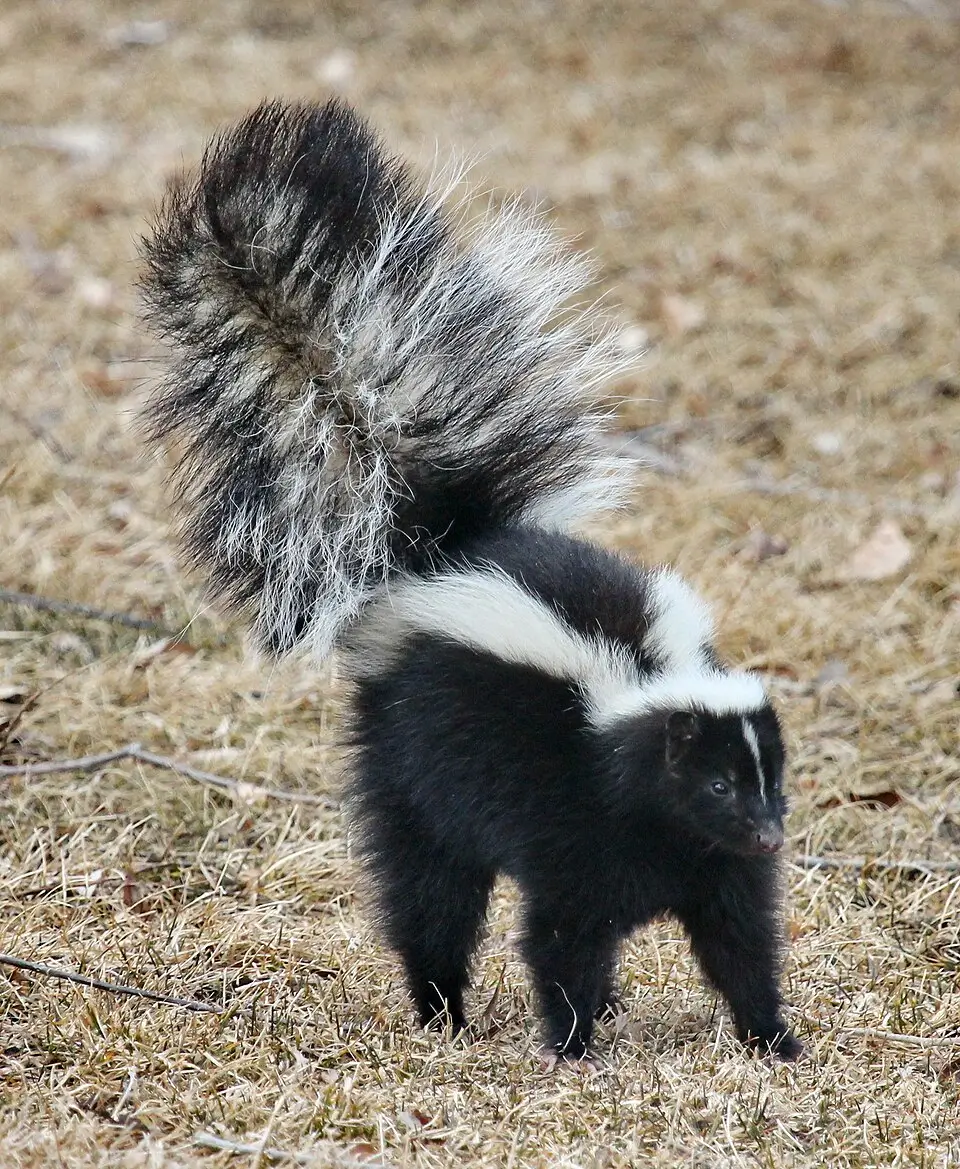
In terms of physical appearance, the striped skunk is immediately identifiable. Its base coat is jet black, contrasted by a prominent white stripe that typically begins at the top of the head and splits into two stripes running along either side of the back toward the tail. The tail itself is a dramatic plume of black and white fur. There is considerable variation among individuals — some skunks display wide stripes, others narrow ones, and some individuals may show more white or more black than average. A small white patch on the forehead is also characteristic. The animal's body is stout and low-slung, with short but strong legs equipped with curved claws well-suited for digging.
Adult striped skunks are relatively modest in size, roughly comparable to a domestic house cat, though they tend to be heavier and more robust in build. Males are generally larger than females. The skull is relatively broad, and the teeth reflect the species' omnivorous diet — a mix of sharp canines and broad molars capable of processing a wide variety of food items.
The striped skunk's most renowned biological feature is, of course, its chemical defense system. Located beneath the tail, paired anal scent glands produce a sulfur-containing chemical compound — primarily thiols and thioacetates — that can be accurately sprayed at threats from distances of up to ten or even fifteen feet. The skunk can aim with remarkable precision, and the spray causes intense irritation to the eyes, skin, and mucous membranes of any animal unfortunate enough to be targeted. Before spraying, skunks typically give clear warning signals: stamping the front feet, raising the tail, and arching the back. These warnings are worth heeding.
Striped skunks are predominantly nocturnal, spending most of their active hours between dusk and dawn. They are opportunistic omnivores with a seasonally varied diet. In warmer months, insects — especially beetles, grasshoppers, and bees — make up a significant portion of their food intake. They are well-known for digging up yellowjacket nests and consuming the larvae within. Small mammals, bird eggs, frogs, crayfish, earthworms, berries, nuts, and carrion also feature in their diet. In agricultural settings, they may occasionally raid gardens or poultry enclosures, though they also provide a valuable service by consuming large numbers of pest insects.
During winter, striped skunks do not truly hibernate in the manner of groundhogs or bears. Instead, they enter a state of torpor — a lighter form of dormancy — retreating to dens in which they may remain for weeks or months during the coldest periods. They accumulate fat reserves in autumn and may share dens communally, particularly females huddling together for warmth. Males tend to venture out during mild winter spells more frequently than females. Dens are often located in abandoned burrows, beneath buildings, in brush piles, or under rocky outcroppings.
Breeding typically occurs in late winter or early spring. After a gestation period of approximately 60 to 75 days, females give birth to litters of around four to seven young, known as kits. The kits are born helpless, with eyes and ears closed, but develop rapidly. By late summer, young skunks are typically seen following their mother on foraging trips, learning the behaviors that will carry them through their first winter.
The striped skunk has a relatively short natural lifespan in the wild, often only two to three years, though individuals in captivity or low-predation environments may live longer. Natural predators include great horned owls — one of the few predators seemingly undeterred by the skunk's chemical defenses — as well as coyotes, foxes, and bobcats. Vehicle collisions represent one of the most significant sources of mortality for skunks across their range.
Habitat & Range
The striped skunk is one of the most range-tolerant mammals in North America. Its distribution spans from southern Canada throughout the contiguous United States and into northern Mexico. It thrives in a wide variety of habitats, showing a clear preference for edge environments — areas where forests meet fields, wetlands meet uplands, or suburban neighborhoods meet natural green spaces.
In Maine, the striped skunk is found across much of the state, taking advantage of the diverse landscape the region offers. Maine's mix of agricultural land, second-growth forest, river corridors, and suburban development creates ideal conditions for a habitat generalist like the striped skunk. The state's numerous wetlands and stream corridors are particularly attractive, as these areas support the invertebrate and small vertebrate prey that skunks depend upon during the warmer months.
Skunks are not typically found in areas of dense, unbroken mature forest, as these landscapes offer limited foraging opportunities. Instead, they favor brushy fields, forest edges, hedgerows, and areas near human habitation where food sources are plentiful. Their adaptability to human-modified landscapes has allowed them to maintain healthy populations even as natural habitats have changed over generations.
Hunting Information
Hunting and trapping traditions run deep in Maine, a state with a rich outdoor heritage and more than 17 million acres of land open to hunting and related pursuits. Maine's Department of Inland Fisheries and Wildlife manages the state's wildlife resources and provides guidance on seasons, licenses, and regulations for the many species that can legally be pursued.
The striped skunk, as a furbearer and small mammal, falls within the category of species that may be subject to hunting and trapping regulations in Maine. Prospective hunters and trappers interested in pursuing striped skunks in Maine should consult the most current regulations published directly by the Maine Department of Inland Fisheries and Wildlife, as season dates, licensing requirements, and specific rules can change from year to year and must be verified through official sources.
Maine offers some of the most varied small game and furbearer hunting in the northeastern United States. The state's extensive rural and wild lands mean that skunks are accessible to hunters and trappers in many regions. Trapping has historically been the most common method for pursuing striped skunks, given the species' nocturnal habits and the practical challenges of spotting and shooting such a small, low-moving animal in the field. However, opportunistic hunting does occur, particularly during night outings targeting other species.
Hunters and trappers pursuing skunks should be well-prepared for the realities of working with this species. Proper handling techniques, protective clothing, and an understanding of skunk behavior can make the experience both safe and rewarding. The pelt of the striped skunk, while not commanding the high prices of some furbearers, has historically been used in the fur trade, and skunk fat was once valued for various practical purposes.
Conservation
The striped skunk is currently listed as a species of least concern by wildlife conservation authorities. Its broad distribution, high reproductive rate, and adaptability to human-altered environments mean that populations remain stable across most of their range. Unlike many wildlife species that have struggled in the face of habitat loss and human development, the striped skunk has in many ways benefited from the creation of edge habitats and the availability of food sources associated with human activity.
That said, skunks do face real challenges. Rabies is a significant concern for striped skunk populations, as the species is one of the primary wildlife vectors for the disease in North America. Periodic rabies epizootics can cause localized population declines. Distemper and other diseases also affect skunk populations.
Road mortality is another consistent threat, particularly in regions where skunks must cross roads frequently in search of food and mates. Habitat fragmentation, while less critical for skunks than for many forest-dependent species, can still limit movement corridors and reduce genetic exchange between populations.
Conservation of the striped skunk is best served by the same broad land stewardship principles that benefit all of Maine's wildlife: maintaining diverse habitats, preserving natural corridors, managing diseases responsibly, and ensuring that hunting and trapping activities are conducted within sustainable, science-based frameworks. Maine's Department of Inland Fisheries and Wildlife continues to play a central role in maintaining this balance.