Overview
Few sights in the natural world are as stirring as a flock of Sandhill cranes moving through an autumn sky. Their bugling calls carry across miles of open country, and their distinctive silhouettes — long necks outstretched, broad wings beating with deliberate power — have inspired wonder in observers for thousands of years. The Sandhill crane (Grus canadensis) is one of North America's most iconic birds, a living testament to the continent's wild heritage and one of the oldest bird species on Earth. Whether witnessed during a dramatic seasonal migration, encountered at a wetland staging area, or studied in the quiet solitude of a northern marsh, the Sandhill crane commands attention and respect from hunters, birdwatchers, and naturalists alike.
Across the United States and Canada, these remarkable birds have made a meaningful conservation comeback over the past several decades, transforming from a species of concern into a celebrated symbol of successful wildlife management. Today, their population numbers and broad distribution offer both ecological benefits and, in many states, sustainable hunting opportunities that connect modern sportsmen and women to one of the most ancient hunting traditions in North America.
Biological Traits
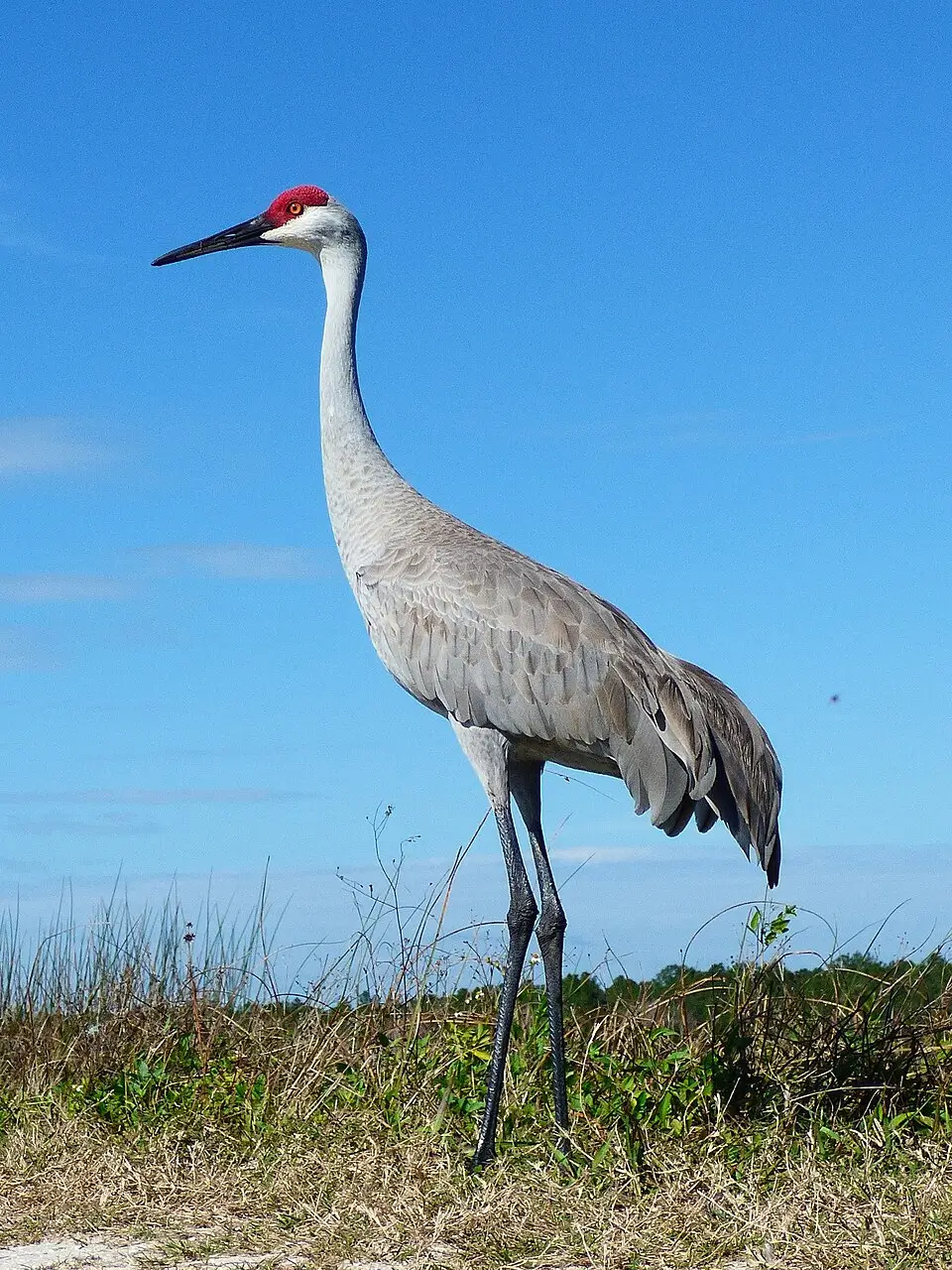
The Sandhill crane is a large, long-legged wading bird belonging to the family Gruidae — the true cranes. It is one of only two crane species native to North America, the other being the critically endangered Whooping crane (Grus americana). Adults stand roughly three to four feet tall and boast a wingspan that can reach up to six or seven feet, making them among the largest flying birds on the continent. Their plumage is predominantly gray, though individual birds often appear rust-tinged due to a behavior known as "feather painting," in which the birds preen iron-rich mud into their feathers — a trait believed to provide camouflage during the nesting season.
One of the Sandhill crane's most distinctive features is the bright red patch of bare skin on the forehead, which deepens in color during moments of excitement or aggression. Both males and females share this feature, making field identification of sex challenging without behavioral observation. Their long, pointed bills are well adapted for probing soil and shallow water in search of food, and their diet is impressively varied — encompassing grains, berries, insects, small mammals, amphibians, and aquatic invertebrates.
Sandhill cranes are renowned for their complex and elaborate courtship dances, performances that involve jumping, wing-spreading, bowing, and tossing of vegetation into the air. These displays strengthen pair bonds that are typically lifelong. Cranes are monogamous, and pairs generally remain together year-round, raising one to two chicks (called "colts") per breeding season. Young cranes remain with their parents through the first winter migration, learning critical survival knowledge along the way.
One of the most remarkable facts about this species is its extraordinary age. Fossil records have identified crane ancestors dating back approximately ten million years, with specimens closely resembling the modern Sandhill crane found in Nebraska that are roughly nine to ten million years old. This makes the Sandhill crane one of the oldest known bird species still in existence — a true living fossil that has outlasted countless other species across geological epochs.
Sandhill cranes are also notably long-lived for birds of their size. Wild individuals can live for twenty years or more, and captive birds have been recorded living even longer. This longevity, combined with their relatively slow reproductive rate, means that population management requires careful, science-based oversight.
Habitat & Range
Sandhill cranes occupy an impressively wide range across North America, with populations found from the high Arctic tundra of Alaska and northern Canada all the way down to the Gulf Coast of the southern United States, and even into parts of Cuba and Siberia. Six recognized subspecies exist, each occupying distinct geographic ranges and displaying slightly different characteristics in terms of body size and migratory behavior.
The species makes use of a diverse array of habitats throughout the year. During the breeding season, cranes favor wetland environments — freshwater marshes, bogs, wet meadows, and the shallow edges of lakes and rivers. These areas provide the seclusion and food resources necessary for successful nesting. Nests are typically large mounds of aquatic vegetation constructed in shallow water or on low, wet ground, offering protection from terrestrial predators.
During migration and winter, Sandhill cranes congregate in extraordinary numbers at key staging areas. Perhaps the most famous of these is the Platte River valley in Nebraska, where hundreds of thousands of cranes — sometimes the majority of the entire mid-continent population — gather each spring before continuing their journey northward. These staging areas serve as critical refueling stops where cranes consume waste grain from agricultural fields and roost in the shallow braided channels of the river.
The birds are strong, capable fliers and can cover enormous distances during migration. They typically travel in large flocks, using thermal updrafts to soar efficiently across the landscape, and their resonant, rattling calls can be heard from remarkable distances as flocks pass overhead.
In the northeastern United States, including New England states like Maine, Sandhill cranes are not historically common breeders, but they are occasionally observed during migration as birds move along the Atlantic Flyway. Maine, positioned in the northeasternmost corner of the contiguous United States, borders both New Hampshire and the Canadian provinces of New Brunswick and Quebec, placing it in a geographic area where wandering and migrating cranes may occasionally appear. Maine's over 17 million acres of diverse landscape — encompassing wetlands, forests, rivers, and coastlines — provides potential stopover habitat for these wide-ranging birds.
Hunting Information
Sandhill cranes are legally hunted in a number of U.S. states and Canadian provinces where populations are robust enough to support regulated harvest. Often referred to affectionately as the "ribeye of the sky" or "rib-eye of the air" by hunters who have had the privilege of pursuing them, Sandhill cranes are widely regarded as exceptional table fare — a fact that surprises many people unfamiliar with crane hunting. The breast meat is dark and richly flavored, often compared favorably to beef in both color and taste.
Hunting Sandhill cranes requires specialized knowledge, patience, and skill. Successful hunters typically employ decoys — full-body or silhouette crane decoys — and rely on calling to draw birds within range. Due to the crane's large body size, hunters typically use heavier shotgun loads than those used for ducks or geese. Pass shooting and decoying are both productive methods depending on conditions and location.
Hunting Sandhill cranes in Maine: Based on the available official information from the Maine Department of Inland Fisheries and Wildlife, specific season dates and licensing requirements for Sandhill crane hunting in Maine are not detailed in the current source data. Maine offers a wide range of hunting and fishing opportunities across its vast landscape, but prospective hunters interested in pursuing Sandhill cranes in Maine should consult the Maine Department of Inland Fisheries and Wildlife directly for the most current and accurate information regarding any applicable seasons, licenses, and regulations. Regulations for migratory birds are subject to annual review by both state and federal authorities.
Because Sandhill cranes are a migratory species, hunting them in the United States is governed at the federal level by the Migratory Bird Treaty Act, with individual states establishing specific season frameworks within federal guidelines. Hunters pursuing cranes anywhere in the U.S. are required to possess valid federal migratory bird hunting licenses in addition to any applicable state licenses — a structure that ensures consistent, science-based management across the species' entire range.
Conservation
The conservation story of the Sandhill crane is one of the great success stories in North American wildlife management. During the late nineteenth and early twentieth centuries, unregulated hunting and widespread habitat loss caused significant declines in crane populations across much of their range. Some subspecies, particularly the non-migratory populations of the southeastern United States, were reduced to dangerously low numbers.
The passage of the Migratory Bird Treaty Act in 1918 provided crucial federal protection for cranes and countless other species, halting the commercial and unregulated hunting that had driven population declines. Combined with ongoing wetland conservation efforts, habitat restoration programs, and careful population monitoring, these protections allowed Sandhill crane populations to recover substantially over the following decades.
Today, the mid-continent population of Sandhill cranes — the largest of all the populations — numbers in the hundreds of thousands, a remarkable achievement that speaks to the effectiveness of science-based wildlife management. While some subspecies, particularly the Mississippi sandhill crane, remain critically endangered and are subjects of intensive recovery programs, the species as a whole is in a far stronger position than it was a century ago.
Wildlife managers continue to monitor crane populations closely through aerial surveys, banding programs, and hunter harvest data. The regulated hunting seasons that exist in many states serve not merely as recreational opportunities but as valuable management tools that provide critical population data to biologists and help maintain crane numbers at healthy, sustainable levels relative to available habitat.
Wetland conservation remains central to the long-term security of Sandhill crane populations. Organizations focused on preserving and restoring wetland habitats — including marshes, wet meadows, and riparian corridors — directly benefit cranes and the dozens of other species that share these vital ecosystems. Hunters and conservation organizations have historically been among the most active and financially significant supporters of wetland preservation, connecting the traditions of the hunt to the broader mission of habitat stewardship.