Overview
Few birds capture the imagination of upland hunters and wildlife enthusiasts quite like the Ruffed Grouse (Bonasa umbellus). Known affectionately in hunting camps across the continent as the "king of upland game birds," the Ruffed Grouse stands as one of North America's most celebrated and challenging quarry. Whether you encounter one exploding from a dense thicket in a thunderous flush or simply observe one drumming on a fallen log in the quiet of a northern forest, the Ruffed Grouse never fails to leave a lasting impression.
In the state of Maine, the Ruffed Grouse holds a particularly special place in the hearts of hunters and naturalists alike. Maine, the largest state in the New England region and the northeasternmost state in the contiguous United States, offers over 17 million acres of some of the finest hunting and fishing opportunities in the entire country. With its vast stretches of mixed forest, dense alder runs, and regenerating clearcuts, Maine provides nearly ideal habitat for this remarkable bird. The Maine Department of Inland Fisheries and Wildlife oversees the management of this cherished species, ensuring that healthy populations remain available for generations of hunters and wildlife watchers to come.
This article explores the fascinating biology, habitat preferences, hunting traditions, and conservation status of the Ruffed Grouse — a bird that has earned its legendary status through sheer wildness, adaptability, and the heart-pounding excitement it delivers to those who pursue it.
Biological Traits
The Ruffed Grouse, Bonasa umbellus, belongs to the family Phasianidae and the order Galliformes, placing it in the same broad family as turkeys, pheasants, and quail. The genus name Bonasa is derived from the Latin word for bison, reportedly a reference to the thunderous sound produced by the bird's drumming display. The species name umbellus refers to the umbrella-like ruff of neck feathers that gives this bird its common name.
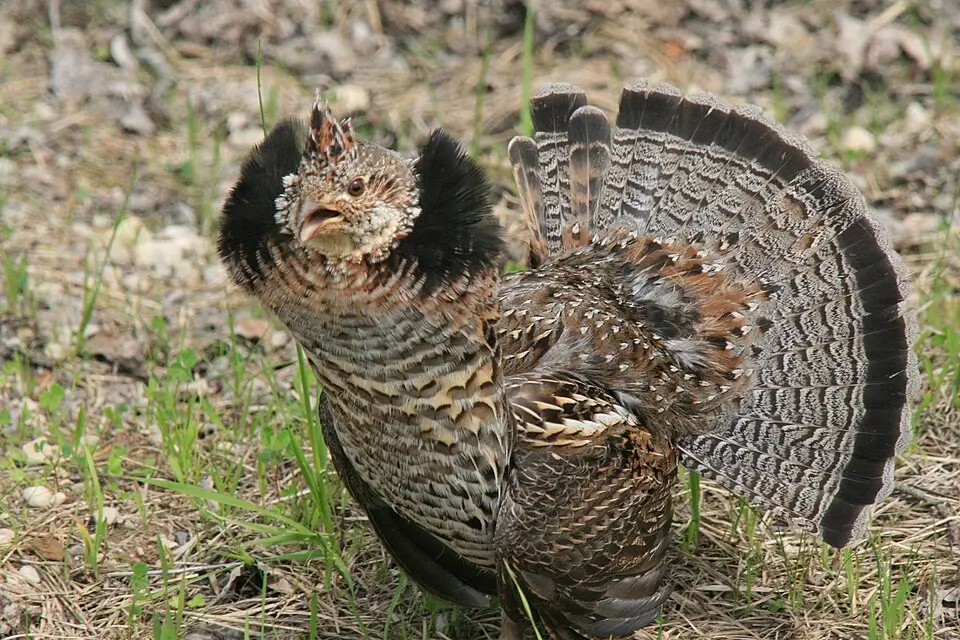
One of the most visually striking features of the Ruffed Grouse is its plumage. The species occurs in two primary color morphs — a gray phase and a brown (rufous) phase — and the prevalence of each morph tends to vary geographically. Gray-phase birds are generally more common in northern populations, while brown-phase birds appear more frequently in southern portions of the range. Regardless of color phase, all Ruffed Grouse display a beautifully barred and mottled pattern across the breast, back, and flanks that provides exceptional camouflage against the leaf-littered forest floor.
Perhaps no behavioral trait of the Ruffed Grouse is more iconic than the drumming display performed by males. A male grouse will stand atop a preferred log — known as a drumming log — and beat his wings rapidly in an accelerating series of strokes. The result is a deep, resonant thumping sound that carries surprisingly far through the forest. This drumming behavior serves primarily as a territorial and courtship signal, announcing the male's presence to both rival males and receptive females. Males may use the same drumming log for years, and these logs often become cherished landmarks for experienced hunters and birdwatchers who learn to locate them.
The Ruffed Grouse is also well known for its cryptic behavior. When approached by a predator — or a hunter — these birds will often hold remarkably tight, relying on their camouflage to remain undetected until the last possible moment. When they do flush, they do so with an explosive burst of wingbeats that startles even the most experienced hunters. This combination of tight-holding behavior and sudden, thunderous flushing is a major part of what makes hunting Ruffed Grouse such a demanding and rewarding pursuit.
Ruffed Grouse are year-round residents wherever they occur, and they demonstrate impressive adaptations for surviving harsh northern winters. In cold weather, the birds develop small comb-like projections called pectinations along the sides of their toes, which act like snowshoes to help them walk atop snow. During severe cold snaps, Ruffed Grouse will dive headfirst into soft, deep snow and burrow into insulating snow caves, sometimes remaining there for extended periods to conserve heat and energy.
The diet of the Ruffed Grouse shifts with the seasons. In summer and early fall, the birds consume a wide variety of insects, berries, leaves, and soft plant material. As winter approaches and food becomes scarce, they rely heavily on buds, catkins, and twigs — particularly those of aspen trees, which are a critical food source throughout much of their northern range.
Habitat & Range
The Ruffed Grouse is a bird of the northern and eastern forests of North America. Its range extends from Alaska and across much of Canada eastward to the Atlantic, and southward through the Appalachian Mountains into the southeastern United States. Within this vast range, the bird shows a strong preference for young to middle-aged mixed forests, particularly those with a significant component of aspen (Populus spp.).
The species thrives in areas characterized by structural diversity — patches of dense young growth interspersed with more open areas, brushy edges, alder thickets, and stands of conifers for winter cover. Regenerating clearcuts, old orchards, stream corridors, and forested hillsides all provide the mosaic of habitat types that Ruffed Grouse require across the different seasons of the year.
In Maine, the combination of extensive northern hardwood and mixed-wood forests, active timber harvesting practices that continually create patches of early successional habitat, and the state's generally cool climate creates excellent conditions for Ruffed Grouse. Maine's vast interior forests, its network of stream drainages lined with alder and willow, and its miles upon miles of regenerating forest provide a patchwork of prime grouse country that is difficult to match anywhere in the northeastern United States.
Hunting Information
The Ruffed Grouse is widely regarded as one of the premier upland game birds of North America, and Maine is among the finest destinations on the continent for pursuing this species. The state's enormous acreage of public and accessible private land, combined with healthy grouse populations in suitable habitat, makes Maine a bucket-list destination for grouse hunters from across the region and beyond.
Hunting Ruffed Grouse in Maine typically involves walking through the bird's preferred habitats — alder runs, birch thickets, regenerating cuts, and mixed hardwood edges — often with a well-trained pointing or flushing dog. The combination of a skilled bird dog working through dense cover and the sudden explosive flush of a grouse remains one of the most thrilling experiences available to any upland hunter.
The Maine Department of Inland Fisheries and Wildlife manages Ruffed Grouse hunting in the state and provides information on seasons, licensing requirements, and regulations through its official resources. Hunters interested in pursuing Ruffed Grouse in Maine are encouraged to consult the department's current regulations directly, as specific season dates, bag limits, and license requirements are subject to change and should always be verified before heading afield.
Hunters generally use lightweight shotguns — typically 20-gauge or 12-gauge — loaded with small shot sizes appropriate for upland birds. Because Ruffed Grouse typically flush at close range in dense cover, open or improved cylinder chokes are generally preferred to allow for a wider shot pattern at short distances.
Conservation
The Ruffed Grouse is not currently considered a species of conservation concern at the continental level, and its populations remain robust across much of its northern range. However, like many wildlife species, Ruffed Grouse populations are subject to periodic fluctuations, and longer-term trends in some portions of the range have prompted attention from wildlife managers and conservation organizations.
Habitat management is widely recognized as the most critical factor in maintaining healthy Ruffed Grouse populations. The birds are closely tied to early successional forest habitats, and the long-term maturation of forests across portions of their range — combined with changes in timber harvesting practices — has reduced the availability of young forest in some areas. Conservation groups and state wildlife agencies, including Maine's Department of Inland Fisheries and Wildlife, work to promote forest management practices that benefit early successional species like the Ruffed Grouse.
Hunters themselves play an important role in grouse conservation through the purchase of licenses and the support of state wildlife agencies. Organizations such as the Ruffed Grouse Society have long advocated for habitat management and research to support grouse populations across North America.
Maine's commitment to wildlife management, its vast forested landscape, and the ongoing efforts of hunters, landowners, and wildlife professionals all contribute to ensuring that the Ruffed Grouse remains a vibrant part of Maine's natural heritage for years to come.