Overview
Few animals capture the spirit of the American West quite like the mule deer (Odocoileus hemionus). With their oversized, mule-like ears, distinctive bounding gait, and preference for rugged, open country, mule deer have long been a symbol of the wide-open landscapes that stretch from the Great Plains to the Pacific coast. They are one of the most recognizable members of the deer family in North America, sharing the continent with their close relative, the white-tailed deer.
For outdoor enthusiasts, wildlife watchers, photographers, and hunters, the mule deer represents both a biological marvel and a cultural icon. Their adaptability to harsh environments — from arid desert canyons to alpine meadows above the treeline — makes them a fascinating subject of study. This article takes a closer look at the biology, habitat, hunting traditions, and conservation status of the mule deer, while also touching on what this species means in the context of states like Maine, where hunting culture runs deep even though mule deer themselves are not native residents.
Biological Traits
The mule deer is a medium-to-large member of the family Cervidae, which includes elk, moose, caribou, and other deer. Its scientific name, Odocoileus hemionus, hints at its most famous feature: "hemionus" derives from Greek roots meaning "half-mule," a nod to the species' remarkably large ears, which can rotate independently to capture sounds from multiple directions. These oversized ears give the mule deer keen hearing, a vital trait for detecting predators in open terrain.
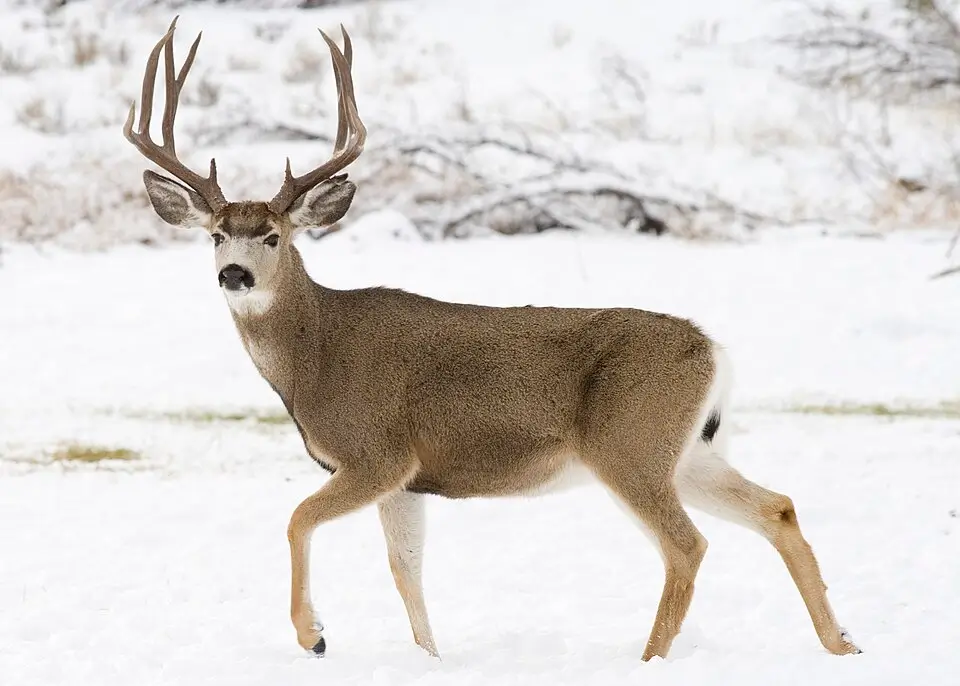
Mule deer are generally stockier than white-tailed deer, with a more compact, muscular build well-suited for navigating steep and broken country. Their coat changes seasonally, ranging from a reddish-brown in summer to a grayish-brown in winter, which helps them blend into the varied backgrounds of their habitats. One of the most distinguishing features is the tail: white with a black tip, set against a white rump patch. This contrasts with the broader, white-undersided tail of the white-tailed deer.
Antlers are another defining characteristic of mule deer bucks. Unlike the single main beam with tines branching off, as seen in white-tailed deer, mule deer antlers grow in a forked or "bifurcated" pattern, with each tine splitting into two. Antlers are shed and regrown annually, typically reaching their maximum size during the breeding season, known as the rut, which occurs in late autumn and early winter.
Perhaps the most iconic behavioral trait of mule deer is their unique form of locomotion called "stotting" or "pronking." When alarmed, mule deer bounce away on all four legs simultaneously, springing several feet off the ground with each leap. This unusual gait allows them to cover uneven terrain quickly, change direction rapidly, and survey their surroundings between bounds — a clear advantage in escaping predators such as mountain lions, coyotes, and wolves.
Mule deer are ruminants and herbivores, feeding on a wide variety of plant material. Their diet typically includes shrubs, forbs, grasses, twigs, leaves, acorns, berries, and even cacti in desert environments. They are known as "concentrate selectors," meaning they prefer high-quality, easily digestible forage rather than bulk-feeding on grasses the way cattle or elk often do. This selective feeding strategy makes them sensitive to habitat quality and seasonal vegetation changes.
Habitat & Range
Mule deer are native to western North America, with a range that extends from the coastal forests of the Pacific Northwest, through the Rocky Mountains and Great Basin, into the deserts of the Southwest, and as far north as the Yukon and as far south as northern Mexico. Several recognized subspecies occupy different regions, including the Rocky Mountain mule deer, the desert mule deer, and the black-tailed deer of the Pacific coast, which is often considered a subspecies or close relative of the mule deer.
Their habitat preferences are remarkably varied. Mule deer thrive in mountain foothills, sagebrush flats, mixed conifer forests, aspen groves, pinyon-juniper woodlands, chaparral, and high-elevation alpine zones. They are well known for their seasonal migrations, sometimes traveling great distances between summer ranges at higher elevations and winter ranges in lower valleys where snow accumulation is less severe. These migration corridors are increasingly recognized as essential to the long-term health of mule deer populations.
It is important to note that mule deer are not found in Maine or anywhere in the eastern United States as a native species. Maine, located in the northeastern corner of the country, is home to the eastern subspecies of the white-tailed deer (Odocoileus virginianus), a close relative of the mule deer. With over 17 million acres of forestland, lakes, and wild terrain, Maine offers exceptional habitat for white-tailed deer, moose, black bear, and other big game — but the mule deer remains a uniquely western animal.
Hunting Information
Mule deer are one of the most pursued big game species in North America, particularly in western states such as Colorado, Wyoming, Montana, Utah, Idaho, Nevada, Arizona, New Mexico, Oregon, and Washington. Hunting mule deer is often associated with the spot-and-stalk method, where hunters glass open country with binoculars or spotting scopes to locate animals before carefully closing the distance on foot. Their preference for open ridgelines, sage flats, and timbered slopes makes for some of the most physically demanding and rewarding hunts in the country.
Specific seasons, license requirements, and tag allocations vary widely by state and are typically managed by each state's wildlife agency. Many western states use a draw or lottery system to issue tags for premium hunting units, particularly for trophy areas. Hunters interested in pursuing mule deer should always consult the wildlife agency of the specific state where they intend to hunt for up-to-date regulations, season dates, and licensing details.
For hunters based in Maine, it is worth understanding that pursuing mule deer requires traveling out of state. Maine itself, however, offers a robust hunting tradition centered on white-tailed deer, moose, black bear, wild turkey, grouse, and waterfowl. The Maine Department of Inland Fisheries and Wildlife manages hunting and trapping seasons across the state, and Maine's reputation as "Vacationland" extends well beyond its summer beaches — its fall and winter hunting opportunities are considered among the best in the country. Maine hunters who travel west to pursue mule deer often find the experience strikingly different from hunting whitetails in the Maine North Woods, with vast vistas replacing dense forest and stalk-style hunting replacing stand hunting.
Common gear for mule deer hunting includes a flat-shooting rifle suitable for longer distances, quality optics for glassing across canyons, sturdy boots for steep terrain, and layered clothing for variable mountain weather. Archery hunters also pursue mule deer during specific seasons, often during early fall when the bucks are still in their summer feeding patterns.
Conservation
The conservation status of the mule deer is generally considered stable across much of its range, and the species is listed as "Least Concern" by international conservation bodies. However, mule deer populations have experienced fluctuations over the decades, with some regions reporting declines due to habitat loss, drought, wildfire, fragmentation from development, and disease pressures such as chronic wasting disease (CWD).
Conservation organizations, state wildlife agencies, and hunters themselves play a significant role in mule deer management. License fees and excise taxes on hunting equipment fund habitat restoration, research, and population monitoring efforts. Groups dedicated to mule deer conservation work to protect migration corridors, restore native vegetation, manage predator populations, and address threats from energy development and roadway collisions.
Migration corridor protection has become a major focus in recent years. Scientists using GPS collar data have mapped extraordinary long-distance migrations, some over 100 miles in length, revealing that mule deer rely on traditional pathways passed down across generations. Protecting these corridors, often through wildlife-friendly fencing, highway overpasses and underpasses, and conservation easements, is now recognized as essential to maintaining healthy populations.
For hunters and outdoor enthusiasts everywhere — including those in Maine — supporting science-based wildlife management, respecting regulations, and contributing to conservation organizations helps ensure that iconic species like the mule deer continue to roam the wild landscapes of North America for generations to come.