Overview
Few birds capture the spirit of the American outdoors quite like the Mourning Dove (Zenaida macroura). With its soft, mournful cooing echoing across fields, farmlands, and forest edges from coast to coast, this slender, elegant bird has become a fixture of the North American landscape. Whether you're a dedicated wing shooter, a casual backyard birdwatcher, or simply someone who appreciates the rhythms of the natural world, the Mourning Dove holds a special place in the tapestry of American wildlife.
Across the United States, the Mourning Dove is widely regarded as the most harvested migratory game bird, with millions of hunters taking to the fields each autumn in pursuit of this fast-flying, challenging target. Yet beyond its appeal to hunters, the Mourning Dove is a fascinating creature in its own right — a species that has adapted remarkably well to human-altered landscapes while maintaining a lifestyle deeply rooted in ancient avian instincts. From the sun-scorched deserts of the Southwest to the rocky coastlines of New England, including the forests and open lands of Maine, the Mourning Dove's range and resilience tell a remarkable story of survival and adaptability.
This article explores the biology, habitat preferences, hunting traditions, and conservation status of one of North America's most beloved and recognizable birds.
Biological Traits
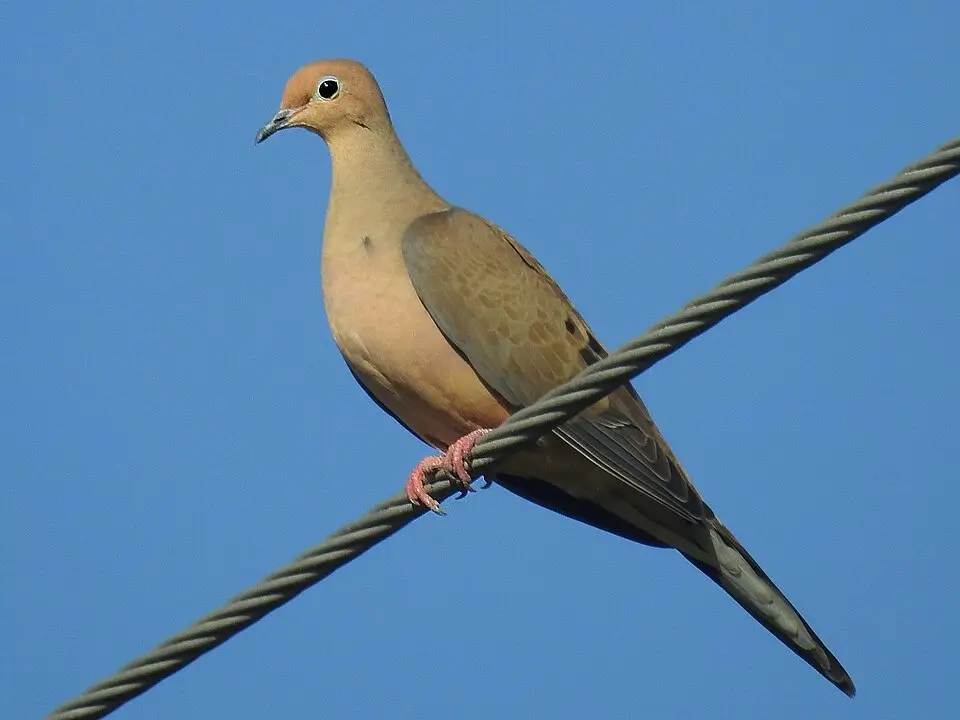
The Mourning Dove (Zenaida macroura) belongs to the family Columbidae, which includes all pigeons and doves worldwide. It is a medium-sized bird, sleek and streamlined, with a small rounded head, a long tapered tail, and soft pinkish-buff plumage accented by subtle iridescent patches on the neck. The wings feature distinctive dark spots, and the tail feathers are edged in white — a feature that flashes prominently during flight and makes the bird instantly recognizable.
One of the Mourning Dove's most distinctive characteristics is its flight. When flushed or startled, a dove launches with an explosive burst of wingbeats that produces a sharp, whistling sound — a phenomenon caused by air rushing through the bird's primary feathers. In sustained flight, Mourning Doves are extraordinarily fast and agile, capable of reaching speeds that challenge even experienced wing shooters. This combination of speed, erratic flight patterns, and relatively small size makes the Mourning Dove one of the most demanding and rewarding targets in upland game bird hunting.
The bird's name derives from its call — a soft, drawn-out "coo-OO-oo-oo" that many people find plaintive or melancholy, evoking quiet mornings and the peacefulness of rural life. This vocalization is produced primarily by males and plays a central role in courtship behavior.
Mourning Doves are prolific breeders. A single pair may raise multiple broods in a single breeding season, sometimes nesting as many as five or six times between spring and early fall. The nest itself is a loosely constructed platform of twigs, usually built in a tree, shrub, or occasionally on the ground. The female typically lays two white eggs per clutch, and both parents share incubation duties. Chicks, known as squabs, hatch after roughly two weeks and develop rapidly, often leaving the nest within two weeks of hatching.
Unlike many birds, Mourning Doves feed their young "crop milk" — a protein- and fat-rich secretion produced in the crop of both male and female parents. This unique nutritional strategy gives squabs a strong start and contributes to the species' remarkable reproductive success.
As granivores, Mourning Doves feed almost exclusively on seeds, which make up the vast majority of their diet. They are ground feeders, often foraging in open areas such as agricultural fields, roadsides, and open woodlands. Common food sources include weed seeds, grain crops such as corn and millet, and wild grasses. Because doves lack a true gizzard capable of grinding hard seeds, they frequently ingest small stones and grit to aid digestion — a behavior known as geophagy.
Habitat & Range
The Mourning Dove enjoys one of the broadest ranges of any bird in North America. It can be found from southern Canada through the contiguous United States, Mexico, and into Central America and the Caribbean. As a migratory species, northern populations move southward in the fall, while southern populations may remain year-round. The subspecies Zenaida macroura carolinensis, found across the eastern United States and Canada, is the most commonly encountered form in the northeastern part of the country.
Mourning Doves thrive in open and semi-open environments. Agricultural lands, grasslands, open woodlands, suburban neighborhoods, and the edges between forests and clearings all provide suitable habitat. They favor areas with access to open ground for foraging, nearby trees or shrubs for perching and nesting, and reliable water sources for drinking.
In Maine, the northeasternmost state in the contiguous United States, Mourning Doves are present primarily during the warmer months, arriving in spring and departing as temperatures drop in the fall. Maine's diverse landscape — encompassing more than 17 million acres of forests, agricultural areas, open fields, and coastal terrain — provides a mosaic of suitable habitats for doves during the breeding and early migration seasons. Open farmlands in southern and central Maine are particularly attractive to foraging doves, as are the edges of woodlots, orchards, and areas with abundant weed seed production.
Maine borders New Hampshire to the west and shares borders with the Canadian provinces of New Brunswick and Quebec to the northeast and northwest, and its geography places it at the northern edge of the Mourning Dove's regular breeding range. As a result, dove populations in Maine tend to be less dense than in more southerly states, though the birds are reliably present during late summer and early fall — a period that coincides with hunting seasons in many parts of the country.
Hunting Information
The Mourning Dove holds a storied place in American hunting culture. Dove hunting is a cherished tradition across the United States, particularly in the South and Midwest, where large concentrations of birds gather in harvested grain fields during the early fall season. The combination of social camaraderie, warm weather, and fast shooting action makes dove season a beloved opener for many hunters each year.
From a purely technical standpoint, hunting Mourning Doves is widely considered one of the most challenging forms of wing shooting available to American hunters. Their speed, agility, and ability to change direction unpredictably demand sharp reflexes, practiced shooting form, and patience. Hunters typically position themselves near food sources, water, or known flight corridors, waiting for birds to pass within range.
For hunters interested in pursuing Mourning Doves in Maine, it is essential to consult the Maine Department of Inland Fisheries and Wildlife for the most current and accurate information regarding season dates, bag limits, licensing requirements, and any applicable regulations. Maine's hunting framework is administered by the Maine Department of Inland Fisheries and Wildlife, which provides a wealth of resources for hunters of all experience levels. Maine is renowned for offering some of the best hunting and fishing opportunities in the country, and the Department works diligently to manage wildlife populations responsibly for both current and future generations.
Because the Mourning Dove is classified as a migratory bird, its management falls under the jurisdiction of the U.S. Fish and Wildlife Service at the federal level, with individual states setting their own season frameworks within federal guidelines. Hunters pursuing doves anywhere in the United States are generally required to possess both a valid state hunting license and, in many cases, a federal Migratory Bird Hunting and Conservation Stamp (commonly known as the Duck Stamp). Specific licensing and permit requirements vary by state, and hunters should always verify current regulations before heading afield.
Conservation
Despite the enormous hunting pressure the species faces — with an estimated harvest of tens of millions of birds annually across the United States — the Mourning Dove remains one of the most abundant birds in North America. This remarkable resilience is largely attributable to the species' prolific breeding habits. With the capacity to produce multiple broods per year, dove populations are capable of sustaining significant annual harvests without long-term population decline when managed appropriately.
The U.S. Fish and Wildlife Service, in cooperation with state wildlife agencies, monitors Mourning Dove populations through annual breeding surveys and banding programs. These data-driven management tools ensure that hunting seasons and bag limits remain sustainable and that population trends are tracked over time. The Mourning Dove's adaptability to human-modified landscapes — including agricultural fields and suburban areas — has also helped it maintain strong numbers even as some other migratory bird species have faced declines.
Conservation of Mourning Dove habitat remains an important priority. Maintaining open agricultural landscapes, hedgerows, and brushy field edges supports not only doves but a wide variety of other wildlife species as well. Initiatives that promote responsible farming practices, land stewardship, and the preservation of open spaces contribute meaningfully to the long-term health of dove populations.
Hunters themselves have historically played a vital role in wildlife conservation through the funding mechanisms established by the Federal Aid in Wildlife Restoration Act (commonly known as the Pittman-Robertson Act), which directs excise taxes on firearms and ammunition toward state wildlife management programs. Every box of shotgun shells purchased by a dove hunter contributes to this conservation funding stream, making sport hunters important partners in the broader effort to sustain healthy wildlife populations.
Conclusion
The Mourning Dove is far more than a backyard visitor or a target on the shooting range. It is a symbol of the enduring connection between people and the natural world — a bird whose gentle call has accompanied generations of Americans through the changing seasons. Whether you encounter one perched on a telephone wire at dawn, cooing softly in the morning stillness, or streaking low across a harvested cornfield just ahead of your shooting position, the Mourning Dove never fails to make an impression.
For hunters in Maine and across the country, the Mourning Dove offers an accessible, challenging, and deeply satisfying hunting experience rooted in long tradition. And for all who share the outdoors, this resilient little bird serves as a reminder of nature's capacity to thrive and adapt — given proper care, respect, and stewardship.