Overview
Few birds in the sporting world carry as much cultural mystique as the common snipe. Long the subject of a classic practical joke — the infamous "snipe hunt" that has sent generations of unsuspecting campers wandering through the dark with flashlights and paper bags — the common snipe is very much a real bird, and a genuinely remarkable one at that. Gallinago gallinago, as it is known scientifically, is a medium-sized wading bird belonging to the sandpiper family Scolopacidae. It is a prized game bird across much of its range, admired not only for its exceptional table quality but also for the extraordinary challenge it presents to hunters and birders alike.
The common snipe is distributed across a wide swath of the Northern Hemisphere, from the British Isles and Western Europe through Asia, and it visits North America as a migratory species during specific seasons. Its secretive habits, cryptic plumage, and famously erratic escape flight have earned it a well-deserved reputation as one of the most difficult birds to hunt — a difficulty so legendary that the term "sniper," used to describe a highly skilled marksman, is said by many etymologists to derive directly from the challenge of shooting this elusive bird.
For hunters in states like Maine, the common snipe represents a unique and somewhat underappreciated opportunity. Maine, with its vast stretches of wetlands, bogs, and marshy fields — spread across more than 17 million acres of prime wildlife habitat — provides excellent stopover and foraging habitat for migrating snipe. The state's reputation as "Vacationland" extends well beyond its beaches and summer tourism; it is a destination for hunters pursuing some of the finest wildlife experiences in the eastern United States.
Biological Traits
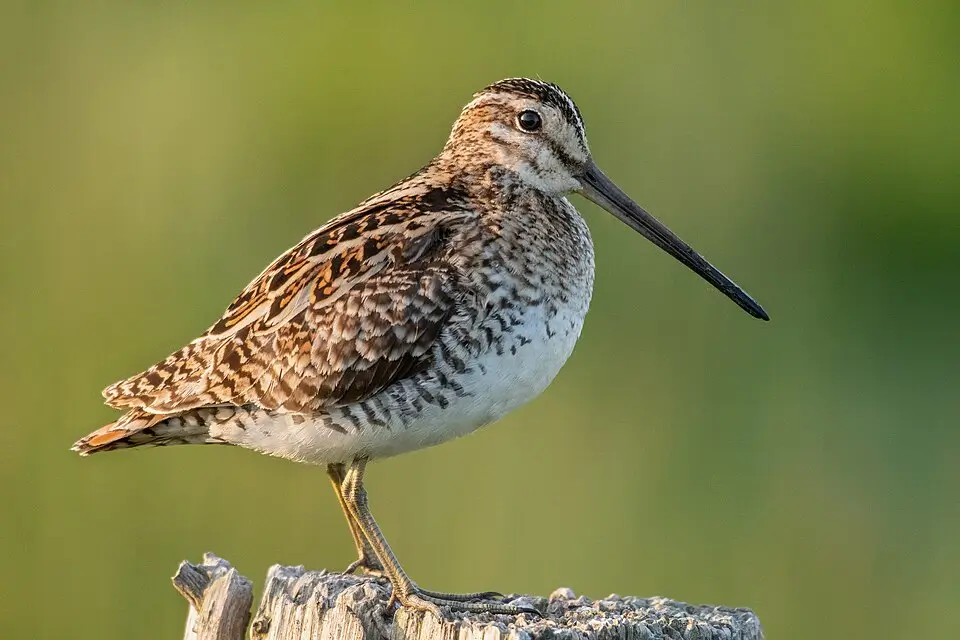
The common snipe is a study in evolutionary adaptation. Its body is built for a life spent probing soft, waterlogged soils in search of invertebrate prey. The bird's most immediately recognizable feature is its remarkably long, straight bill, which can measure nearly one-third of the bird's total body length. This bill is not merely a simple probe — the tip is flexible and richly supplied with sensory nerve endings called Herbst corpuscles, which allow the snipe to detect prey items such as earthworms, insect larvae, crustaceans, and mollusks deep within the mud, without ever needing to see them directly. This adaptation is shared with other members of the woodcock and snipe family and represents a highly refined form of tactile foraging.
The plumage of the common snipe is a masterpiece of natural camouflage. The bird's upperparts are streaked and barred in various shades of brown, buff, black, and cream, creating a pattern that mimics dead grass, leaf litter, and the broken shadows of marsh vegetation with extraordinary fidelity. Pale stripes run along the crown and back, contributing further to the disruptive coloration. When a snipe crouches motionless in cover, it becomes nearly invisible against the ground — a survival strategy that the bird relies upon heavily before resorting to flight.
When flushed, the common snipe transforms instantly from a stationary, invisible object into a blur of chaotic motion. The bird launches into the air with a rasping, scratchy call — often transcribed as "scaipe" — and immediately begins a series of rapid, zigzagging twists and turns that make it exceptionally difficult to track with a shotgun. This evasive flight is not random; it is a refined anti-predator behavior refined over millennia of coexistence with hawks, falcons, and other aerial predators. The speed and unpredictability of a flushed snipe is the primary reason the bird commands such respect among wingshooters.
One of the most extraordinary behavioral traits of the common snipe is its aerial display, known as "drumming" or "winnowing." During courtship, the male performs steep aerial dives, and as air rushes over the two stiffened outer tail feathers, which are held out at an angle, a haunting, throbbing sound is produced — a sound created not by the syrinx (the bird's vocal organ) but entirely by the mechanical vibration of feathers in the wind. This otherworldly sound, heard most commonly at dusk and dawn during the breeding season, is one of the more remarkable natural acoustic phenomena associated with any North American game bird.
Habitat & Range
The common snipe occupies a broad global range, breeding across much of Europe and Asia and wintering in Africa, southern Asia, and parts of the Americas. In North America, the species is widely distributed as a migratory visitor, moving through a variety of wetland habitats during spring and fall migration, and overwintering in the southern United States and Central America.
The bird is intimately associated with wet, open habitats. It favors areas with soft, probe-able soils — wet meadows, bogs, fens, marshes, the margins of lakes and ponds, flooded agricultural fields, and tidal flats. The common snipe tends to avoid densely wooded areas, preferring instead the open or semi-open conditions where it can both feed effectively and detect approaching danger. Emergent vegetation, such as rushes, sedges, and grasses, provides crucial cover, and the bird is rarely found far from some form of protective vegetation.
In Maine, the combination of northern latitude, extensive freshwater wetlands, bogs, and coastal marsh systems creates excellent habitat for migrating snipe. Maine's position at the northeastern corner of the contiguous United States places it squarely along the Atlantic Flyway, one of the major migratory corridors for shorebirds and waterfowl in eastern North America. Birds moving southward from their Canadian and Arctic breeding grounds regularly pass through Maine's wetlands during autumn migration, pausing to feed and rest before continuing their journey.
Hunting Information
The common snipe has a long and distinguished history as a game bird in both Europe and North America. In Britain, snipe shooting was once considered a pinnacle of upland bird hunting skill, and the challenge of consistently bagging snipe earned hunters who could do so the title of "sniper" — a term that eventually migrated into military usage.
Hunting common snipe demands a combination of patience, fieldcraft, and exceptional shooting ability. Because the bird relies on cryptic coloration and stillness as its first line of defense, hunters must often nearly step on a snipe before it flushes. The explosive, erratic flush that follows gives the shooter only a brief window — often less than two seconds — before the bird is out of range or obscured by cover. Many experienced wingshooters consider snipe among the most challenging birds to consistently hit, ranking them alongside woodcock and ruffed grouse in terms of difficulty.
Dogs trained for flushing and retrieving are valuable companions in snipe hunting. Spaniels, in particular, excel at working through the thick, wet vegetation that snipe prefer, both for flushing birds and for recovering downed birds in heavy cover. Pointing breeds can also be effective, and watching a dog work a snipe marsh is a genuinely memorable hunting experience.
For hunters in Maine, the state's Department of Inland Fisheries and Wildlife oversees hunting regulations, and Maine's extensive wetland systems — part of those celebrated 17 million-plus acres of wildlife habitat — offer meaningful opportunities to encounter migrating snipe during their autumn passage. As with all migratory shorebirds in the United States, snipe hunting is regulated under federal migratory bird laws, and hunters should always consult the current year's regulations for up-to-date license requirements, season dates, and bag limits before heading afield.
Traditional snipe hunting attire leans toward waterproof boots and clothing appropriate for wet, often cold, marsh conditions. Hunters should be prepared to walk extensively through challenging terrain, as snipe can be widely scattered and require hunters to cover significant ground.
Conservation
The common snipe remains a relatively widespread and numerous species across its global range, and is not currently listed as threatened or endangered. However, like many wetland-dependent species, it faces ongoing pressures from habitat loss and degradation. The draining and conversion of wetlands for agriculture and development has reduced available snipe habitat in many parts of its range, particularly in Western Europe.
Conservation efforts that benefit wetland ecosystems broadly — including wetland restoration projects, sustainable agriculture initiatives that retain wet meadows and marshy margins, and the protection of key migratory stopover sites — directly benefit the common snipe and the many other species that share its habitat. Organizations focused on waterfowl and shorebird conservation, as well as state wildlife agencies like Maine's Department of Inland Fisheries and Wildlife, play important roles in monitoring snipe populations and maintaining the habitat conditions they depend upon.
Regulated hunting, conducted responsibly within established frameworks of migratory bird law, remains compatible with healthy snipe populations. The hunting community has historically been among the most active supporters of wetland conservation, recognizing that protecting habitat is ultimately the foundation of sustainable wildlife populations.