Overview
Few waterfowl command the attention and admiration of coastal hunters and wildlife enthusiasts quite like the Common eider (Somateria mollissima). As the largest duck native to the Northern Hemisphere, this remarkable sea duck has carved out an iconic place in the natural heritage of cold northern coastlines, arctic tundra, and rocky island shores. From its distinctive plumage and fascinating social behavior to its legendary down feathers and rich cultural history, the Common eider stands apart as one of the most compelling waterfowl species in the world.
For hunters and naturalists in Maine — a state whose rugged Atlantic coastline stretches for thousands of miles and whose offshore islands dot the Gulf of Maine — the Common eider is a particularly significant bird. Maine represents some of the most important Common eider habitat in the eastern United States, and the species is deeply woven into the state's outdoor traditions and coastal identity. Whether you are a devoted sea duck hunter, a birder scanning rocky ledges through binoculars, or simply a curious observer of the natural world, understanding the Common eider is a rewarding endeavor.
Biological Traits
The Common eider, known scientifically as Somateria mollissima, belongs to the family Anatidae, the large and diverse family that includes all ducks, geese, and swans. The genus name Somateria comes from the Greek words for "body" and "wool," a fitting reference to the bird's famously dense and insulating plumage — particularly the extraordinary down feathers that have made this species famous throughout human history.
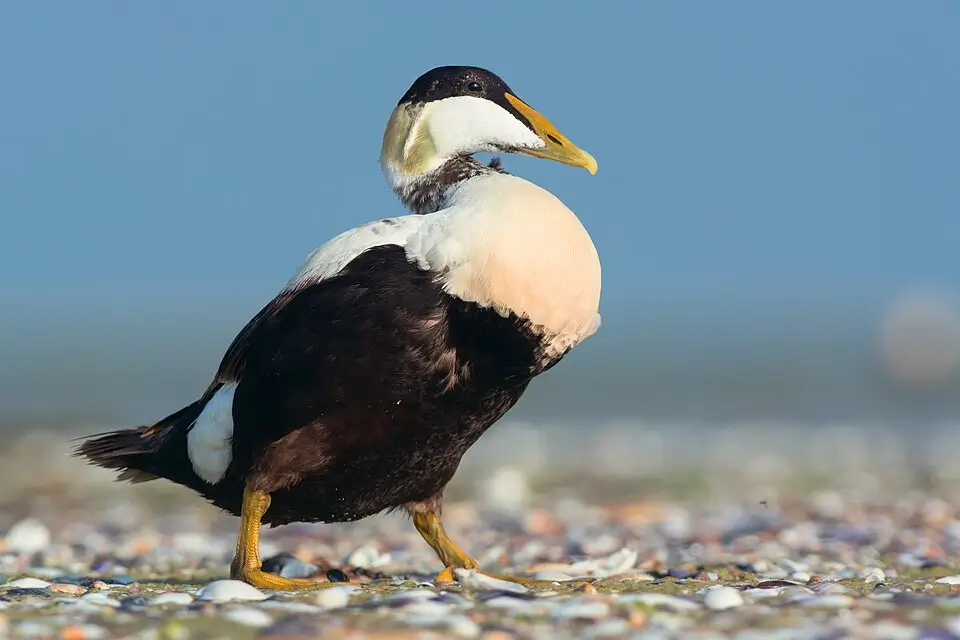
In terms of size, the Common eider is genuinely impressive among ducks. Adult males are boldly patterned birds, featuring striking black-and-white plumage with a distinctive pale green wash on the back of the head and neck. The male's bill is long and wedge-shaped, exhibiting a characteristic sloping profile that extends seamlessly up the forehead — a feature unique to eiders and useful for field identification. During the breeding season, the male's colors are vivid and unmistakable.
Female Common eiders, by contrast, wear the cryptic brown and buff barring typical of many female ducks — a practical adaptation that provides camouflage while incubating eggs in open nesting sites. Despite the more understated appearance, female eiders possess a stately, robust beauty of their own, with the same characteristic bill shape found in males.
One of the most celebrated characteristics of the Common eider is its down. Eider down — the soft, fluffy under-feathers that females pluck from their own breasts to line their nests — is among the finest natural insulating materials known to science. Lightweight, compressible, and extraordinarily warm, eider down has been harvested by human communities in Iceland, Scandinavia, and other northern regions for centuries. This remarkable material has been used in everything from sleeping bags and pillows to the finest cold-weather clothing.
Common eiders are highly social birds, often seen in large rafts on the water outside of the breeding season. They are strong, powerful swimmers and divers, using their wings underwater to pursue prey. Their diet consists primarily of marine invertebrates — mussels, clams, sea urchins, starfish, crabs, and other shellfish — which they locate and retrieve by diving to the seafloor in coastal shallows.
Vocalizations also set the Common eider apart. The male produces one of the most distinctive and memorable sounds in all of North American waterfowl — a soft, cooing call that has been described as an expression of surprised delight, often rendered phonetically as "ah-OOO." This call carries across the water on a still morning and is a defining sound of the northern coast.
Habitat & Range
The Common eider is a bird of the high north, with a circumpolar distribution that spans arctic and subarctic regions across North America, Europe, and Asia. In North America, the species nests along coastlines from Alaska across northern Canada and down through parts of the northeastern United States, including Maine. Outside the breeding season, eiders range along coastlines, congregating in areas with abundant shallow-water invertebrate prey.
Maine holds a special place in the range of the Common eider. The state's extensive and largely undeveloped coastline, with its thousands of offshore islands, ledges, and rocky shores, provides vital nesting and wintering habitat. The Gulf of Maine is one of the most biologically productive marine systems on the Atlantic coast, and the rich mussel beds and other invertebrate communities found there provide year-round food resources for eiders.
The northeastern character of Maine — its cold waters, rocky substrate, and relatively low levels of coastal development compared to areas further south — makes it a stronghold for Common eiders in the contiguous United States. Colonies of nesting eiders can be found on many of the state's coastal islands, where females gather in sometimes impressive concentrations to raise their young in relative safety.
During winter, Common eiders that breed at higher latitudes move south along the Atlantic coast, and Maine's coastal waters serve as important wintering grounds as well. Flocks of eiders riding the swells offshore, diving for mussels and other shellfish, are a classic winter scene along the Maine coast. Their large size, distinctive profile, and often impressive numbers make them one of the most conspicuous waterfowl species on the winter coastline.
Hunting Information
Sea duck hunting is a beloved tradition along the Maine coast, and the Common eider is among the most sought-after species by dedicated sea duck hunters. Pursuing eiders on the open ocean, often in cold, challenging conditions, is a quintessentially Maine experience that demands skill, preparation, and a deep appreciation for coastal environments.
Maine offers some of the best hunting and fishing opportunities in the country, and the state's Department of Inland Fisheries and Wildlife oversees hunting regulations and licensing for waterfowl, including sea ducks such as the Common eider. Hunters interested in pursuing Common eiders in Maine should consult the Maine Department of Inland Fisheries and Wildlife for current season dates, bag limits, licensing requirements, and any specific regulations applicable to sea duck hunting in coastal zones, as these details are subject to change and must be verified through official sources before any hunting activity.
Sea duck hunting for Common eiders typically involves hunting from boats or rocky shore positions, often using large decoy spreads to attract birds. The birds' tendency to raft in large numbers and their flight patterns along coastlines and around headlands make for challenging and exciting shooting. Hunters must be well-prepared for the physical demands of cold-weather marine environments, including rough seas, wind, and the practicalities of boat-based hunting.
Because Common eiders are large, robust birds, proper equipment — including appropriate loads and a reliable shotgun — is important for ethical and effective hunting. The tradition of sea duck hunting in Maine is part of a broader outdoor culture that values fair chase, conservation, and a genuine connection to the natural landscape.
Federal migratory bird regulations, administered by the U.S. Fish and Wildlife Service, also apply to Common eider hunting, and hunters must possess appropriate federal and state licenses and stamps. As with all migratory waterfowl hunting, compliance with both state and federal regulations is essential.
Conservation
The Common eider is a species that has experienced significant population fluctuations over time. Historically, eider populations were impacted by hunting and egg collection, and the species was heavily reduced in some areas. With the advent of modern wildlife management and migratory bird protections, Common eider populations have recovered substantially in many parts of their range.
Conservation of the Common eider is closely tied to the health of marine ecosystems. Because the species depends heavily on shellfish and marine invertebrates, the quality and productivity of coastal waters directly affects eider populations. Ongoing monitoring by wildlife agencies, conservation organizations, and researchers helps ensure that hunting pressure and habitat conditions are managed in ways that support long-term population health.
In Maine, the presence of healthy nesting colonies and robust winter populations is a testament to the success of conservation efforts and the quality of the state's coastal environment. Hunters, naturalists, and conservation organizations alike share a common interest in maintaining the conditions that allow Common eiders to thrive along the Maine coast and beyond.
The Common eider also holds cultural and economic significance in communities where eider down is harvested sustainably — most notably in Iceland — providing a model for how wildlife can be valued and protected while supporting local livelihoods.