Overview
Among the diving ducks that grace the coastal waters and inland lakes of North America, few are as striking or as intriguing as the Black scoter (Melanitta americana). Known for its bold plumage and robust, sea-going nature, the Black scoter is a bird that captivates both birdwatchers and waterfowl hunters alike. It belongs to a group of sea ducks collectively known as scoters, and it holds a respected place in the traditions of coastal waterfowl hunting across the northeastern United States — including the rugged and beautiful state of Maine.
The Black scoter is sometimes called the "butter bill" or "common scoter" in colloquial usage, owing in part to the distinctive knobbed, orange-yellow bill found on adult males. It is a hardy bird, built for life on open water, capable of diving to considerable depths in pursuit of its preferred foods. Whether riding swells on the open Atlantic or clustering in large rafts just offshore, the Black scoter is a symbol of wild, windswept coastlines and untamed natural landscapes.
This article takes a comprehensive look at the Black scoter — its biology, behavior, habitat, its role in waterfowl hunting culture in states like Maine, and its conservation status.
Biological Traits
The Black scoter (Melanitta americana) is a member of the family Anatidae, the broad family of birds that encompasses ducks, geese, and swans. Within that family, it belongs to the tribe of sea ducks — a group of diving ducks adapted to saltwater and deep freshwater environments.
Appearance
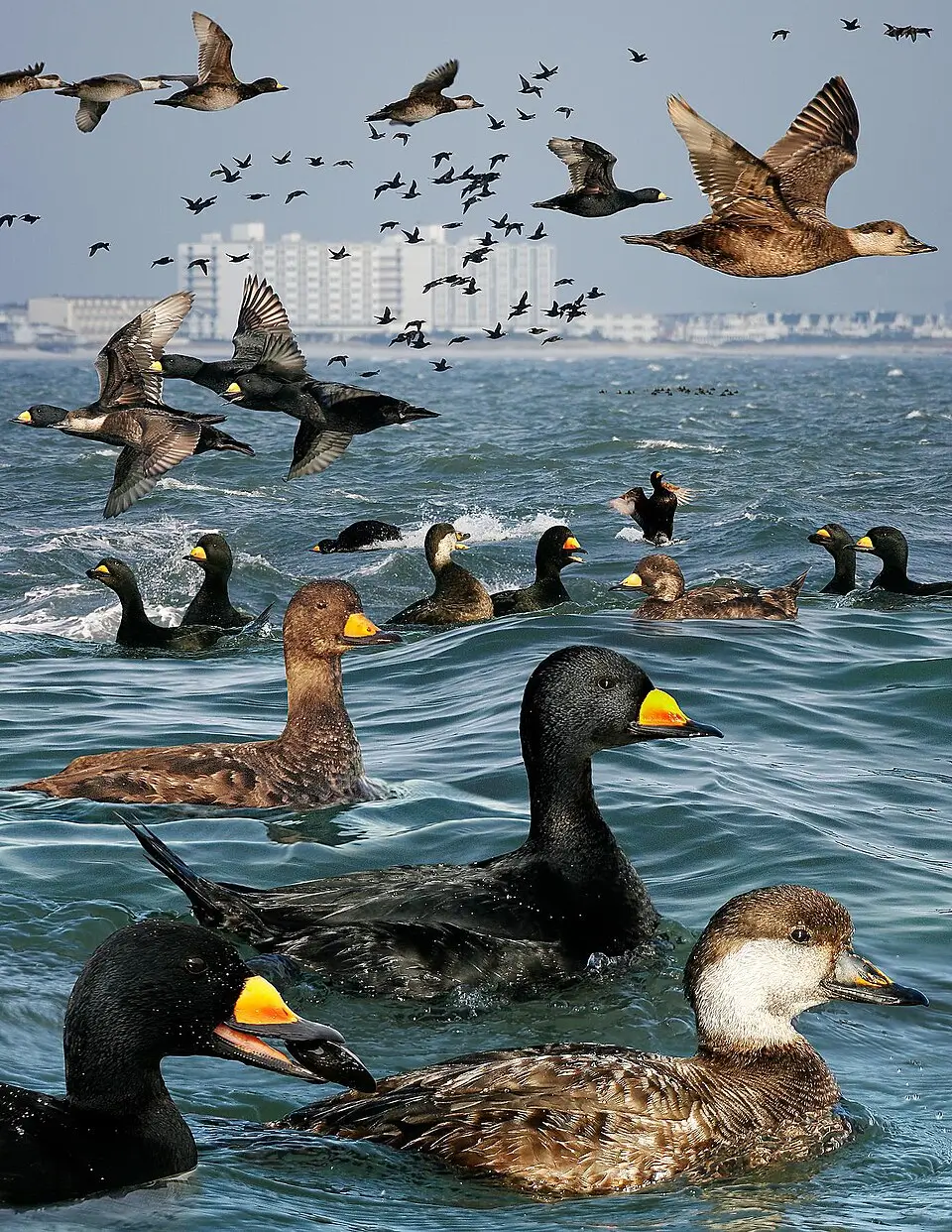
The adult male Black scoter is one of the most visually distinctive ducks in North America. Its plumage is almost entirely jet black, making it one of the few truly all-black ducks on the continent. The most notable feature of the male is its bill: a large, bulbous, orange-yellow knob sits prominently at the base of the bill, giving the bird an immediately recognizable silhouette. This feature is so characteristic that it has earned the bird its colloquial nickname "butter bill."
Female Black scoters, by contrast, are considerably more subdued in appearance. They exhibit dark brownish-black plumage on their upperparts, with notably paler, buffy-white cheeks and throat that contrast sharply against the darker cap on their head. This contrast is a reliable field identification mark for females and immature birds. Females lack the prominent knob and coloration of the male's bill.
Both sexes are stocky, medium-to-large ducks with relatively short, thick necks and rounded heads. In flight, they appear compact and powerful, often traveling in low, fast-moving lines over the water's surface. Their wingbeats are rapid, and flocks often form loose, undulating lines or clusters.
Behavior and Diet
Like all scoters, the Black scoter is a highly accomplished diver. It feeds primarily on mollusks, crustaceans, and other aquatic invertebrates, using its powerful wings to propel itself underwater. Mussels, clams, and other bivalves form a significant portion of its diet, and the bird's strong, specialized bill is well suited for prying open and crushing hard-shelled prey. In freshwater environments, particularly during the breeding season, Black scoters may also consume aquatic insects, small fish, and plant material.
Black scoters are gregarious birds, particularly outside of the breeding season. During fall, winter, and migration, they gather in large flocks — known as rafts — on coastal bays, estuaries, and nearshore ocean waters. These rafts can number in the hundreds or even thousands of birds, making them a spectacular sight for anyone fortunate enough to witness them.
Reproduction
The Black scoter breeds primarily in subarctic and boreal regions. Nesting typically occurs near freshwater lakes and ponds in northern Canada and Alaska. The female constructs a nest on the ground, usually concealed in dense vegetation near water, and lines it with down feathers. A typical clutch consists of several eggs, which the female incubates largely on her own. Ducklings are precocial — meaning they are relatively mobile and independent shortly after hatching — and are led to water quickly after birth.
Scientific Classification
- Kingdom: Animalia
- Phylum: Chordata
- Class: Aves
- Order: Anseriformes
- Family: Anatidae
- Genus: Melanitta
- Species: M. americana
Habitat & Range
The Black scoter occupies a broad range across North America, with distinct breeding and wintering areas connected by well-established migratory routes.
Breeding Range
During the summer months, Black scoters breed across a vast swath of northern North America. Their breeding range extends from western Alaska eastward across northern Canada, including portions of the Yukon, Northwest Territories, northern Quebec, and Labrador. They favor subarctic tundra and boreal forest environments, nesting near shallow ponds, lakes, and slow-moving rivers where aquatic food sources are abundant. The remote and often inaccessible nature of their breeding grounds means that detailed studies of their nesting behavior can be challenging to conduct.
Wintering Range
Come autumn, Black scoters undertake substantial migrations southward along both the Atlantic and Pacific coasts of North America. On the Atlantic coast, they are a familiar sight from the Gulf of St. Lawrence south to the Carolinas and beyond, with large concentrations found along the coast of New England. Maine, with its extensive and rugged coastline stretching along the Gulf of Maine, is an important area for wintering and migrating Black scoters. The birds favor nearshore marine environments, particularly shallow coastal bays, estuaries, and ocean inlets where their preferred invertebrate prey is abundant.
On the Pacific coast, Black scoters winter from Alaska south through British Columbia, Washington, Oregon, and California. Inland sightings are less common but do occur, particularly during migration, on large lakes and reservoirs.
Maine's Coastal Importance
Maine's geography makes it a particularly significant location for Black scoters and other sea ducks. With over 3,500 miles of tidal coastline — one of the most irregular and richly varied coastlines in the United States — Maine offers an enormous amount of habitat for diving ducks. Rocky headlands, protected coves, tidal flats, and nearshore Atlantic waters all provide foraging and resting habitat for scoters moving through or wintering along the coast. The cold, productive waters of the Gulf of Maine are rich in the mollusks and invertebrates that Black scoters depend upon.
Hunting Information
The Black scoter has a long history as a game bird in North America. Sea duck hunting, including hunting for scoters, is a cherished tradition in many coastal communities, particularly in the northeastern United States and Atlantic Canada. For hunters willing to brave cold temperatures, rough seas, and challenging conditions, sea duck hunting offers an exciting and uniquely demanding outdoor experience.
Hunting in Maine
Maine is widely regarded as one of the premier destinations for sea duck hunting on the East Coast. The state's extensive coastline, abundant sea duck populations, and rich hunting heritage make it a natural draw for waterfowl hunters seeking scoters, eiders, long-tailed ducks, and other species. The Maine Department of Inland Fisheries and Wildlife oversees hunting regulations in the state and notes that Maine offers some of the best hunting and fishing opportunities in the country, with over 17 million acres available to outdoor enthusiasts.
Sea duck hunting in Maine typically involves boat-based hunting along the coast or from shore points and rocky ledges where birds are known to fly. Decoys are commonly used to attract scoters into range, and hunters often set up in areas where birds are naturally concentrated. The Black scoter, along with the Surf Scoter and White-winged Scoter, are the three scoter species commonly encountered by Maine hunters.
It is important for hunters to consult the most current Maine Department of Inland Fisheries and Wildlife regulations before pursuing Black scoters or any other sea ducks. Regulations regarding seasons, bag limits, licensing, and legal shooting hours are subject to change and are ultimately set in coordination with the U.S. Fish and Wildlife Service under the framework of the Migratory Bird Treaty Act. Hunters should always verify current rules directly with the Maine Department of Inland Fisheries and Wildlife or the federal agency to ensure full compliance.
The Appeal of Sea Duck Hunting
Beyond the practical aspects, there is an undeniable allure to hunting sea ducks like the Black scoter. It demands preparation, local knowledge, and a willingness to embrace the raw, elemental nature of coastal environments. Early mornings on cold, windswept water, the sight of birds working into decoys against a grey Atlantic sky, and the camaraderie of fellow hunters all contribute to an experience that many consider among the most memorable in North American waterfowl hunting.
Conservation
The Black scoter, like many sea duck species, faces a variety of conservation challenges. Its remote breeding grounds, dependence on healthy coastal marine ecosystems, and the complex nature of its migratory lifestyle all make it a species that benefits from thoughtful management and ongoing monitoring.
Scoters and other sea ducks are managed under the framework of the Migratory Bird Treaty Act in the United States, a landmark piece of wildlife legislation that has provided critical protections for migratory birds for over a century. Cooperative management between the United States and Canada ensures that populations are monitored and that harvest levels remain sustainable.
Habitat conservation on both the breeding and wintering grounds is essential for the long-term health of Black scoter populations. Protecting the subarctic and boreal regions where they nest, as well as the coastal marine environments where they spend much of their lives, is a priority for waterfowl conservationists and wildlife managers.
Hunters themselves play an important role in conservation through the purchase of licenses and Federal Duck Stamps, funds from which directly support waterfowl habitat acquisition and protection. The tradition of ethical, regulated hunting and the culture of stewardship it fosters have historically been among the most powerful forces for wildlife conservation in North America.