Overview
Few birds captivate the imagination of wildlife enthusiasts and hunters quite like the American woodcock (Scolopax minor). Known by a colorful array of nicknames — including "timberdoodle," "bog sucker," "mud snipe," and "Labrador twister" — this compact, secretive shorebird has carved out a unique niche in the ecosystems of eastern North America. Despite belonging to the sandpiper family, the American woodcock has largely abandoned the open shores and mudflats favored by most of its relatives, opting instead for dense, moist woodlands and brushy thickets where it leads a remarkably secretive life.
For hunters across the northeastern United States, the arrival of woodcock each fall is a beloved seasonal tradition. In states like Maine, where vast stretches of young alder runs, aspen thickets, and moist bottomland forest dominate the landscape, the woodcock holds a place of special reverence. It is a bird that tests the skills of even the most experienced upland hunter, demanding a well-trained pointing or flushing dog, a quick eye, and an intimate understanding of the bird's preferred cover types. Yet beyond the hunting tradition, the American woodcock is also a subject of deep fascination for birders and wildlife biologists, thanks to its extraordinary physical adaptations, its enchanting springtime sky dance display, and its role as an important indicator species for the health of young forest habitats.
This article explores the biology, habitat preferences, hunting traditions, and conservation status of this remarkable bird, with a particular focus on its significance in the state of Maine.
Biological Traits
The American woodcock is a bird of striking evolutionary specialization. Classified within the family Scolopacidae — the same family that includes sandpipers, snipes, and curlews — Scolopax minor is one of only a handful of shorebirds to have fully adapted to a woodland lifestyle.
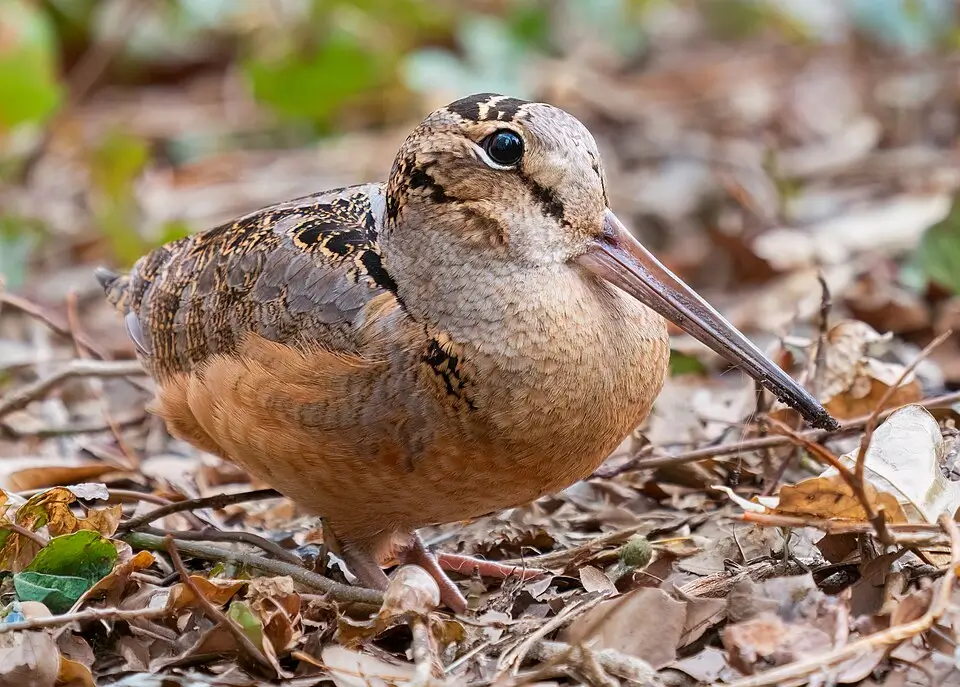
Physically, the woodcock is a compact, rotund bird with extraordinarily short legs, a plump body, and an exceptionally long bill that can measure up to nearly three inches in length. This bill is one of the woodcock's most remarkable features. Highly sensitive and flexible at the tip, it is perfectly engineered for probing soft soil in search of earthworms, which form the cornerstone of the bird's diet. The upper mandible of the bill is prehensile — meaning the woodcock can open just the tip of its bill while it remains inserted in the ground, allowing it to grasp and extract earthworms with impressive efficiency. An adult woodcock may consume its own body weight in earthworms in a single day, making rich, moist soils absolutely essential to its survival.
Another extraordinary anatomical feature of the woodcock is the placement of its eyes. Set far back and high on the skull, the woodcock's large eyes provide a nearly 360-degree field of vision — including binocular vision both in front of and behind the bird. This adaptation allows the woodcock to watch for predators while its bill is buried in the ground, a critical survival advantage for a bird that spends much of its foraging time with its head down.
The woodcock's plumage is a masterwork of camouflage. Browns, rusts, blacks, and tans blend together in intricate patterns that mimic the dead leaves of the forest floor with uncanny precision. When a woodcock flushes from underfoot, many hunters describe the experience as startling — the bird seems to materialize from thin air before rocketing upward through the canopy on whistling wings.
Perhaps the most celebrated aspect of the American woodcock's biology is its springtime courtship display, known as the "sky dance." At dawn and dusk, male woodcock move to open clearings and singing grounds where they perform a spectacular aerial display. The male begins by producing a series of nasal "peent" calls from the ground, then launches into a spiraling, towering flight that can carry him hundreds of feet into the air. At the apex of this flight, the woodcock's wings produce a distinctive twittering sound as he begins a twisting, plummeting descent, vocalizing a liquid, bubbling song before landing near his starting point to repeat the performance. This display is repeated for weeks during the spring breeding season and is considered one of the great wildlife spectacles of the northeastern woods.
Habitat & Range
The American woodcock is found exclusively in eastern North America, breeding across a broad range that stretches from the Gulf Coast states northward through the Great Lakes region and into the boreal forests of Canada. The heart of the woodcock's breeding range encompasses the northeastern United States and adjacent Canada — a region of young, regenerating forests that provides exactly the habitat mosaic the species requires.
Woodcock are strongly associated with early successional habitats — young forests of alder, aspen, birch, and other fast-growing species that create a dense canopy of cover close to the ground. These young forests typically grow in moist areas near streams, wetlands, and bottomlands where earthworm-rich soils are available for feeding. Mature forest, by contrast, provides little of value to the woodcock; the closed canopy and lack of shrubby undergrowth make it unsuitable for breeding and feeding.
Maine is particularly well-suited to the woodcock's needs. With over 17 million acres of forests and a landscape shaped by centuries of logging, agriculture, and natural succession, Maine offers an abundance of the young alder runs, brushy clearcuts, and moist bottomland thickets that woodcock favor. The state's numerous rivers, streams, and wetlands further enhance habitat quality by maintaining the moist soils that support robust earthworm populations.
During fall migration, woodcock from across the northeastern breeding range funnel southward through the Atlantic Flyway, moving at night in response to cold fronts that push temperatures downward. "Flight birds," as hunters call migrant woodcock, can appear in large numbers at traditional stopover sites, concentrating in the best available cover before pushing further south toward wintering grounds in the Gulf Coast states. This migratory movement adds an element of excitement and unpredictability to the fall hunting season, as hunters never quite know when a new flight of birds might arrive.
Hunting Information
Woodcock hunting is one of the most cherished upland hunting traditions in eastern North America, and Maine offers some of the finest timberdoodle hunting opportunities in the country. The Maine Department of Inland Fisheries and Wildlife oversees hunting seasons and regulations within the state, and hunters are encouraged to consult official state resources for current season dates, bag limits, and licensing requirements before heading afield.
Hunting woodcock in Maine is typically a pursuit that pairs well with the pursuit of ruffed grouse, as both species favor similar young forest habitats. Hunters work through alder thickets, aspen edges, and brushy bottomlands with pointing breeds — English setters, Brittanys, and German shorthaired pointers are popular choices — or with flushing spaniels. The dog is absolutely central to the woodcock hunt; the bird's cryptic camouflage and tendency to sit tight make it nearly impossible to find and flush consistently without a good nose working the cover.
Shooting woodcock presents its own unique challenges. When flushed, the bird rises steeply through dense overhead cover, offering only a brief window for a shot before it disappears into the canopy. Lightweight 20-gauge or 28-gauge shotguns loaded with fine shot are the traditional choice, matching the light-framed bird and the close, brushy shooting situations that define the woodcock hunt.
Maine's hunting heritage and its vast, wild landscape make it an outstanding destination for anyone seeking to pursue woodcock. The state's commitment to quality hunting opportunities, as reflected through the Maine Department of Inland Fisheries and Wildlife, ensures that woodcock hunting remains a viable and rewarding tradition for generations of hunters to come.
Conservation
The American woodcock has experienced long-term population declines across much of its range, a trend that wildlife biologists attribute primarily to the loss and maturation of young forest habitats. As forests across the northeastern United States have matured following the abandonment of agricultural lands and the decline of traditional logging practices, the young early-successional forests that woodcock depend upon have become less abundant.
Conservation efforts on behalf of the American woodcock have centered on habitat management — specifically the creation and maintenance of young forest through timber harvesting, prescribed fire, and other management tools. Organizations such as the American Woodcock Society and various state wildlife agencies have championed young forest habitat initiatives that benefit not only woodcock but a suite of other wildlife species that share these habitats, including ruffed grouse, New England cottontail, golden-winged warbler, and white-tailed deer.
In Maine, the state's active forestry economy and culture of working forest management contribute positively to woodcock habitat by producing the forest age classes the bird requires. The Maine Department of Inland Fisheries and Wildlife plays an active role in monitoring woodcock populations and implementing management actions to support the species' long-term viability.
The woodcock's status as both a beloved game species and a wildlife indicator species has helped build broad coalitions of support for young forest conservation. Hunters, birders, and wildlife managers alike share a common interest in ensuring that the timberdoodle's sky dance continues to grace the northeastern woods for generations to come.