Overview
Few birds capture the imagination of upland hunters and wildlife enthusiasts quite like the ruffed grouse (Bonasa umbellus). Known for its explosive flush, cryptic camouflage, and haunting drumming displays, this remarkable bird has earned a devoted following across North America. Whether you are a seasoned wingshooter navigating the aspen thickets of the Great Lakes states, a birdwatcher listening for the deep, rhythmic thumping of a displaying male, or an outdoor adventurer exploring the rugged forests of Idaho, the ruffed grouse represents one of the continent's most iconic wildlife encounters. Compact, resilient, and endlessly fascinating, the ruffed grouse is a species that rewards careful study and patient pursuit.
In Idaho — a state defined by dramatic contrasts of jagged mountain ranges, deep river canyons, dense conifer forests, and sprawling high desert — the ruffed grouse finds a comfortable home in the forested north and the riparian corridors threading through its mountains. Idaho's status as the 14th-largest state by land area, covering 83,569 square miles, means there is no shortage of wild country for this bird to inhabit. From the moist forests of the Idaho Panhandle near the British Columbia border to the mixed woodlands of the Clearwater region, ruffed grouse are a beloved target for hunters and a cherished sighting for naturalists.
Biological Traits
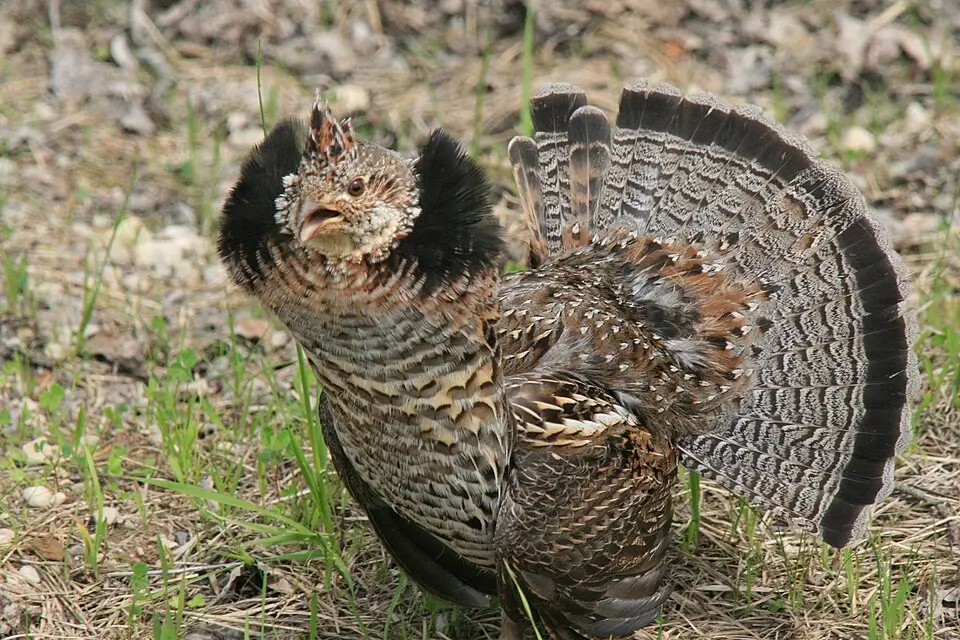
The ruffed grouse, Bonasa umbellus, belongs to the family Phasianidae — the same broad family that includes pheasants, turkeys, and other grouse. The genus name Bonasa is derived from the Latin word for bison, a reference to the bull-like booming sound the male produces during his courtship display. The species epithet umbellus refers to the umbrella-like ruff of dark feathers around the bird's neck, which the male fans dramatically during display.
Ruffed grouse are medium-sized birds, roughly comparable in body size to a large pigeon or a small chicken. They exhibit two primary color morphs — a gray phase and a brown (or rufous) phase — which vary in prevalence across their range. The gray phase tends to be more common in northern and western portions of their range, while the brown phase predominates in the south and east. Regardless of color phase, both sexes display beautifully barred and streaked plumage that provides extraordinary camouflage against the forest floor. The tail is broadly banded, featuring a distinctive dark subterminal band that is particularly visible in flight.
One of the most remarkable biological features of the ruffed grouse is the male's drumming display. Unlike many birds that produce sound vocally, male ruffed grouse create their signature drumming by standing on a log or elevated perch and rapidly beating their wings against the air. This creates a series of low-frequency thumps that begin slowly and accelerate into a whirring blur. The sound carries remarkably well through dense forest, allowing males to advertise their territory and attract mates across considerable distances. Drumming can occur throughout much of the year but peaks during spring breeding season.
Ruffed grouse are largely non-migratory, relying on year-round use of their forest habitat. In winter, they exhibit a fascinating behavioral adaptation: they dive into deep, powdery snow to create insulating roost tunnels that protect them from extreme cold. Their feet are equipped with comblike pectinations along the toes — small projections that essentially act as snowshoes, improving the bird's ability to walk across the surface of snow. This adaptation is most pronounced in winter months.
The diet of the ruffed grouse shifts seasonally. In spring and summer, they consume a wide variety of insects, tender plant shoots, berries, and leaves. As autumn progresses and winter sets in, their diet shifts dramatically toward buds and catkins — particularly those of aspen, birch, and alder trees. This reliance on winter buds means that the presence of young aspen stands is critically important to sustaining healthy grouse populations in northern forests.
Ruffed grouse are also well known for their population cycles, a phenomenon most dramatic in northern portions of their range. Populations rise and fall on a roughly 10-year cycle, a pattern that has fascinated wildlife biologists for generations. While the precise mechanisms driving these cycles are complex and still studied, interactions between grouse populations and their predators — particularly the goshawk and great horned owl — appear to play a significant role.
Habitat & Range
The ruffed grouse boasts one of the widest distributions of any upland game bird in North America. Its range stretches from Alaska eastward across Canada to the Atlantic Provinces, and southward through much of the forested United States, including the Appalachian Mountains, the Great Lakes region, New England, the upper Midwest, and the Rocky Mountain West. In the western United States, populations are found primarily in forested mountain zones where suitable habitat conditions exist.
In Idaho, ruffed grouse are most reliably found in the northern and north-central portions of the state. The Idaho Panhandle, which shares a border with British Columbia to the north and is flanked by Washington to the west and Montana to the east, provides classic ruffed grouse habitat: moist mixed forests, riparian corridors lined with alder and willow, and regenerating aspen stands. The Clearwater, Nez Perce, and Payette national forests also harbor grouse populations, particularly in areas where early-successional forest habitats and riparian zones provide the structural diversity that grouse require.
The key to productive ruffed grouse habitat is structural complexity and early-successional forest. Grouse thrive in areas that have experienced natural disturbance — such as fire, windthrow, or flooding — or managed disturbance such as timber harvesting. These events create the young, dense stands of woody vegetation where grouse feed, loaf, and escape predators. Mature, closed-canopy forest alone is generally poor grouse habitat; it is the mosaic of young and older forest, interspersed with brush, berry patches, and openings, that supports the highest densities of birds.
Riparian corridors — the strips of vegetation lining streams and rivers — are especially valuable in drier western states like Idaho. These zones remain comparatively lush and productive even when surrounding upland habitats are dry, and they concentrate grouse in predictable locations that savvy hunters and wildlife observers learn to seek out.
Hunting Information
The ruffed grouse holds a cherished place in North American hunting tradition. Often called the "king of upland game birds," grouse hunting demands a combination of woodsmanship, shooting skill, and intimate knowledge of forest habitats that many wingshooters find deeply rewarding. The explosive, twisting flush of a ruffed grouse through dense timber tests even experienced shots, and the birds' tendency to put trees between themselves and a hunter the instant they flush adds a degree of challenge that keeps hunters humble and engaged.
In Idaho, ruffed grouse are a legal upland game species, and hunters should consult the Idaho Department of Fish and Game for current season dates, bag limits, and any applicable licensing requirements. Because regulations change from year to year, always verify current rules directly with the official state wildlife agency before heading afield. Hunters pursuing ruffed grouse in Idaho will generally find their best opportunities in the northern and north-central portions of the state, particularly in areas offering the young aspen stands, alder-choked creek bottoms, and mixed conifer-deciduous forests that grouse favor.
Many successful grouse hunters in the West work stream drainages methodically, focusing on the brushy edges where riparian vegetation meets upland timber. Early autumn hunting, before leaf drop reduces ground cover and bird densities in certain areas, can be particularly productive. Dogs — especially pointing breeds and flushers — are valuable partners in grouse cover, helping hunters locate birds that would otherwise sit tight and remain invisible beneath the forest understory.
Because ruffed grouse are largely non-migratory, hunting pressure can affect local populations, and ethical hunters are mindful of harvest rates in heavily used areas. Participating in hunter-reported harvest surveys and supporting habitat conservation programs helps ensure that grouse populations remain robust for future generations.
Conservation
The ruffed grouse is currently listed as a species of Least Concern by conservation standards, with populations distributed across a broad range and supported by managed forest habitats across North America. However, like all wildlife, grouse are sensitive to habitat changes, and long-term trends in certain parts of their range have drawn the attention of wildlife managers and conservationists.
The most significant conservation challenge for ruffed grouse in many areas is the maturation and homogenization of forest habitats. As forests age without disturbance, the young aspen stands and brushy early-successional habitats that grouse depend upon can decline. Active forest management — including timber harvest, prescribed fire, and habitat restoration — plays a vital role in maintaining the diverse forest structure that grouse need to thrive.
Organizations such as the Ruffed Grouse Society (RGS) have worked for decades to promote habitat conservation, scientific research, and hunting heritage related to ruffed grouse and American woodcock. Their work in partnering with state and federal land management agencies to create and maintain quality grouse habitat has had meaningful positive impacts across the species' range.
In Idaho, the combination of vast public land — administered by the U.S. Forest Service, Bureau of Land Management, and other agencies — and a strong tradition of conservation-minded outdoor recreation provides a solid foundation for sustaining healthy grouse populations. Hunters, birdwatchers, hikers, and other forest users all share a stake in the health of Idaho's forests and the remarkable wildlife they support.
The ruffed grouse, with its booming drums, explosive flushes, and quiet beauty, is a living symbol of North America's wild forested places. Protecting and stewarding those places is both a responsibility and a privilege for all who love the outdoors.