Overview
When most people think of the world's fastest land animals, the African cheetah immediately comes to mind. Yet right here in the American West, a remarkable creature holds the title of the fastest land animal in the Western Hemisphere and the second-fastest in the entire world. The pronghorn (Antilocapra americana) is one of North America's most extraordinary and iconic wildlife species — a living relic of the Pleistocene epoch that has roamed the open plains and high desert grasslands of the continent for millions of years.
Often called the "American antelope" or simply the "antelope" by hunters and ranchers throughout the West, the pronghorn is not, technically speaking, a true antelope at all. It is the sole surviving member of the family Antilocapridae, a group of hoofed mammals that evolved entirely in North America. This makes the pronghorn one of the most unique large mammals on the planet — a creature so biologically distinct that it occupies its own taxonomic family, with no living close relatives anywhere on Earth. Understanding this animal means appreciating a species that is simultaneously ancient and astonishing, a true marvel of evolutionary biology that continues to captivate wildlife enthusiasts, naturalists, and hunters from across the country and around the world.
Idaho, with its sweeping high desert terrain in the southern part of the state, provides some of the most compelling pronghorn habitat in the Pacific Northwest and Mountain West regions. The state's wide-open landscapes, rimrock canyons, and sage-steppe ecosystems create an ideal environment for this fleet-footed ungulate, making Idaho a destination of genuine interest for those hoping to observe or hunt this remarkable animal in its natural setting.
Biological Traits
The pronghorn (Antilocapra americana) is a study in superlatives. Its speed is perhaps its most celebrated attribute — capable of reaching sustained speeds of approximately 55 miles per hour and capable of cruising comfortably at 40 miles per hour for extended distances, the pronghorn is built for velocity in a way that no other North American animal can match. Unlike the cheetah, which can sprint at higher peak speeds but exhausts itself quickly, the pronghorn can maintain its high-speed travel over long distances, an adaptation that likely evolved in response to now-extinct Pleistocene predators such as the American cheetah (Miracinonyx tridentatus) that once shared the continent.
The physical adaptations that make this speed possible are numerous and fascinating. The pronghorn possesses an extraordinarily large windpipe, lungs, and heart relative to its body size, allowing it to process oxygen at a remarkable rate during exertion. Its legs are long and slender, ending in cushioned, pointed hooves that grip the ground efficiently. Unlike deer, pronghorns lack dewclaws — the small vestigial toes found on the lower legs of most other hoofed animals — which reduces weight and drag during a full run.
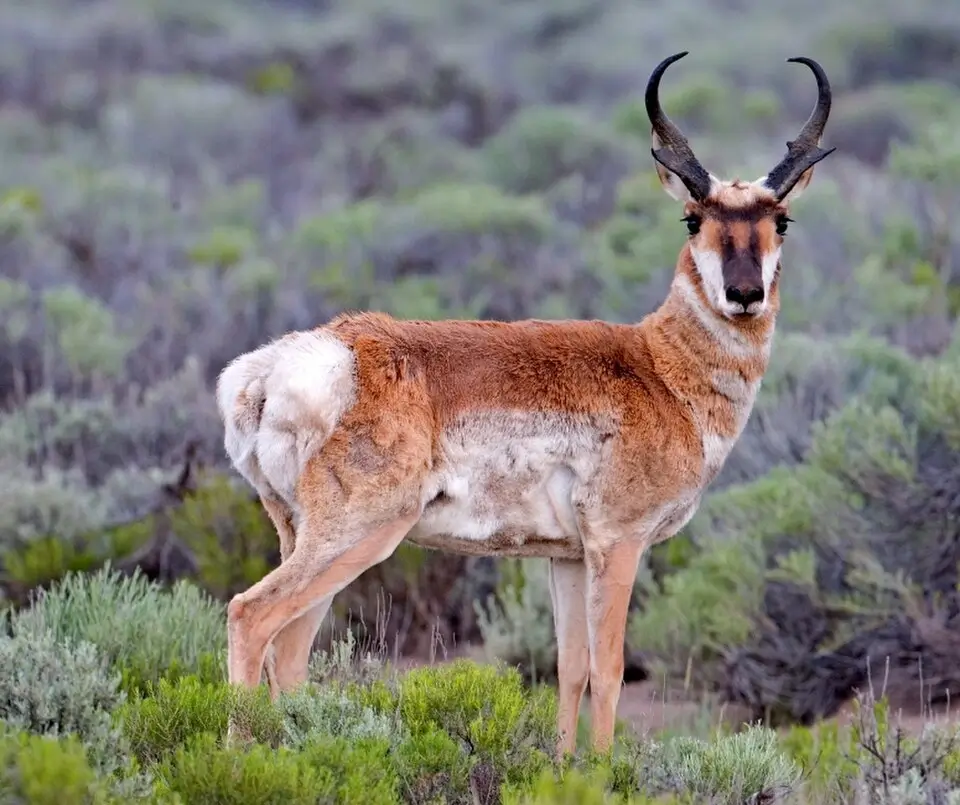
One of the pronghorn's most distinctive features is its horns, which give the animal both its common name and its scientific genus. The name Antilocapra translates roughly to "antelope-goat," while the species name americana simply denotes its geographic origin. Both male bucks and female does typically grow horns, though the buck's horns are considerably larger and more dramatic. The horns are composed of a bony core covered by a keratinous sheath — similar in structure to a cow's horn — but uniquely among horned animals, the pronghorn sheds and regrows this outer sheath annually. This trait gives the pronghorn its name, as the bony core typically features a forward-pointing prong. True antelope, by contrast, do not shed their horns, and deer shed their bony antlers entirely each year. The pronghorn's horn-shedding mechanism is entirely its own.
Pronghorns are also known for their remarkable eyesight. Their large, prominently positioned eyes provide an exceptionally wide field of vision, and their visual acuity has been compared to that of an 8-power binocular. This allows them to detect movement and potential threats at extraordinary distances — a critical survival tool in the open habitat where they live. When alarmed, pronghorns raise the white hair on their rumps in a distinctive flare that serves as a visual alarm signal visible to other pronghorns at great distances, a behavior that helps the herd stay coordinated in open terrain.
The pronghorn is a mid-sized ungulate, with adult bucks typically weighing between 90 and 140 pounds and does being somewhat smaller. Their coloration is a warm tan or brownish-orange on the back and sides, with white markings on the belly, chest, and rump. Bucks also display distinctive black facial markings and black patches on the neck that does lack. The rut, or breeding season, typically occurs in late summer to early autumn, and does commonly give birth to twins in late spring, a reproductive strategy that helps maintain healthy population levels.
Habitat and Range
The pronghorn is quintessentially a creature of open country. It thrives in the short-grass prairies, mixed-grass plains, sagebrush steppes, and desert grasslands of western North America. Its range historically extended from southern Canada through the western United States and into northern Mexico, covering an enormous swath of open terrain that roughly corresponds to the Great Plains and the intermountain West.
Today, pronghorn remain widely distributed across much of this historic range, with healthy populations found in states including Wyoming, Montana, Colorado, New Mexico, Nevada, Oregon, and Idaho, among others. Wyoming is generally recognized as hosting the largest single pronghorn population in the world, but Idaho's high desert regions — particularly in the state's southern counties — provide important and productive habitat.
Idaho sits at the intersection of the Pacific Northwest and Mountain West, and while much of the state is characterized by rugged forested mountains, its southern reaches are defined by the vast Snake River Plain and the surrounding sage-steppe ecosystem. This landscape, with its open sagebrush flats, grassy benches, and broad valleys, is precisely the kind of terrain that pronghorns require. The animals depend on open sightlines to detect predators at distance and need relatively flat or rolling terrain to utilize their speed advantage effectively.
Pronghorn are also notably migratory in some parts of their range, undertaking seasonal movements between summer and winter ranges that can cover significant distances. These migration corridors, which in some cases represent some of the longest land mammal migrations in North America, are an important conservation consideration as development and fencing can impede traditional movement routes.
Hunting Information
Pronghorn hunting is a beloved and storied tradition throughout the American West, and for good reason. The combination of challenging open terrain, keen-eyed and alert quarry, and the stunning high desert landscapes that pronghorns call home makes a pronghorn hunt a genuinely memorable experience for any big-game hunter.
In Idaho, pronghorn hunting opportunities exist within the state's high desert regions, and hunters interested in pursuing pronghorn should consult the Idaho Department of Fish and Game directly for the most current and accurate information regarding season dates, unit boundaries, tag availability, application deadlines, and licensing requirements. Pronghorn hunting in Idaho, as in most western states, is typically managed through a controlled draw system, meaning that hunters must apply for a limited number of tags allocated to specific hunting units. This system helps wildlife managers maintain healthy and sustainable pronghorn populations across the state.
Hunting pronghorn presents a unique and rewarding set of challenges. Because these animals live in open terrain and possess exceptional eyesight, spot-and-stalk hunting is the predominant method used by pronghorn hunters. A quality pair of binoculars and a spotting scope are essential tools, as hunters must often glass animals from great distances before attempting an approach. The lack of significant cover in pronghorn country means that even a careful stalk can be difficult, requiring patience, skill, and a working knowledge of terrain features such as dry washes, rolling ridgelines, and erosion channels that can conceal an approaching hunter.
Rifle hunting is the most common method, with shots often taken at moderate to long range given the open nature of the terrain. Archery hunting for pronghorn is considered one of the more challenging pursuits in North American big-game hunting, as getting within bow range of an animal with such extraordinary eyesight in open terrain requires exceptional skill and persistence. Some hunters use ground blinds positioned near water sources as a productive strategy for archery pronghorn hunting.
The meat of the pronghorn is widely regarded as excellent table fare — lean, flavorful, and mild when properly handled in the field. Prompt field dressing and cooling of the meat is important, particularly given that pronghorn seasons often occur during warm late-summer conditions.
Conservation
The story of pronghorn conservation in North America is largely a success story, though one that required significant effort and commitment to achieve. By the early 20th century, pronghorn populations had been reduced to dangerously low numbers due to unregulated market hunting, habitat conversion, and disease. Estimates suggest that pronghorn numbers may have dropped to as few as 13,000 animals at their lowest point in the early 1900s, compared to historical populations that may have numbered in the tens of millions.
Through coordinated conservation efforts, regulated hunting, and habitat protection, pronghorn populations have rebounded dramatically, with current estimates placing the continental population at approximately 500,000 or more animals. This recovery represents one of the great achievements of the North American Model of Wildlife Conservation, a management framework based on science-based regulation and the principle that wildlife is a public resource held in trust for all citizens.
Today, conservation challenges for pronghorn include habitat fragmentation from road and fence construction, energy development on public and private lands, drought, and the potential long-term effects of climate change on sagebrush ecosystems. Organizations including state wildlife agencies, the Pronghorn Foundation, and various sporting and conservation groups continue to work on behalf of pronghorn habitat and population health, including efforts to maintain and restore migration corridors critical to long-term population viability.
In Idaho, the management of pronghorn as a game species by the Idaho Department of Fish and Game ensures that populations are monitored and that hunting pressure is calibrated to population health, contributing to the long-term sustainability of this remarkable species in the state.