Overview
Few animals capture the imagination of outdoor enthusiasts quite like the mountain goat. Perched on impossibly steep cliffs, navigating treacherous rock faces with apparent ease, and standing stoically against the backdrop of snow-capped peaks, the mountain goat (Oreamnos americanus) is one of North America's most iconic and awe-inspiring large mammals. Known for its brilliant white coat and remarkable agility at high elevations, this species has long fascinated wildlife biologists, hunters, photographers, and hikers alike. Despite its name and appearance, the mountain goat is not a true goat in the strictest taxonomic sense — it belongs to a distinct lineage that has evolved specifically to thrive in some of the most challenging terrain on the continent.
In states like Idaho, where rugged mountain ranges define the landscape, the mountain goat occupies a special place in the wildlife community. Idaho's dramatic elevation changes, sprawling wilderness areas, and rocky alpine zones provide ideal habitat for this remarkable animal. Whether you are a hunter pursuing one of the most coveted tags in North American big game, a wildlife watcher hoping to glimpse a nimble billies on a distant ridgeline, or simply someone with a deep appreciation for wild places and the creatures that inhabit them, the mountain goat offers an unforgettable connection to the high country.
Biological Traits
The mountain goat (Oreamnos americanus) is classified within the family Bovidae and the subfamily Caprinae, placing it in the same broad group as sheep, goats, and chamois. However, it is the sole member of the genus Oreamnos, making it a unique evolutionary lineage within North American wildlife. The species name americanus reflects its exclusively North American range, distinguishing it from the wild goats and ibexes of Eurasia and Africa.
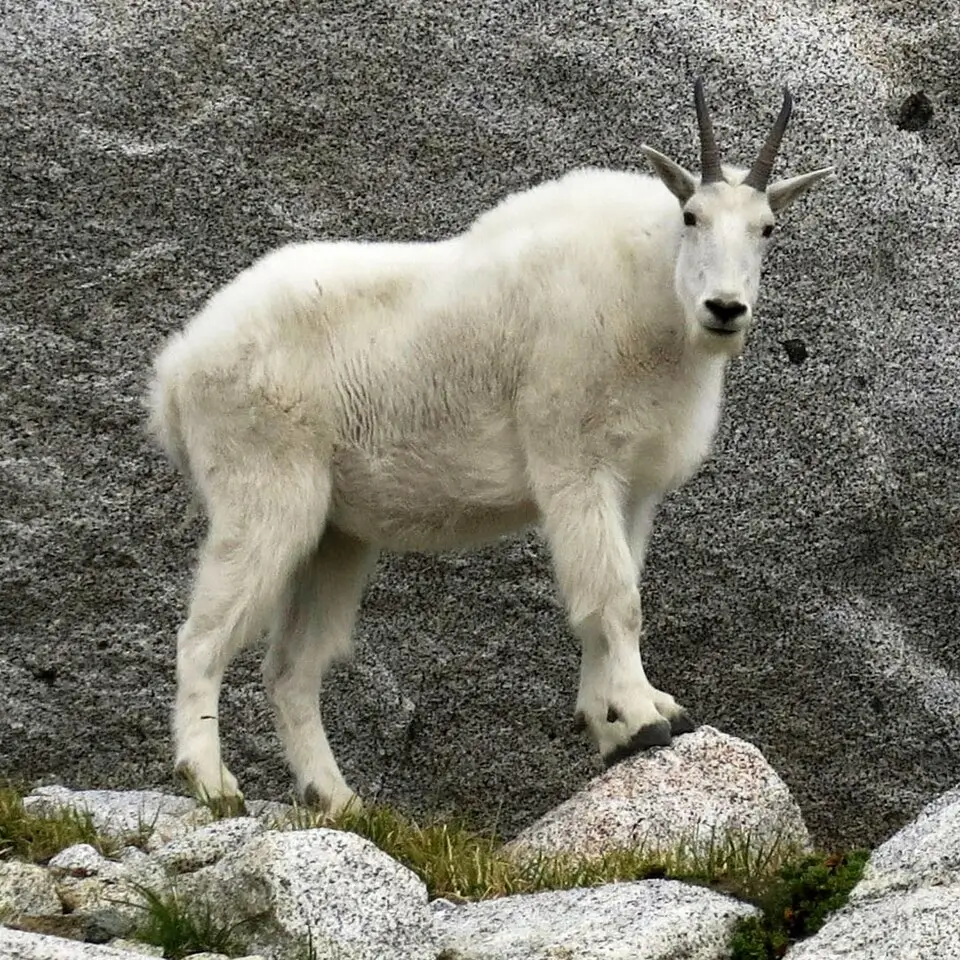
One of the most immediately recognizable features of the mountain goat is its dense, white double-layered coat. This coat consists of a thick, woolly undercoat covered by longer, coarser guard hairs, providing exceptional insulation against the brutal cold, wind, and snow that characterize alpine environments. The coat is so effective that mountain goats can remain active and comfortable in temperatures that would be lethal to most other large mammals. During the warmer months, they shed their heavy winter coat, and their appearance becomes somewhat scruffy during the molting process before the new growth fills in.
Both male mountain goats — called billies — and female mountain goats — called nannies — possess short, sharp, black horns that curve slightly backward. These horns are permanent structures that grow throughout the animal's life and are never shed, unlike antlers. A goat's age can be estimated by counting the growth rings on its horns, with each ring typically representing one year of life. Billies tend to be larger and heavier than nannies, though the difference is less pronounced than in many other ungulate species.
Mountain goats are well known for their extraordinary hooves, which are specially adapted for life on rocky, steep terrain. Each hoof features a hard outer edge for gripping rock surfaces and a soft, rubbery inner pad that acts almost like a suction cup, allowing these animals to maintain traction on nearly vertical surfaces. Combined with strong leg muscles and exceptional balance, this anatomical adaptation allows mountain goats to scale cliffs and navigate terrain that would be impossible for virtually any other hoofed animal.
The diet of the mountain goat is typical of high-alpine herbivores, consisting primarily of grasses, sedges, forbs, mosses, lichens, and woody shrubs. Because alpine vegetation is often sparse and highly seasonal, mountain goats are opportunistic feeders that make the most of whatever plant material is available. During winter months, when deep snow covers much of their range, they may paw through snow to access dried vegetation beneath, or seek out wind-scoured ridges where plant material remains exposed.
Social behavior in mountain goats is generally characterized by a loose, non-territorial structure. Nannies and their young kids tend to form small groups, while billies are often solitary or gather in small bachelor groups outside of the breeding season. The rut, or breeding season, typically occurs in late autumn. During this time, billies actively seek out receptive nannies and may engage in displays of dominance. Kids are born in late spring, usually as a single offspring, though twins do occur. Young kids are remarkably precocious and can follow their mothers across difficult terrain within hours of birth — a necessary survival trait in their rugged mountain environment.
Habitat & Range
The mountain goat's range spans the rugged mountain systems of western North America, from the coastal ranges of southern Alaska and the Yukon southward through the Rocky Mountains into the contiguous United States. Their stronghold lies in the northern Rockies, the Cascades, and the Coast Ranges, with populations extending into Montana, Idaho, Wyoming, Colorado, and several other western states. Mountain goats have also been introduced to several mountain ranges outside their historical native range as part of wildlife management programs.
In Idaho specifically, the mountain goat occupies several of the state's most dramatic and remote mountain ranges. The rugged terrain of central and northern Idaho — including wilderness areas associated with the Bitterroot, Clearwater, and Salmon River mountain ranges — provides classic mountain goat habitat characterized by steep cliffs, rocky outcroppings, and high-elevation meadows. Idaho's status as the 14th-largest state by land area, with vast stretches of public land managed by federal agencies, means that significant tracts of undisturbed alpine habitat remain available to support mountain goat populations.
Mountain goats are obligate alpine and subalpine animals for much of the year. They favor terrain above treeline where steep cliffs and rocky escarpments provide both natural predator defenses and mineral lick sites. During the harshest winter weather, they may descend to lower elevations in search of food and shelter, but they rarely venture far into forested valleys. The combination of rugged terrain and high elevation that defines their preferred habitat also makes them one of the most challenging species to observe, photograph, or hunt.
Hunting Information
The mountain goat is widely regarded as one of the most prestigious and challenging big game animals in North America. Hunting opportunities are extremely limited due to the species' relatively small population sizes, its remote and demanding habitat, and the conservative management approach taken by wildlife agencies across its range. In most jurisdictions where mountain goat hunting is permitted, tags are allocated through lottery or draw systems, with odds that can be extraordinarily long — sometimes reflecting decades of waiting or near-impossible draw odds in highly competitive units.
In Idaho, mountain goat hunting is managed by the Idaho Department of Fish and Game. Because the source data for this article does not include specific current season dates, license fees, or tag quotas, hunters interested in pursuing mountain goat in Idaho are strongly encouraged to consult the Idaho Department of Fish and Game's official website and most current hunting regulations booklet for up-to-date and accurate information. Regulations, season structures, and available tags can change from year to year based on population surveys and management objectives.
What is universally understood about mountain goat hunting — regardless of the specific jurisdiction — is that it demands exceptional physical fitness, advanced wilderness skills, and thorough preparation. The terrain mountain goats inhabit is genuinely dangerous, with steep cliffs, loose rock, unpredictable weather, and significant elevation challenges. Successful mountain goat hunters typically invest months in physical conditioning and pre-season scouting. Shot opportunities often require long approaches on foot, sometimes involving technical scrambling. Recovery of a downed animal in cliff terrain can be one of the most logistically demanding tasks in all of big game hunting.
Despite — or perhaps because of — these challenges, a mountain goat tag is considered a once-in-a-lifetime achievement by many hunters. The animals themselves are notoriously patient and deliberate in their movements, offering hunters who put in the effort a chance at a meaningful and deeply memorable experience in some of the most spectacular wilderness in North America.
Conservation
Mountain goat populations across North America are generally considered stable, though they face several ongoing challenges that wildlife managers and conservationists monitor carefully. Disease transmission, climate change affecting alpine habitat and snowpack, human disturbance in high-elevation areas, and predation from wolves, mountain lions, and bears all represent factors that can influence local population dynamics.
Wildlife agencies in states like Idaho conduct periodic population surveys to monitor mountain goat numbers and ensure that hunting harvests remain within sustainable limits. The conservative, permit-based approach to mountain goat hunting reflects a management philosophy that prioritizes long-term population health over maximizing hunting opportunity — a philosophy broadly supported by both hunters and wildlife conservation advocates.
Mountain goats also benefit from the protection afforded by the rugged, remote wilderness areas they inhabit. Much of their core habitat in Idaho and across the West lies within designated wilderness areas, national forests, and other public lands where development and motorized access are restricted. This inherent protection from habitat loss distinguishes mountain goats from many other species that face more direct anthropogenic pressures on their habitat.
Public interest in mountain goats — whether from hunters, wildlife watchers, or outdoor photographers — helps sustain political and financial support for alpine conservation. Tag fees, license revenue, and excise taxes on hunting equipment contribute meaningfully to wildlife management funding under the North American Model of Wildlife Conservation, ensuring that resources are available to protect and study mountain goat populations for future generations.