Overview
Few birds capture the essence of the American West quite like the Dusky grouse (Dendragapus obscurus). A robust, secretive upland bird of the high country, the Dusky grouse commands respect among hunters, birders, and wildlife enthusiasts alike. Often encountered along forested ridgelines and mountain slopes, this bird has earned a reputation as one of the most challenging and rewarding upland game species in the western United States. Whether you are a seasoned grouse hunter or simply a nature lover with an appreciation for wild places, the Dusky grouse offers a compelling subject worthy of deeper exploration.
Idaho, with its vast wilderness landscapes, dramatic mountain ranges, and diverse coniferous forests, provides some of the finest Dusky grouse habitat anywhere in the bird's range. The state's rugged terrain — from the towering peaks of the Sawtooth Range to the dense forests of the Panhandle — creates a mosaic of ecosystems perfectly suited to this remarkable species. Understanding the biology, behavior, and habitat preferences of the Dusky grouse is the first step toward appreciating just how extraordinary this bird truly is.
Biological Traits
The Dusky grouse is a large, chunky member of the family Phasianidae, which includes pheasants, turkeys, and other familiar game birds. Scientifically classified as Dendragapus obscurus, the species name "obscurus" — meaning obscure or dark — is a fitting nod to both the bird's cryptic plumage and its elusive nature in the field.
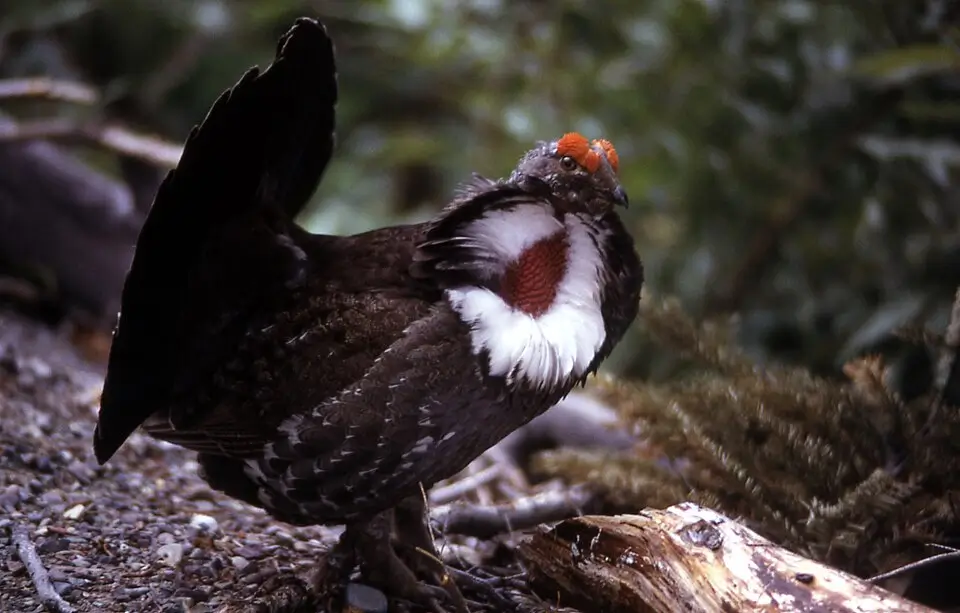
Adult males are noticeably larger than females, a trait common among grouse species, and display striking plumage during the breeding season. Males are predominantly dark gray to charcoal in coloration, with subtle barring and streaking across the body. During courtship displays, males inflate colorful air sacs on the sides of their necks — yellow to reddish-purple depending on the individual — which are framed by white-tipped feathers that fan outward dramatically. The tail is long and squared, often fanned during display. A distinctive yellow-orange comb above the eye becomes particularly vivid during the breeding season, adding to the male's impressive courtship appearance.
Females, by contrast, are mottled brown and buff, a camouflage pattern that provides exceptional concealment when nesting on the forest floor. This cryptic coloration is a critical adaptation for ground-nesting birds that must remain hidden from predators during the long incubation period.
One of the most fascinating behavioral traits of the Dusky grouse is its seasonal migration, which is the reverse of what most people might expect. Rather than moving to lower elevations in winter, Dusky grouse actually move upslope as the cold months approach. By winter, they are often found near or above treeline, feeding almost exclusively on the needles of conifers such as fir and spruce. This ability to subsist on conifer needles — a food source that most animals find unpalatable and nutritionally poor — is a remarkable physiological adaptation. The birds' digestive systems expand and adjust seasonally to process this tough, resinous diet.
In spring and summer, the diet broadens considerably. Dusky grouse consume a wide variety of foods including insects, berries, flowers, leaves, and forbs. Chicks in particular rely heavily on protein-rich insects during their first weeks of life, a critical nutritional requirement for rapid growth and feather development.
The Dusky grouse is not a highly vocal bird by most standards, but the male's hooting call during the breeding season is distinctive and carries surprising distances through dense forest. This deep, resonant booming is produced with the help of the inflated neck sacs and is used to establish territory and attract females.
Habitat & Range
The Dusky grouse occupies a broad swath of mountainous terrain across the American West, ranging from the Yukon Territory in Canada southward through British Columbia, Washington, Oregon, Idaho, Montana, Wyoming, Utah, Colorado, and into New Mexico. The species is closely associated with the Rocky Mountain and Pacific coastal mountain systems, where complex topography and diverse forest communities provide the varied habitats the bird requires across its annual cycle.
Throughout the warmer months, Dusky grouse favor open woodlands, forest edges, and shrubby clearings where foraging is productive and nesting cover is available. They are frequently found in areas transitioning between open meadows and coniferous forest, particularly where berry-producing shrubs such as serviceberry, huckleberry, and snowberry are abundant. Brushy forest edges created by old burns, logging openings, or natural disturbances are attractive to grouse during summer and early fall, as these areas produce an abundance of food and offer protective cover.
As discussed, the species shifts upward in elevation as winter approaches, eventually settling into mature stands of subalpine fir and Engelmann spruce where needles provide their cold-season sustenance. This elevational migration is the opposite of the downslope movement typical of many other mountain wildlife species and represents one of the Dusky grouse's most unusual ecological adaptations.
Idaho sits squarely within the core of the Dusky grouse's range. The state's mountainous geography — including the Clearwater Mountains, the Bitterroot Range, the Sawtooth Mountains, and the high plateaus of central Idaho — provides a wealth of suitable habitat. Idaho's extensive public lands, including national forests administered by the U.S. Forest Service and lands managed by the Bureau of Land Management, ensure that vast areas of prime Dusky grouse habitat remain accessible to wildlife and hunters alike.
Hunting Information
Dusky grouse hunting is a beloved tradition in Idaho and across the western mountain states. The pursuit of these birds demands physical fitness, patience, and a willingness to explore rugged, often remote terrain. Unlike pheasant or quail hunting, which often takes place in agricultural lowlands, Dusky grouse hunting typically involves long hikes up steep mountain trails and through dense forest. The challenge of reaching the birds is part of the appeal for many dedicated upland hunters.
Hunters typically work forest edges, logging roads, and brushy clearings in the early fall season, when birds are still found at middle elevations. Dogs can be highly effective for locating and flushing Dusky grouse, and pointing breeds in particular are popular among enthusiasts. The birds can hold tight for a pointing dog and offer satisfying shooting opportunities in the challenging terrain.
Because Idaho hunting regulations, season dates, and licensing requirements can change from year to year, prospective hunters are strongly encouraged to consult the Idaho Department of Fish and Game (IDFG) directly for the most current and accurate information before heading afield. The IDFG maintains up-to-date regulations on season dates, bag limits, and any unit-specific requirements that may apply. Accessing the official IDFG website or contacting a local regional office ensures that hunters are fully informed and compliant with current rules.
Idaho's vast network of national forests and BLM lands provides extraordinary public access opportunities for Dusky grouse hunters. Planning a hunt in coordination with current agency maps and regulations will help ensure both a legal and enjoyable experience.
Conservation
The Dusky grouse is currently considered a species of low conservation concern across most of its range. It does not appear on federal threatened or endangered species lists, and overall population trends are generally considered stable. However, like all wildlife, the Dusky grouse is not entirely insulated from the pressures of habitat change.
Forest management practices, wildfire ecology, and long-term climatic shifts all have the potential to influence Dusky grouse populations over time. The species' reliance on structurally diverse forests — with open edges for summer foraging and mature conifer stands for winter — means that large-scale changes in forest composition or structure could affect habitat suitability in certain areas.
Conservation-minded hunters play a meaningful role in the long-term stewardship of Dusky grouse populations. Through license purchases and excise taxes on firearms and ammunition — funds directed through the Federal Aid in Wildlife Restoration Act (commonly known as the Pittman-Robertson Act) — hunters contribute directly to wildlife management, habitat conservation, and research programs that benefit grouse and countless other species.
Citizen science efforts, including breeding bird surveys and hunter harvest data collected by state agencies like the Idaho Department of Fish and Game, provide wildlife managers with valuable information about population trends and distribution. These data help managers make informed, science-based decisions about season structures and habitat priorities.
Appreciating the Dusky grouse in its full ecological context — as a species shaped by millions of years of mountain living, capable of thriving on conifer needles in winter and raising chicks in sun-dappled forest clearings in summer — deepens our respect for wild places and the creatures that inhabit them.