Overview
Few birds in the sporting world carry quite the mystique of the common snipe. Long the subject of the legendary "snipe hunt" prank — where unsuspecting newcomers are sent into the dark with a bag to catch an imaginary creature — the common snipe (Gallinago gallinago) is, in fact, a very real and genuinely fascinating bird. Far from being a fictional quarry, the common snipe is a prized game bird pursued by dedicated upland and wetland hunters across Europe, Asia, and North America, including the diverse landscapes of Idaho.
The common snipe belongs to the family Scolopacidae, which includes sandpipers, woodcocks, and their relatives. It is a bird that rewards patience, careful observation, and skilled shooting. Its erratic, zigzagging flight pattern when flushed has challenged wingshooters for centuries, earning it a well-deserved reputation as one of the most difficult birds to hit consistently. In fact, the English word "sniper" — referring to a skilled marksman — is widely believed to have derived from the difficulty of hunting this bird. Anyone skilled enough to bring down a snipe on the wing was considered a marksman of the highest order.
For hunters and wildlife enthusiasts in Idaho, the common snipe represents a unique opportunity. Idaho's varied terrain — from its high mountain marshes and river floodplains to its sagebrush wetlands and irrigated agricultural meadows — provides excellent habitat for this secretive shorebird. Whether you are an experienced wingshooter looking to add a challenging quarry to your season or a naturalist eager to observe one of nature's more intricately camouflaged creatures, the common snipe deserves a prominent place on your radar.
Biological Traits
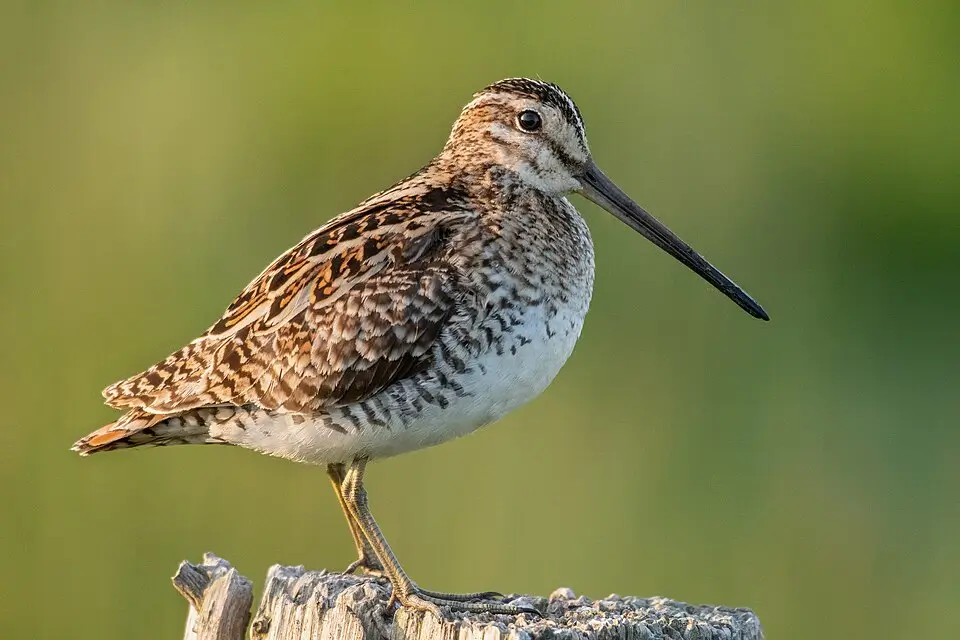
The common snipe is a medium-sized wading bird, instantly recognizable — once you know what to look for — by a set of distinctive physical characteristics. The most obvious feature is its remarkably long, straight bill, which can measure roughly a quarter of the bird's total body length. This specialized bill is a marvel of evolutionary engineering, perfectly adapted for probing soft mud and wet soil in search of invertebrates, worms, and other prey items buried below the surface. The bill's tip is highly sensitive and flexible, allowing the snipe to feel and grasp prey underground without needing to open its entire bill.
The bird's plumage is a masterpiece of cryptic camouflage. Its upper parts are a rich mixture of brown, buff, black, and white streaks and bars that blend almost seamlessly with the dead grasses, reeds, and muddy substrate of its preferred wetland habitats. Pale stripes run along the crown and back, providing disruptive patterning that breaks up the bird's outline against a textured background. The underparts are generally paler, often white with brown streaking on the breast and flanks. When a common snipe crouches motionless in vegetation — which is its first line of defense when approached — it can be virtually impossible to detect, even at close range.
Both sexes are similar in appearance, which is relatively uncommon among game birds. The common snipe is approximately 25 to 27 centimeters in length, with a wingspan ranging from roughly 44 to 47 centimeters. These are not large birds by any measure, but their compact, muscular build powers an astonishing burst of speed when flushed.
One of the most remarkable biological traits of the common snipe is its aerial display, known as "drumming" or "winnowing." During the breeding season, males perform dramatic display flights, climbing high into the sky before diving steeply with their outer tail feathers spread wide. The rush of air over these stiffened feathers produces a distinctive, haunting sound — often described as a trembling or bleating hum — that carries long distances across open wetland habitat. This sound, produced entirely by the physical interaction of air and feathers rather than the bird's vocal cords, is one of the most evocative calls of the northern wetlands.
The common snipe is primarily crepuscular and nocturnal in its feeding habits, meaning it tends to be most active around dawn and dusk. It feeds by probing soft ground with its long bill, using a rhythmic "sewing machine" motion to work the substrate. Its diet consists primarily of earthworms, insect larvae, small crustaceans, and occasionally plant material.
Habitat & Range
The common snipe has one of the broadest distributions of any shorebird in the Northern Hemisphere. Its breeding range spans a vast swath of the Palearctic region, from Iceland and the British Isles across Scandinavia, Russia, and Siberia to the Pacific coast of Asia. In North America, the closely related Wilson's snipe (Gallinago delicosa) was historically considered the same species, and the two remain nearly identical in appearance and behavior, though they are now generally recognized as separate species by most taxonomic authorities.
Throughout its range, the common snipe gravitates toward wetland habitats of all kinds. It favors freshwater marshes, bogs, fens, wet meadows, riverine floodplains, flooded agricultural fields, and the margins of lakes and ponds. The key requirement is soft, moist soil that can be probed for food, combined with sufficient vegetative cover — grasses, sedges, rushes, and low shrubs — to provide concealment from predators.
In Idaho, conditions are often excellent for snipe. The state's diverse geography includes extensive river systems such as the Snake River Plain, high-elevation mountain meadows, irrigated farmland, and numerous lakes and reservoirs. Wetland areas in southern Idaho, the upper Snake River region, and the many marshes scattered throughout the state's northern panhandle provide ideal conditions during migration and, in some areas, during the breeding season. Idaho's location along the Pacific Flyway makes it an important stopover point for migratory shorebirds, and snipe numbers can be particularly notable during spring and fall migration periods.
Snipe in Idaho tend to favor areas where emergent vegetation meets wet, open ground — edges of marshes, boggy meadow corners, and the reed-fringed margins of slow-moving streams. Hunters and birdwatchers alike often find success by working these transitional zones during the early morning and late afternoon hours when the birds are most active.
Hunting Information
Snipe hunting is a legitimate and highly regarded wing-shooting tradition that has been enjoyed across the world for generations. The common snipe — and its close relative, Wilson's snipe, in North America — has long been considered a premium sporting bird, not only because of its challenging flight characteristics but also because of its excellent table quality. The meat is dark, rich, and flavorful, comparable in many respects to woodcock.
The challenge of snipe hunting lies largely in the bird's behavior. When approached, a snipe will typically hold tight in heavy cover, relying on its camouflage rather than fleeing. When it does flush, often at the last possible moment and from beneath one's feet, it launches into a rapid, twisting, zigzagging flight that makes accurate shooting genuinely difficult. This unpredictable escape pattern, combined with the bird's relatively small size, demands quick reflexes and an experienced eye. Light field loads are typically preferred, as the snipe is not a heavily built bird, and open to modified choke configurations generally work well in the types of brushy, open wetland terrain where snipe are commonly found.
In Idaho, hunters interested in pursuing snipe should consult the Idaho Department of Fish and Game for current season dates, bag limits, and licensing requirements, as these regulations can change from year to year. While specific season dates and limits were not available at the time of this writing, snipe are a migratory species managed under the Federal Migratory Bird Treaty Act, meaning that a valid hunting license along with a Federal Migratory Bird Hunting and Conservation Stamp (commonly known as the "Duck Stamp") is typically required. Hunters are strongly encouraged to verify all current requirements directly with Idaho Fish and Game and the U.S. Fish and Wildlife Service before heading afield.
Dogs can be a valuable asset when hunting snipe. Breeds that excel in wet, dense cover — spaniels and certain pointing breeds among them — are well-suited to working snipe habitat. A good bird dog can locate holding birds more efficiently and help retrieve downed birds from dense marsh vegetation where they might otherwise be difficult to find.
Conservation
The common snipe is currently listed as a species of Least Concern on the International Union for Conservation of Nature (IUCN) Red List, reflecting its wide distribution and relatively stable global population. That said, like many wetland-dependent species, the common snipe is not entirely insulated from the pressures of habitat loss. The draining and conversion of wetlands for agricultural and urban development has reduced available habitat in many parts of its range, and ongoing wetland conservation efforts are important for the long-term well-being of the species.
In North America, programs administered through organizations such as Ducks Unlimited, the North American Wetlands Conservation Act, and various state wildlife agencies have helped to preserve and restore millions of acres of wetland habitat, benefiting snipe along with countless other species of waterfowl, shorebirds, and wetland wildlife. Hunters themselves have historically played a meaningful role in wetland conservation, as revenues from the Federal Duck Stamp program have funded the protection and acquisition of critical wetland areas across the continent.
In Idaho, conservation efforts focused on maintaining healthy riparian corridors, irrigated meadows, and natural wetland complexes serve the dual purpose of supporting both wildlife populations and the hunting opportunities that depend on them. Responsible hunting, combined with active habitat stewardship, ensures that future generations of outdoor enthusiasts will have the chance to experience the thrill of a flushing snipe against a cold autumn sky.