Overview
Few birds in North America command as much admiration and wonder as the Wood duck (Aix sponsa). Widely regarded as one of the most beautiful waterfowl species on the continent — and by many accounts, one of the most strikingly beautiful ducks in the entire world — the Wood duck occupies a special place in the hearts of birdwatchers, wildlife enthusiasts, and hunters alike. With its jewel-toned plumage, unique nesting habits, and remarkable comeback story from the brink of population collapse, the Wood duck stands as a testament to what dedicated conservation efforts can achieve.
In Georgia and across the broader Southeastern United States, the Wood duck is a familiar and beloved resident. Its preference for wooded swamps, bottomland hardwood forests, and slow-moving rivers makes it a common sight in the diverse wetland landscapes that define much of the Peach State. Whether you are paddling a quiet river at dawn or walking a wooded trail beside a beaver pond, the flash of iridescent green and chestnut as a Wood duck takes flight is an unforgettable sight.
This article explores the biology, behavior, habitat, and conservation of this remarkable species, along with what hunters and outdoor enthusiasts in Georgia should know about enjoying and protecting it.
Biological Traits
The Wood duck, Aix sponsa, belongs to the family Anatidae — the broad family of birds that includes all ducks, geese, and swans. Its genus name, Aix, is derived from a Greek word referring to a diving bird, while sponsa is a Latin term meaning "betrothed" or "bride," a reference to the extraordinary, almost ornate appearance of the male in breeding plumage.
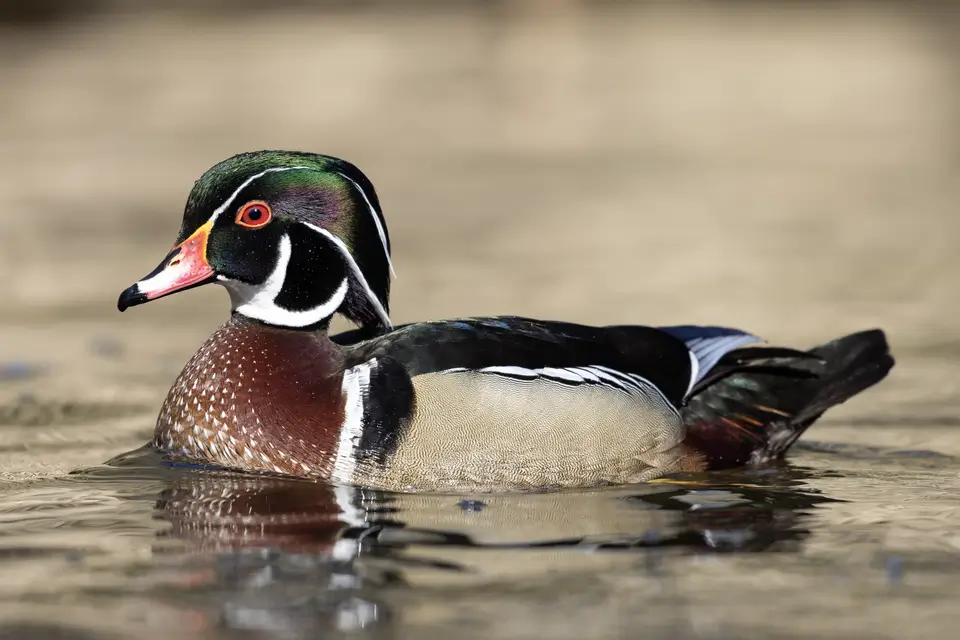
The male Wood duck is nothing short of spectacular. His head is adorned with an elaborate iridescent green and purple crest, swept back like a flowing mane. Bold white markings trace geometric patterns along his face and throat, while his chest is a deep chestnut-red marked with white spots. His flanks are a warm buff-gold, separated from the chest by crisp black and white bars. His bill is a vivid combination of red, white, and black, and his eyes are a striking scarlet red. No amount of description fully does justice to the living, moving bird.
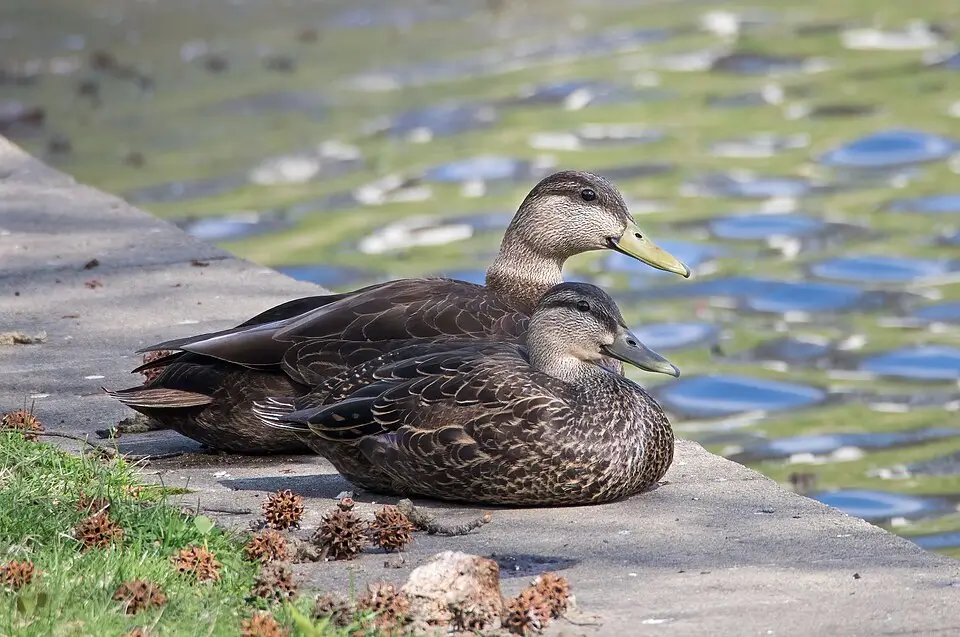
Female Wood ducks, like most female ducks, are considerably more subdued in appearance — an evolutionary adaptation that provides camouflage during nesting. The hen is primarily gray-brown with a distinctive white teardrop-shaped eye ring, which makes her readily identifiable among other female ducks.
Wood ducks are medium-sized ducks, compact and agile in flight. They are uniquely adapted among North American waterfowl for life in forested environments. Their feet feature strong, sharp claws that allow them to perch and grip branches and tree cavities with ease — a remarkable trait not shared by most other ducks. Their broad, long tails and short, broad wings help them navigate with agility through the dense canopy of wooded swamps and riverside forests.
One of the most extraordinary aspects of Wood duck biology is their nesting behavior. Unlike the vast majority of ducks, which nest on the ground, Wood ducks are cavity nesters. They seek out natural tree cavities — often old woodpecker holes, particularly those made by Pileated Woodpeckers — and hollow limbs over or near water. The female lays anywhere from around 6 to 15 eggs per clutch, and incubation typically lasts approximately 28 to 37 days. Within just one to two days of hatching, the ducklings must perform one of the most dramatic acts in all of birdlife: they leap from the nest cavity, sometimes from heights of 50 feet or more, landing on the forest floor or water below. Their light bodies and downy feathers cushion the fall, and the tiny ducklings are remarkably resilient. They follow their mother to water almost immediately and begin feeding on their own within hours.
Wood ducks are omnivorous and opportunistic feeders. Their diet shifts with the seasons and includes aquatic plants, seeds, acorns, berries, aquatic insects, and small invertebrates. Acorns are a particularly important food source during the fall and winter months, and bottomland hardwood forests rich in oak trees are prime Wood duck habitat for this reason.
Wood ducks are also known for "dump nesting," a behavior where multiple females lay eggs in the same cavity, sometimes resulting in clutches of 30 or more eggs, though many of these eggs fail to hatch successfully under such crowded conditions.
Habitat & Range
The Wood duck is found across a broad range in North America. There are two primary populations: an eastern population that ranges from the Gulf Coast northward through the eastern United States and into southern Canada, and a western population concentrated along the Pacific Coast. Georgia, situated in the heart of the Southeast, falls squarely within the range of the eastern population, and Wood ducks are present in the state year-round, making Georgia an important stronghold for the species.
Wood ducks show a strong preference for forested wetland environments. Bottomland hardwood forests — low-lying forested areas along rivers and streams that experience periodic flooding — are prime habitat. Wooded swamps, beaver ponds, oxbow lakes, slow-moving rivers lined with mature trees, and shrubby wetlands all provide ideal conditions. The species requires a combination of water, mature trees with nesting cavities, and abundant food sources including aquatic vegetation and mast-producing hardwoods such as oaks.
Georgia's diverse landscape offers tremendous Wood duck habitat. The state's numerous river systems, including the Altamaha, Savannah, Flint, Ogeechee, and Chattahoochee Rivers and their associated bottomlands, provide extensive forested wetland corridors. The coastal plain of southern Georgia is particularly rich in the kind of swampy, wooded habitat that Wood ducks favor. However, suitable habitat can also be found throughout the Piedmont region and even in the mountain foothills, wherever wooded wetlands and forest-fringed waterways exist.
Because Wood ducks nest in tree cavities, the availability of mature trees with suitable hollow spaces is a critical habitat requirement. This is why Wood duck populations responded so dramatically and positively to the widespread installation of nest boxes — artificial structures that supplement natural cavity availability and allow Wood ducks to thrive even in areas where large, old trees with natural cavities have been reduced by logging or land development.
Hunting Information
The Wood duck holds a prominent place in waterfowl hunting traditions across Georgia and the Southeast. For many waterfowlers, a morning hunt in a flooded bottomland timber stand or along a wooded creek, with Wood ducks weaving through the trees at first light, represents one of the most exciting and challenging experiences in all of duck hunting. The birds' speed, agility, and tendency to fly through dense timber make them a demanding target that tests a hunter's reflexes and shooting skills.
Wood duck hunting in Georgia is regulated by the U.S. Fish and Wildlife Service in coordination with the Georgia Department of Natural Resources (Wildlife Resources Division). As with all migratory waterfowl, hunting seasons and bag limits are set annually and are subject to change based on population surveys and management objectives. Hunters are required to possess the appropriate state and federal licenses and stamps, including a Federal Duck Stamp, which directly funds wetland conservation. Specific season dates, bag limits, and licensing requirements for any given year should always be confirmed through the Georgia Department of Natural Resources' official resources and the current Georgia Waterfowl Hunting Regulations before heading afield.
Many experienced Wood duck hunters in Georgia focus their efforts on flooded timber, wooded creek bottoms, swampy impoundments, and beaver ponds — the kinds of places where Wood ducks feel most at home. Early morning flights, when birds move from roosting areas to feeding areas, can offer outstanding shooting opportunities. Calling Wood ducks is a skill in itself; the hen's distinctive rising "oo-eek, oo-eek" call is a recognizable sound in wooded wetlands and can be replicated with specialized Wood duck calls to draw birds into range.
Decoys are also employed by many Wood duck hunters, often set in small spreads near wooded banks or partially submerged logs to mimic the way Wood ducks naturally loaf and rest along the water's edge.
Conservation
The Wood duck's conservation story is one of the great success stories in North American wildlife management. By the late 19th and early 20th centuries, unregulated market hunting and widespread habitat destruction had reduced Wood duck populations to dangerously low levels. There was genuine concern that the species might follow the Passenger Pigeon into extinction.
The passage of the Migratory Bird Treaty Act of 1918 was a turning point, providing legal protection for Wood ducks and other migratory birds and eliminating the commercial hunting that had devastated populations. As legal protections took hold and habitat conservation efforts expanded, Wood duck numbers began to recover.
The widespread adoption of nest box programs proved to be a transformative conservation tool. Biologists, hunters, and conservation organizations — including Ducks Unlimited and various state wildlife agencies — installed thousands of nest boxes across suitable habitat, dramatically increasing nesting success and helping populations rebound. Today, Wood ducks are one of the most abundant duck species in eastern North America and are considered a conservation success story of the first order.
Ongoing conservation priorities for Wood ducks include the protection and restoration of bottomland hardwood forests, the management of wooded wetlands, and the continued maintenance of nest box programs. Hunters in Georgia and throughout the Southeast play a direct role in conservation through the purchase of hunting licenses and Federal Duck Stamps, revenues from which fund wetland acquisition and habitat protection.
The Wood duck's remarkable recovery reminds us that wildlife populations can rebound when given adequate protection, suitable habitat, and sustained conservation commitment. It stands as an inspiring example for wildlife managers, hunters, and conservationists working to protect North America's rich natural heritage.