Overview
Few waterfowl carry the mystique and sporting tradition of the American black duck (Anas rubripes). A fixture of eastern North American wetlands for centuries, this robust dabbling duck has earned a devoted following among waterfowlers, birders, and wildlife enthusiasts alike. Despite its name, the American black duck is not truly black — rather, it displays a rich, dark chocolate-brown plumage that sets it apart from the more familiar mallard, to which it is closely related. Secretive, wary, and supremely adapted to both coastal marshes and inland freshwater environments, the American black duck represents one of the great native waterfowl species of the eastern United States and Canada.
For hunters and conservationists in Georgia and across the broader Southeast, the American black duck holds a special place in the annual waterfowl calendar. Though more commonly associated with the northeastern United States and eastern Canada, black ducks do venture into southern states during migration and winter, offering occasional opportunities for duck hunters who know where to look. Understanding this bird — its biology, habits, habitat preferences, and the conservation challenges it faces — is essential for anyone who pursues it in the field or simply wishes to appreciate one of North America's most compelling waterfowl species.
Biological Traits
The American black duck is classified within the family Anatidae, the large and diverse family of ducks, geese, and swans. Its genus, Anas, contains many of the world's most familiar dabbling ducks, including the mallard (Anas platyrhynchos), the gadwall, and the northern pintail. The black duck's closest relative is unquestionably the mallard, and the two species are capable of producing fertile hybrid offspring — a fact that has significant implications for black duck conservation, as will be discussed later.
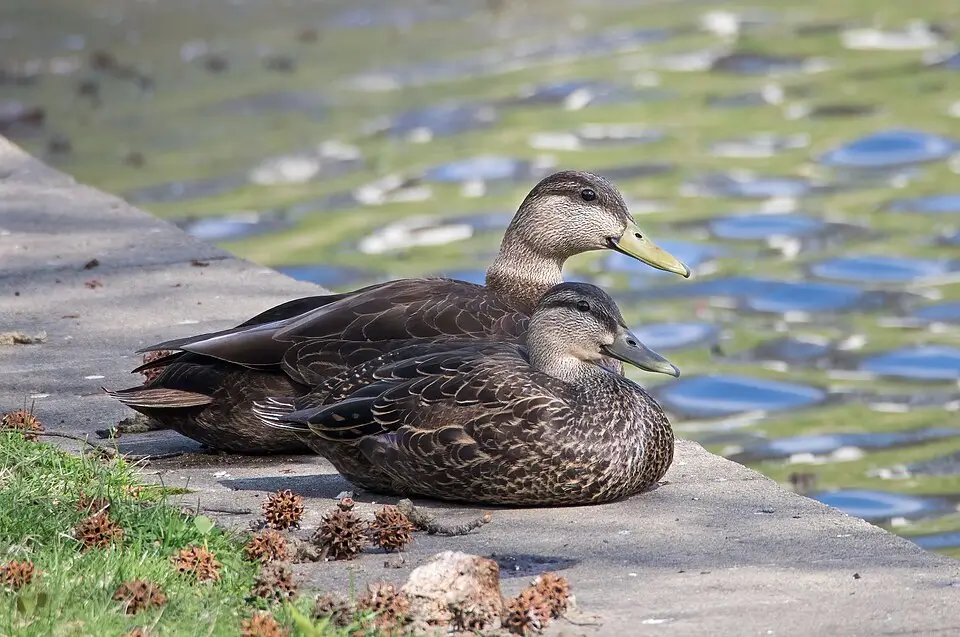
In terms of physical appearance, the American black duck is a large, stocky dabbling duck. Both males (drakes) and females (hens) display a very similar dark brown body plumage, heavily streaked with buff-colored feather edgings that create a distinctive scalloped pattern. The head and neck tend to be noticeably paler than the body, creating a contrast that helps observers distinguish the species in mixed flocks. One of the most striking field marks of the American black duck is its speculum — the iridescent patch of secondary feathers on the wing — which glows a vivid violet-purple, bordered by black. Unlike the mallard's speculum, the black duck's iridescent patch typically lacks the prominent white borders, a useful distinction when identifying birds in flight.
The bill of the American black duck also provides useful identification clues. In drakes, the bill is a clean, bright yellow-olive, while in hens it tends to be a duller, more muted olive-green with darker markings. The legs and feet of both sexes are orange to reddish-orange, a characteristic shared with the mallard.
In terms of size, the American black duck is comparable to a mallard. Adult birds typically measure between 21 and 23 inches in length, with a wingspan ranging from roughly 35 to 37 inches. They are strong, powerful fliers, capable of swift and direct flight — a trait well known to hunters who have watched flocks rocketing low over marsh grass with seemingly effortless speed.
Like all dabbling ducks, the American black duck feeds primarily by tipping up in shallow water, reaching down with its bill to forage for aquatic plants, seeds, invertebrates, and small aquatic creatures. It can also feed on land, grazing on grasses, grains, and agricultural crops. This dietary flexibility makes the black duck highly adaptable to a range of wetland environments across its range.
One behavioral trait that has long impressed hunters and naturalists alike is the American black duck's exceptional wariness. Compared to many other puddle ducks, black ducks are notoriously alert and difficult to decoy. Experienced waterfowlers often describe them as among the most challenging of all dabbling ducks to bring within range, earning them a reputation as the "black ghost" of the marsh.
Habitat & Range
The American black duck is fundamentally a bird of eastern North America. Its breeding range extends across much of the northeastern United States and a broad swath of eastern Canada, from the Atlantic coast westward through the Great Lakes region and into central Canada. Key breeding areas include the boreal forests and wetlands of Quebec, Ontario, and the Maritime Provinces, as well as the coastal marshes and inland bogs of New England and the Great Lakes states.
During the breeding season, black ducks favor a variety of freshwater and brackish wetland habitats. They nest in forested wetlands, beaver ponds, lake margins, coastal salt marshes, and shrubby uplands near water. The nest is typically a shallow depression on the ground, lined with down feathers and concealed in dense vegetation. Hens are solely responsible for incubation and rearing of the ducklings, which are precocial — meaning they are mobile and capable of feeding themselves shortly after hatching.
In winter, the American black duck's range shifts southward and toward the coast. Large numbers of wintering birds congregate along the Atlantic coast from New England south through the Mid-Atlantic states, with significant populations utilizing the extensive tidal marshes, estuaries, bays, and coastal wetlands of states like New Jersey, Delaware, Maryland, Virginia, and North Carolina. Some birds continue further south during particularly cold winters, reaching the coastal marshes and inland wetlands of the Carolinas, Georgia, and Florida.
For Georgia waterfowlers, the American black duck is not a common or abundant species, but it does appear in the state during winter months, particularly along coastal areas, tidal creeks, rice field impoundments, and freshwater marshes. Georgia's coastline, with its extensive network of tidal marshes, barrier island wetlands, and riverine habitats, provides suitable wintering habitat for black ducks moving through on their southward migration. Hunters and birders in coastal Georgia counties have recorded black ducks with some regularity during the winter season, though they are never as numerous here as they are further north along the Atlantic coast.
Hunting Information
The American black duck has a long and storied history as a game bird in North America. For generations of waterfowlers along the Atlantic Flyway — the broad migratory corridor stretching from the Canadian Maritime Provinces to the Gulf of Mexico — the black duck has been regarded as one of the premier quarry species, prized for its wariness, its sporting qualities in the air, and the quality of its dark, richly flavored table fare.
Hunting the American black duck requires patience, skill, and a thorough understanding of the bird's habits. As noted, black ducks are famously wary, often hanging up well outside decoy spreads or trading high overhead without committing. Successful black duck hunters typically emphasize meticulous concealment, natural-looking decoy spreads, and careful calling — black ducks tend to respond best to subtle, realistic calling rather than aggressive flagging and high-volume quacking.
Black ducks are most commonly hunted in tidal marshes, coastal estuaries, freshwater impoundments, and flooded agricultural fields. Early morning and late afternoon flights are typically most productive, as birds move between roosting and feeding areas.
Because hunting regulations for migratory waterfowl in the United States are established annually by the U.S. Fish and Wildlife Service and administered at the state level, specific season dates, bag limits, and licensing requirements for the American black duck in Georgia and other states can vary from year to year. Hunters are strongly advised to consult the most current Georgia Department of Natural Resources waterfowl regulations and the U.S. Fish and Wildlife Service Migratory Bird Hunting regulations for up-to-date, legally accurate information before pursuing this species. No specific season dates or bag limits are referenced in this article, as these figures are subject to annual revision.
Conservation
The conservation story of the American black duck is one of the more closely watched narratives in North American waterfowl management. Over the course of the 20th century, black duck populations experienced significant long-term declines from historic highs, driven by a combination of factors including habitat loss, hunting pressure, and — perhaps most notably from a biological standpoint — increasing hybridization with the closely related mallard.
As mallard populations expanded eastward through the 20th century, aided in part by game farm releases and habitat changes, the two species came into increasingly frequent contact throughout the black duck's core range. Because the two ducks are so closely related and will readily interbreed, hybridization has become a meaningful concern for wildlife biologists working to maintain the genetic integrity of pure American black duck populations. The visual identification of hybrid birds in the field can be challenging, adding complexity to harvest management.
Habitat conservation has been central to black duck recovery efforts. The protection and restoration of coastal and freshwater wetlands throughout the Atlantic Flyway remains a critical priority. Organizations such as Ducks Unlimited, the Atlantic Flyway Council, and numerous state and federal agencies have invested significantly in wetland protection, restoration of tidal marshes, and breeding habitat enhancement across the species' range.
The North American Waterfowl Management Plan, a landmark international conservation framework involving the United States, Canada, and Mexico, has specifically identified the American black duck as a species of management concern, emphasizing the need for coordinated habitat conservation and carefully managed harvest levels to support population stability and long-term recovery.
Today, while the American black duck remains a huntable species across much of its range, management of the harvest is approached with careful attention to population monitoring data gathered through annual waterfowl breeding surveys, band recovery programs, and winter waterfowl counts. The commitment of hunters, conservation organizations, and wildlife agencies to the long-term stewardship of this species reflects the broader ethic of conservation that has historically defined responsible waterfowl hunting in North America.
The American black duck endures as a symbol of the wild, unspoiled wetlands of eastern North America — a bird worthy of both pursuit and protection, and a reminder of what careful, science-based wildlife management can achieve.