Overview
Few birds capture the spirit of the American landscape quite like the wild turkey. Bold, wary, and magnificently adapted to the forests and fields of North America, Meleagris gallopavo stands as one of the continent's most recognizable and celebrated game birds. With its iridescent plumage, thunderous gobble, and uncanny ability to vanish into the woodland at the first hint of danger, the wild turkey has earned a place of deep reverence among wildlife enthusiasts, conservationists, and hunters alike.
In the state of Georgia, the wild turkey holds a particularly special status. The rolling hardwood forests, pine savannas, river bottoms, and agricultural edges that define the Georgia landscape provide nearly ideal habitat for this impressive bird. From the Blue Ridge Mountains in the north to the longleaf pine flatwoods in the south, wild turkeys can be found across nearly every corner of the Peach State. Whether you are a seasoned turkey hunter rising before dawn to call in a thundering tom, a wildlife photographer hoping to capture a strutting gobbler in golden morning light, or simply a nature lover who thrills at the sight of a flock of these birds moving through the woods, Georgia offers extraordinary opportunities to experience the wild turkey in its element.
Understanding the biology, behavior, and habitat needs of the wild turkey deepens our appreciation for this remarkable bird and helps ensure that populations remain healthy and abundant for generations to come.
Biological Traits
The wild turkey, Meleagris gallopavo, belongs to the family Phasianidae, which includes pheasants, grouse, peacocks, and other large ground-dwelling birds. It is the heaviest member of the order Galliformes native to North America, and one of only two turkey species in the world — the other being the ocellated turkey (Meleagris ocellata) of the Yucatán Peninsula.
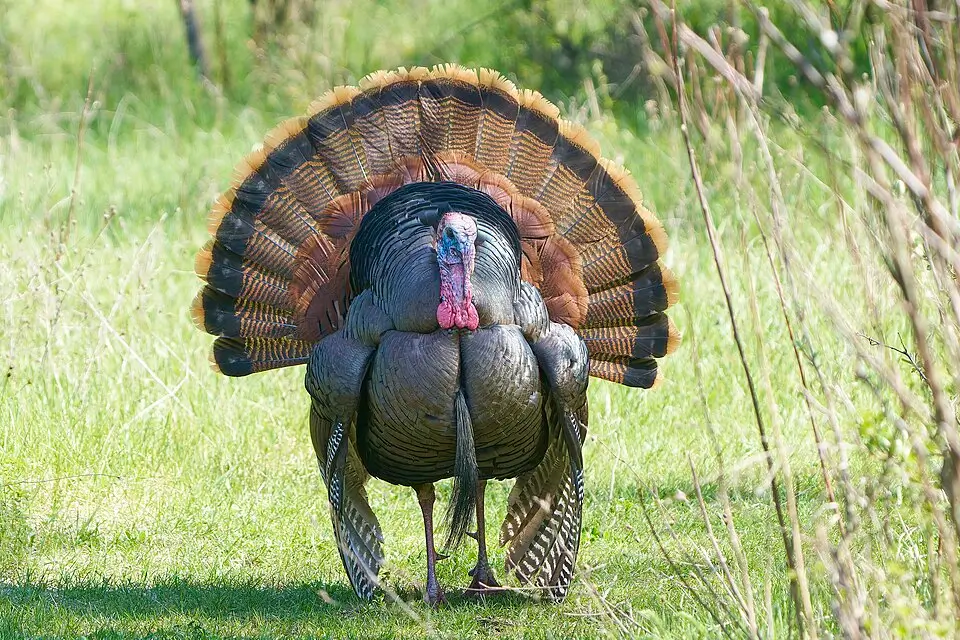
Wild turkeys are striking birds, particularly the males, known as toms or gobblers. Adult males are large and powerfully built, typically weighing between 11 and 24 pounds, though exceptional individuals can exceed this range. Their plumage is a breathtaking mosaic of iridescent bronze, copper, gold, and green feathers that catch the light differently depending on the angle of view. The male's bare head and neck can shift colors dramatically — from vivid red to electric blue to ghostly white — depending on the bird's emotional state. Toms are also defined by several distinctive anatomical features: a fleshy, pendulous "snood" that hangs over the beak, a "carunculated" wattle of bumpy red skin beneath the chin, sharp leg spurs used in combat with rival males, and a fan-shaped tail that is spread dramatically during courtship displays. Perhaps the most iconic of these features is the "beard," a tuft of coarse, hair-like modified feathers that grows from the breast of males and, less commonly, older females.
Female wild turkeys, called hens, are noticeably smaller and more cryptically colored, with brownish-buff plumage that provides effective camouflage while nesting and foraging. This size difference — known as sexual dimorphism — is one of the most pronounced among North American birds.
Wild turkeys are highly vocal animals. The gobble of a mature tom is one of the most thrilling sounds in the natural world, audible from over a mile away under the right conditions. Beyond the gobble, turkeys communicate through a sophisticated repertoire of calls including yelps, clucks, purrs, cutts, and cackles, each conveying specific social information to other birds in the flock.
These birds are omnivores with a broad and opportunistic diet. They forage actively on the ground, scratching through leaf litter to uncover acorns, seeds, berries, insects, small reptiles, and even amphibians. Mast crops — particularly acorns from the abundant oak trees found across Georgia — are critically important seasonal food sources. In agricultural areas, turkeys readily exploit fields planted with corn, soybeans, and other grains.
Wild turkeys roost in trees at night, typically selecting large, horizontal branches in mature hardwoods or pines that offer protection from ground-based predators. Their powerful vision — estimated to be three times sharper than human eyesight, with a nearly 270-degree field of view — makes them extraordinarily vigilant and difficult to approach during daylight hours.
Habitat & Range
The wild turkey is a species of remarkable adaptability, occupying an extraordinary diversity of habitats across North America. The species' native range originally encompassed much of the continental United States, parts of northern Mexico, and portions of southern Canada. Following significant population declines in the 19th and early 20th centuries due to overhunting and habitat loss, successful restoration efforts have expanded the wild turkey's range to all 49 contiguous states and Hawaii, as well as parts of Canada and Mexico.
Wild turkeys thrive in a mosaic of habitat types, though they show a clear preference for landscapes that combine mature forest — particularly hardwoods that produce mast crops like acorns, beechnuts, and wild berries — with open areas such as meadows, pastures, agricultural fields, and forest edges. This combination provides the diverse resources that turkeys need across different seasons: dense forest for roosting and escaping predators, open areas for displaying and feeding, and a variety of food sources throughout the year.
Georgia's varied geography makes it an outstanding wild turkey state. The mountainous forests of the Blue Ridge in the northern part of the state provide classic turkey habitat, with mixed hardwood-conifer forests covering rugged terrain. The Piedmont region, a broad transitional zone of rolling hills between the mountains and the coastal plain, offers a rich patchwork of hardwood forests, farmland, and river corridors that support robust turkey populations. In southern Georgia, the coastal plain's longleaf pine ecosystems, interspersed with hardwood drains, creek bottoms, and open agricultural land, create conditions where turkeys flourish. The state's numerous wildlife management areas, national forests, and private timberlands collectively provide millions of acres of productive turkey habitat.
Hunting Information
The wild turkey is among the most pursued and prized game birds in North America, and Georgia has a long, proud tradition of turkey hunting. The experience of calling a gobbler into range on a spring morning — working through a landscape draped in dogwood blossoms and morning mist, trading calls with a bird that may respond from hundreds of yards away — is considered by many hunters to be the pinnacle of upland bird hunting.
Turkey hunting typically involves hunters concealing themselves along forest edges, in natural terrain features, or in portable blinds, and using calls to mimic the vocalizations of hens and other turkeys. A wide variety of calls are used, including friction-based slate and box calls, mouth-operated diaphragm calls, and tube calls. Skilled callers can replicate virtually the entire turkey vocabulary, and the art of calling is a deeply studied and celebrated aspect of turkey hunting culture.
Georgia offers spring and fall turkey seasons, providing hunters with two distinct opportunities per year. Spring hunting coincides with the breeding season, when toms are actively gobbling and responding aggressively to hen calls. Fall hunting offers a different, often more challenging pursuit, as hunters may seek to locate and scatter flocks, then call the scattered birds back together. Hunters pursuing turkeys in Georgia should always consult the Georgia Department of Natural Resources (DNR) Wildlife Resources Division for the most current and accurate information on season dates, bag limits, licensing requirements, and any special regulations applicable to the specific area they plan to hunt, as regulations can change from year to year.
Shotguns loaded with heavy shot are the most common choice for turkey hunting, though archery and crossbow equipment are also popular and often have their own extended seasons. Hunting wild turkeys successfully requires patience, woodsmanship, an understanding of turkey behavior, and a genuine respect for the bird's extraordinary senses. The challenge and the reward are both considerable.
Conservation
The conservation story of the wild turkey is one of the great success stories in American wildlife management. By the early 20th century, unregulated market hunting and widespread deforestation had reduced wild turkey populations to dangerously low levels, with the species extirpated from many parts of its former range. In the 1930s, estimates put the total North American population at fewer than 30,000 birds.
The recovery of the wild turkey is a testament to the power of science-based wildlife management, habitat restoration, and hunter-funded conservation. The development of the "cannon net" trap-and-transplant technique in the mid-20th century allowed wildlife managers to capture wild birds and relocate them to areas where populations had been wiped out. Organizations such as the National Wild Turkey Federation (NWTF), founded in 1973, have partnered with state and federal agencies to restore habitat, fund research, and advocate for sound wild turkey management across the continent. Today, the wild turkey population in North America is estimated at approximately 7 million birds — a remarkable recovery from the brink of collapse.
In Georgia, the wild turkey has been successfully restored across the state through coordinated management efforts. The species is no longer considered threatened or endangered, and healthy, sustainable populations support both hunting and wildlife viewing. Ongoing habitat management — including prescribed fire in longleaf pine ecosystems, forest management that maintains mast-producing hardwoods, and preservation of diverse landscape mosaics — continues to benefit wild turkeys and the countless other species that share their habitat.
Hunters play a central and ongoing role in wild turkey conservation through the purchase of licenses and equipment, contributions to the Federal Aid in Wildlife Restoration Act (commonly known as the Pittman-Robertson Act), and active involvement in organizations dedicated to turkey habitat and population management. This model of hunter-funded conservation remains one of the most effective mechanisms for wildlife stewardship in the world.
The future of the wild turkey in Georgia and across North America looks bright, provided that habitat is protected and managed thoughtfully, populations are monitored carefully, and the hunting traditions that have long supported conservation efforts continue to thrive.