Overview
Few animals capture the spirit of the American West quite like the mule deer. With its oversized, mule-like ears, distinctive bounding gait, and regal, forked antlers, the mule deer (Odocoileus hemionus) is one of the most recognized and celebrated big-game animals on the continent. Whether you encounter one silhouetted against a crimson Rocky Mountain sunset or pick up its tracks in a high-desert canyon, the mule deer commands respect and admiration from wildlife enthusiasts, naturalists, and hunters alike.
This species is a cornerstone of western North American ecosystems and a premier target for hunters who make annual pilgrimages to chase it across rugged terrain. Understanding the biology, behavior, and habitat preferences of mule deer is not only fascinating from a scientific standpoint but also essential knowledge for anyone who hopes to pursue or simply observe these remarkable animals. In this guide, we'll explore everything from the mule deer's physical characteristics and life history to its range, hunting traditions, and conservation outlook.
Biological Traits
Taxonomy and Classification
The mule deer belongs to the family Cervidae — the deer family — and the genus Odocoileus, which it shares with its close cousin, the white-tailed deer (Odocoileus virginianus). The species name hemionus is derived from the Greek word for "mule," a direct nod to the animal's most immediately recognizable feature: its large, prominent ears. These ears, which can measure nearly a foot in length, are highly mobile and give the mule deer an exceptional ability to detect sounds across long distances — a critical survival advantage in open and rugged terrain.
There are several recognized subspecies of mule deer, the most notable being the Rocky Mountain mule deer (Odocoileus hemionus hemionus), which represents the largest and most widely distributed form, and the black-tailed deer, which includes the Columbian black-tailed deer (Odocoileus hemionus columbianus) and the Sitka black-tailed deer (Odocoileus hemionus sitkensis). Black-tailed deer are sometimes considered a separate grouping due to their distinct range and certain physical differences, though they remain classified under the same species umbrella.
Physical Appearance
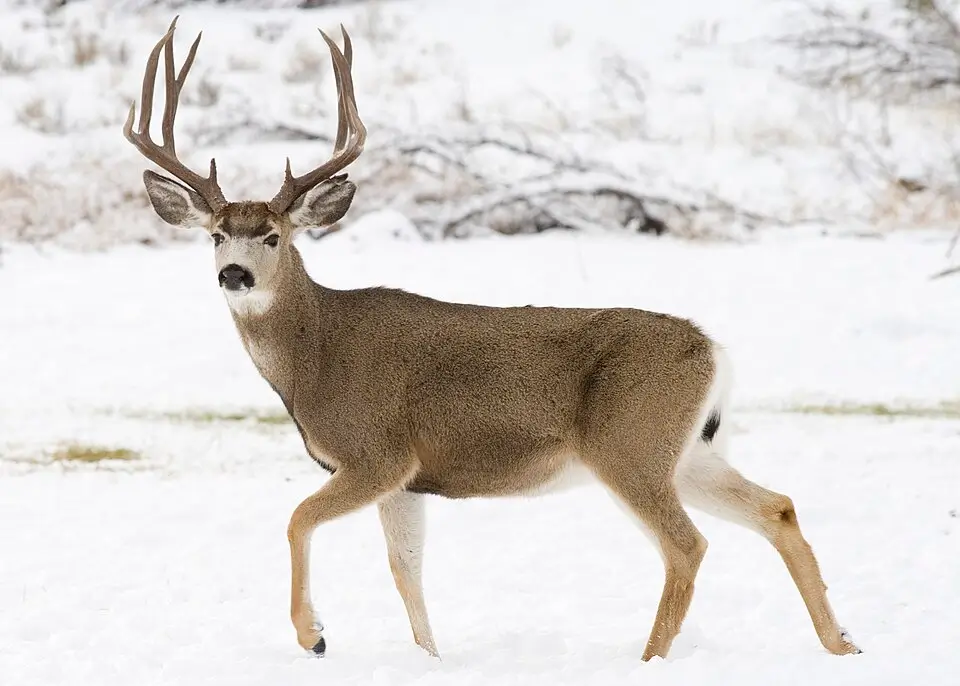
Mule deer are stocky, medium-to-large deer with a characteristic gray-brown coat that tends to be more reddish in summer and grayer in winter. They have a distinctive white rump patch and a narrow, rope-like tail that is either white or black-tipped, depending on the subspecies. This tail coloration is one of the most reliable ways to distinguish mule deer from white-tailed deer in the field — white-tailed deer "flag" their broad, white-underside tails when alarmed, while mule deer do not.
Bucks carry antlers that are uniquely bifurcated, meaning each beam divides or forks into two equal tines, and those tines may fork again. This creates a symmetrical, chandelier-like rack that is distinctly different from the single main beam with multiple tines typical of white-tailed deer antlers. Antler growth begins in spring, coinciding with longer days and increasing testosterone levels, and bucks shed their velvet in late summer as the breeding season approaches.
Adult bucks are noticeably larger than does. Bucks typically weigh anywhere from 150 to over 300 pounds in the largest Rocky Mountain populations, while does are considerably smaller and lighter. Body size also varies significantly by region and subspecies.
Behavior and Locomotion
One of the most distinctive behavioral traits of the mule deer is its unique form of locomotion known as "stotting" or "pronking." When alarmed or fleeing a predator, mule deer will bound with all four feet leaving the ground simultaneously, landing and springing upward again in a pogo-stick-like motion. This gait, while perhaps slower than a full gallop, is extraordinarily effective at navigating steep, rocky, and uneven terrain — the kind of landscape where mule deer most often live.
Mule deer are generally considered less flighty and more deliberate in their movements than white-tailed deer. Where a spooked white-tail might crash immediately through the brush and disappear, a mule deer will often stop at a distance and look back at the source of disturbance — a behavior that hunters are well-acquainted with. This tendency to pause and look back can work both for and against deer in hunting scenarios.
Mule deer are also notable for their migratory behavior. Many populations undertake significant seasonal migrations, moving to higher elevations in summer to take advantage of nutritious alpine vegetation, then descending to lower valleys and foothills as winter snows drive them down. These migrations can span dozens or even hundreds of miles in some populations.
Diet and Feeding Habits
Mule deer are browsers, meaning they feed primarily on the leaves, stems, and twigs of shrubs and trees rather than grazing on grasses. Their diet shifts seasonally based on availability, and they are highly adaptable in what they consume. Common forage plants include sagebrush, bitterbrush, mountain mahogany, cliffrose, and a wide variety of forbs and wildflowers in spring and summer. Mule deer have a four-chambered stomach, allowing them to process and extract maximum nutrition from tough, fibrous plant material through the process of rumination, or "chewing the cud."
Reproduction
The breeding season, known as the rut, typically occurs in late fall — generally November and December for most mule deer populations. During this time, bucks actively seek out and compete for does. Dominant bucks may gather harems of does, though mule deer rut behavior tends to be somewhat less dramatic than that of elk. After a gestation period of approximately 200 days, does give birth in late spring or early summer, usually to one or two spotted fawns. Twins are common, and triplets occasionally occur in areas with excellent forage. Fawns are born with spotted coats that provide excellent camouflage, and they are capable of standing and walking within hours of birth.
Habitat and Range
Mule deer are quintessentially western North American animals. Their range extends from the coast of Alaska and British Columbia southward through the Rocky Mountain states, the Great Basin, the Sonoran Desert, and into the highlands of Mexico and Baja California. In the United States, they are found throughout the western half of the country, with particularly robust populations in states like Colorado, Wyoming, Montana, Idaho, Nevada, Utah, and California.
The species occupies an impressive variety of habitats, including alpine meadows, sagebrush flats, pinyon-juniper woodlands, chaparral, coniferous forests, and desert scrublands. What most of these habitats share in common is open or semi-open terrain with a mix of vegetation types — areas that provide both forage and cover. Mule deer are fundamentally creatures of the edge, thriving where different habitat types meet and intermingle.
Hunting Information
Mule deer hunting is a storied and deeply cherished tradition across the American West. The pursuit of a mature mule deer buck — often called a "muley" by hunters — is considered one of the ultimate big-game challenges in North America. Hunters routinely travel far from home to pursue mule deer in states like Colorado, Wyoming, Utah, and Montana, where public land access remains plentiful and populations are generally strong.
Hunting methods vary depending on terrain and personal preference. Spot-and-stalk hunting, in which hunters glass from a distance with binoculars or spotting scopes and then execute a careful stalk on a located animal, is perhaps the most popular and traditional approach. Mule deer's open habitat makes this method particularly effective. Archery hunting during the early season, rifle hunting during the general season, and muzzleloader hunting in special seasons all provide unique and rewarding opportunities.
A note for hunters in Georgia: Mule deer are not native to Georgia, and there is no mule deer hunting season in the state. Georgia's deer hunting opportunities center on the white-tailed deer, which is abundant throughout the state. Hunters in Georgia who wish to pursue mule deer will need to travel west and obtain the appropriate out-of-state licenses, tags, and permits for their chosen destination state. Specific season dates, license requirements, and tag availability vary significantly by state and management unit, so prospective hunters should consult the wildlife agency of their intended destination well in advance.
Conservation
Mule deer are currently listed as a species of Least Concern by wildlife authorities, reflecting the fact that overall populations, while subject to fluctuations, remain large across their range. However, wildlife managers, hunters, and conservation organizations continue to monitor mule deer populations closely, as certain regional populations have experienced declines linked to a variety of factors including habitat loss, drought, disease, and predator dynamics.
Hunter-conservationists have played an enormous role in mule deer conservation through license and tag fees, which fund state wildlife agencies, as well as through organizations like the Mule Deer Foundation, which works to restore, improve, and protect mule deer habitat across the West. The relationship between regulated hunting and conservation continues to be a powerful model for wildlife management.