Overview
Few animals embody the spirit of North American wildlife quite like the cottontail rabbit. Bounding through open fields, ducking beneath brush piles, and pausing momentarily to twitch a nose at the scent of a passing breeze, the cottontail is a creature that countless people encounter in their daily lives — whether they are wildlife watchers, backyard gardeners, or seasoned hunters. In Georgia, a state rich with diverse ecosystems ranging from the Blue Ridge Mountains in the north to the coastal marshes in the south, the cottontail rabbit holds a particularly beloved place in the outdoor tradition.
For generations, hunting cottontail rabbits has served as an introduction to the sporting life for many young hunters across the country. It is a pursuit that demands patience, sharp eyes, and a keen understanding of the natural world. At the same time, the cottontail plays an indispensable role in the broader ecological web, serving as prey for hawks, foxes, coyotes, and a wide array of other predators that depend on healthy rabbit populations to survive. Understanding the biology, behavior, and habitat needs of the cottontail rabbit enriches the experience of anyone who spends time in the Georgia outdoors.
This guide explores the world of the cottontail rabbit — from its scientific classification and physical characteristics to its habitat preferences, hunting traditions, and conservation status — offering a thorough overview for hunters and wildlife enthusiasts alike.
Biological Traits
The cottontail rabbit belongs to the genus Sylvilagus, a group of small to medium-sized lagomorphs native to the Americas. The genus Sylvilagus encompasses more than a dozen recognized species distributed across North, Central, and South America, making it one of the most diverse and widespread rabbit genera on the continent. The name Sylvilagus is derived from Latin, roughly translating to "forest hare," though cottontails inhabit a much broader range of environments than forests alone.
Cottontails are lagomorphs, which means they belong to the order Lagomorpha — a group that also includes hares and pikas. While they are often confused with rodents due to their small size and similar appearance, lagomorphs are a distinct taxonomic group, distinguished in part by the possession of two pairs of upper incisors rather than one. This unique dental arrangement, along with other anatomical differences, sets rabbits firmly apart from the rodent world.
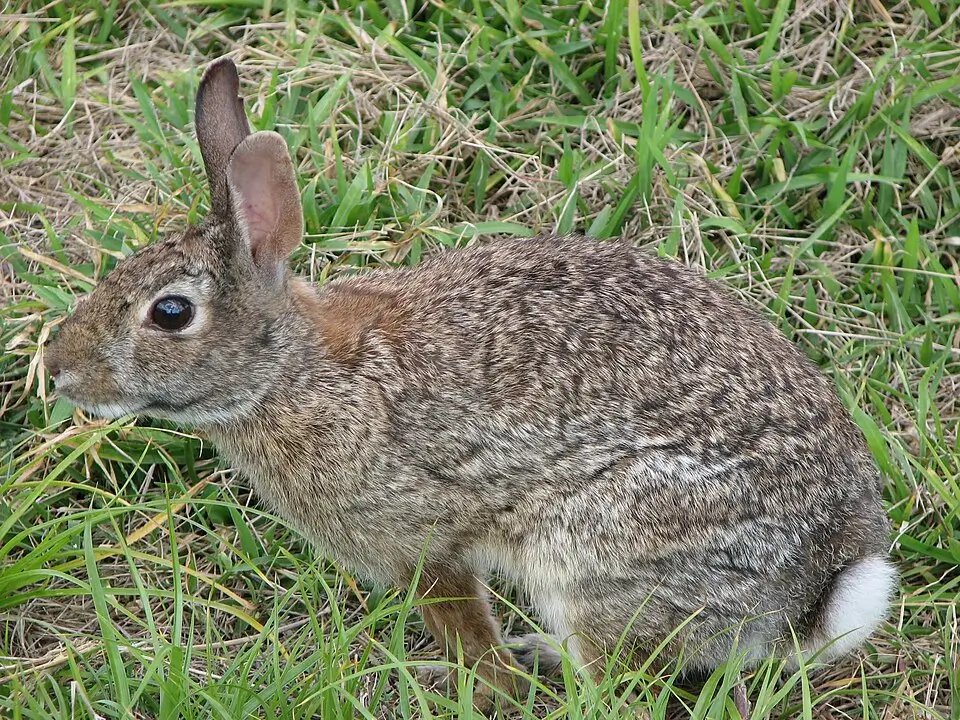
Physically, cottontail rabbits are compact, well-muscled animals built for speed and agility. Their most recognizable feature is the short, rounded tail that appears strikingly white on the underside — a characteristic that gives the entire genus its common name. When a cottontail flees from a predator, this white flash of tail serves as a visual signal that can help alert other rabbits in the area to danger, while simultaneously potentially confusing the pursuing predator.
Cottontails possess long, powerful hind legs that allow them to accelerate rapidly and change direction with remarkable quickness. Their large eyes are positioned on the sides of the head, providing a wide field of vision that helps detect approaching threats from nearly every direction. Their ears, while not as dramatically elongated as those of jackrabbits or hares, are well-developed and highly sensitive, capable of rotating independently to capture sounds from multiple directions simultaneously.
The fur of cottontail rabbits typically ranges from grayish-brown to reddish-brown on the back and sides, with a paler, often white or buff-colored belly. This coloration provides effective camouflage in a wide range of natural settings, helping the rabbit blend into leaf litter, tall grass, and brushy undergrowth. Seasonal variation in coat color is relatively minor in cottontails compared to some northern hare species, which undergo dramatic molts to achieve winter-white camouflage.
Cottontails are prolific breeders, a trait that has contributed significantly to their success as a species. Females, known as does, are capable of producing multiple litters per year, with each litter typically containing several young, called kittens or kits. Newborn cottontails are altricial — born helpless, with eyes closed and very little fur — but they develop rapidly and are capable of independent foraging at a relatively young age. This reproductive strategy helps cottontail populations recover quickly from periods of high predation or habitat disruption.
As herbivores, cottontail rabbits consume a wide variety of plant materials. Their diet shifts with the seasons, incorporating green grasses, clover, and broadleaf plants during warmer months, while transitioning to bark, twigs, and dried vegetation during the winter. Like all lagomorphs, cottontails practice a behavior known as cecotrophy — the consumption of specialized soft fecal pellets called cecotropes, which are rich in nutrients and allow the rabbit to extract maximum nutritional value from its plant-based diet.
Habitat & Range
The genus Sylvilagus is remarkably adaptable, with different species occupying a stunning diversity of habitats across the Americas. In the eastern United States — including throughout Georgia — the Eastern Cottontail (Sylvilagus floridanus) is the most commonly encountered species, thriving in the transitional zones between open fields and woodland edges.
Cottontails are quintessential "edge" animals, meaning they prefer habitats where two or more distinct ecological communities meet. The border between a crop field and a hedgerow, the margin of a forest and an open meadow, or the transition zone between a wetland and upland brush — these are precisely the kinds of environments where cottontail populations tend to flourish. This preference for edge habitat is deeply connected to the rabbit's need for both open foraging areas and dense cover for escape and shelter.
Brush piles, briar thickets, honeysuckle tangles, and overgrown fence rows are among the most important structural elements of cottontail habitat. These dense cover types provide refuge from aerial and ground predators, shelter from extreme weather, and nesting sites for does raising young. The preservation and creation of such habitat features is a key consideration for land managers and wildlife-friendly landowners interested in supporting healthy cottontail populations.
Georgia's diverse landscape offers abundant cottontail habitat. From the agricultural patchwork of the Piedmont region, where fields, woodlots, and brushy draws create extensive edge habitat, to the longleaf pine flatwoods of the coastal plain, where open understories and dense wire grass provide both food and cover, Georgia's geography supports cottontail populations across much of the state. Even suburban and semi-rural areas can support thriving populations, provided sufficient brushy cover and foraging opportunities exist.
Hunting Information
Rabbit hunting holds a storied place in the American outdoor tradition, and Georgia is no exception. For many hunters, chasing cottontails behind a pack of beagles represents a cherished connection to a way of life passed down through families for generations. The sound of beagle hounds working a fresh rabbit track through a frosty briar thicket is one of the most evocative sounds in all of small game hunting.
Cottontail hunting in Georgia is typically pursued during the fall and winter months, when cooler temperatures, leaf-off conditions, and reduced vegetation make rabbits easier to locate and pursue. Hunters commonly employ one of several approaches: walking with beagles or other hounds trained to track and circle rabbits back to waiting hunters, still-hunting by slowly working through likely cover and watching for rabbits to flush, or beating brush piles and dense thickets to push rabbits into the open.
Shotguns are the most popular firearm choice for cottontail hunting, with smaller shot sizes providing an effective pattern for these quick, close-range targets. Light upland guns in 20 or 12 gauge are well-suited to the task. Some hunters also enjoy pursuing cottontails with small-caliber rifles or even archery equipment, particularly during still-hunting situations where close, deliberate shots are possible.
Important Note: Specific season dates, bag limits, and licensing requirements for cottontail rabbit hunting in Georgia were not available in the source data used for this article. Hunters are strongly encouraged to consult the Georgia Department of Natural Resources (DNR) Wildlife Resources Division directly for current and accurate regulations before hunting. Regulations can change from year to year, and compliance with state law is both a legal obligation and an expression of respect for the resource.
Conservation
Cottontail rabbits are not currently considered a species of significant conservation concern across most of their range, owing in large part to their adaptability and reproductive capacity. Healthy populations exist across wide swaths of North America, and the Eastern Cottontail in particular has demonstrated a notable ability to persist in human-modified landscapes.
That said, habitat loss and fragmentation remain the primary long-term threats to cottontail populations at local and regional scales. The conversion of brushy, edge-rich agricultural landscapes to large-scale monoculture farming, suburban development, and the loss of hedgerows and fencerows have reduced available habitat in many areas. Maintaining and enhancing habitat through practices such as establishing brush piles, planting native shrubs and grasses, maintaining vegetated buffers, and managing lands with periodic disturbance can all contribute positively to cottontail population health.
Hunters, wildlife managers, and conservation organizations all play meaningful roles in supporting cottontail populations. Through license purchases and excise taxes on sporting equipment — funds directed through the Federal Aid in Wildlife Restoration Act, commonly known as the Pittman-Robertson Act — hunters contribute directly to wildlife management and habitat conservation programs that benefit cottontails and dozens of other species.
In Georgia, ongoing land conservation efforts, wildlife-friendly farming practices, and the work of organizations dedicated to preserving rural and agricultural landscapes all contribute to a future where cottontail rabbits continue to thrive. For a state as ecologically rich and geographically diverse as Georgia, maintaining the habitat conditions that support healthy small game populations is both a conservation priority and a cultural imperative.
The cottontail rabbit, small and swift, unassuming yet essential, stands as a reminder of the broader natural community that surrounds us. Whether encountered in a backyard garden, spotted in a frost-covered field at dawn, or pursued across a Georgia hillside with a pack of eager beagles, the cottontail rabbit deserves appreciation, respect, and thoughtful stewardship from all who share the landscape with it.