Overview
Few birds in the avian world command as much intrigue as the Common snipe (Gallinago gallinago). Long associated with stealth, speed, and a remarkable ability to vanish into wetland landscapes, the Common snipe has earned a legendary reputation among birdwatchers, naturalists, and hunters alike. Its name has even worked its way into the English language — the term "sniper," used to describe a skilled marksman, originates directly from the challenge of hunting this elusive, fast-flying shorebird. That linguistic legacy alone speaks volumes about the respect this small wading bird commands.
The Common snipe is a member of the sandpiper family Scolopacidae, a large and diverse group of shorebirds found across the globe. Compact yet capable of breathtaking aerial maneuvers, the snipe is a bird that rewards patient observation and demands respect from anyone who pursues it in the field. For hunters and wildlife enthusiasts in the southeastern United States — including the state of Georgia — understanding the biology, habits, and habitat preferences of this remarkable bird is the first step toward a more enriching experience in the outdoors.
This guide provides a thorough look at the Common snipe, covering everything from its physical characteristics and behavioral quirks to its wide-ranging habitat and its place in the traditions of American hunting culture.
Biological Traits
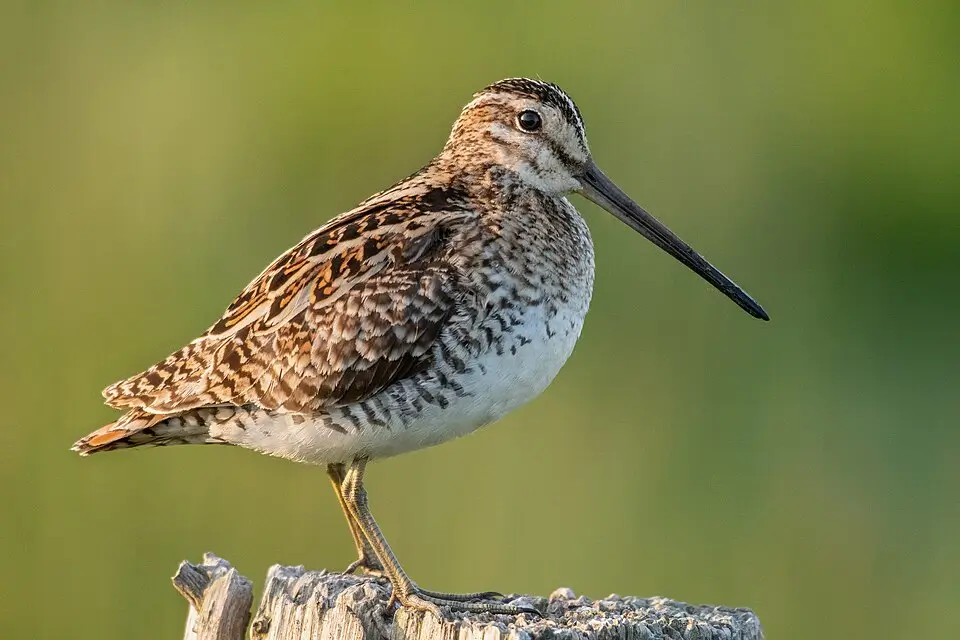
The Common snipe is a medium-sized wading bird, distinctively proportioned with a long, straight bill that is among its most recognizable features. This bill, which can measure several inches in length, is not merely for show — it is a highly specialized feeding instrument, packed with sensitive nerve endings near the tip. This sensory adaptation allows the snipe to probe soft mud and soil in search of invertebrates, detecting prey through touch rather than sight. The tip of the bill is also slightly flexible, allowing the bird to grip and extract earthworms, insect larvae, and small crustaceans from beneath the surface without having to remove its bill entirely from the substrate.
The plumage of the Common snipe is a masterwork of natural camouflage. Brown, buff, black, and white streaks run across the bird's body in intricate patterns that mimic the textures of dried grasses, dead leaves, and muddy terrain. The head is marked with bold longitudinal stripes of dark brown and pale buff, and the back features prominent pale stripes that break up the bird's outline when it crouches in dense vegetation. This cryptic coloration makes the snipe extraordinarily difficult to spot, even at close range. Many hunters and birders have walked within feet of a resting snipe without ever detecting it.
When flushed from cover, the Common snipe displays one of its most celebrated behaviors: a fast, erratic, zigzagging flight that makes it exceptionally difficult to track. This evasive aerial display, often accompanied by a sharp, rasping call, has earned the bird a well-deserved reputation as one of the most challenging quarry species in the field. The snipe's wings are long and pointed, built for speed and agility, and the bird can accelerate rapidly from a standing start, often twisting and banking unpredictably before leveling off at altitude.
During the breeding season, the Common snipe performs a dramatic aerial display known as "drumming" or "winnowing." In this display, the male climbs high into the sky before diving steeply, causing air to rush through its stiffened outer tail feathers. The result is a haunting, trembling sound that carries far across open marshland — a sound that has mystified and delighted naturalists for centuries. For many years, the source of the sound was debated, with some naturalists attributing it to the wings rather than the tail. Modern science has confirmed the tail feathers as the true instrument of this remarkable performance.
The Common snipe is generally a solitary bird outside of the breeding season, though loose aggregations known as a "wisp" can gather in particularly productive feeding areas during migration. The collective noun "wisp" is perfectly suited to this secretive species — like a wisp of fog, a group of snipe can appear and disappear with little warning.
Habitat & Range
The Common snipe has one of the broadest ranges of any shorebird species. It breeds across a vast swath of the Northern Hemisphere, from Iceland, the British Isles, and western Europe eastward through Russia, Siberia, and into parts of Asia. Breeding habitat typically includes wet meadows, bogs, marshes, moorland, and the marshy margins of rivers and lakes — anywhere that offers soft, probe-able soil and sufficient vegetative cover for concealment.
During the winter months, many populations of Common snipe undertake significant migrations southward, occupying a wide variety of wetland habitats across Africa, southern Asia, and the Americas. In North America, the Common snipe is closely related to — and was for many years considered the same species as — the Wilson's snipe (Gallinago delicata), which is the species most commonly encountered by hunters and birders in the United States. The two species were split based on differences in tail feather count and other morphological traits, though they remain very similar in appearance and behavior.
In the context of Georgia and the broader southeastern United States, snipe are primarily encountered as winter visitors and migrants. Georgia's diverse wetland ecosystems — including its coastal marshes along the Atlantic shoreline, the river bottomlands of the Piedmont, the swampy lowlands of the coastal plain, and the flooded agricultural fields that dot the landscape — provide outstanding habitat for wintering snipe. These birds seek out areas with shallow standing water and soft, wet soil where invertebrate prey is abundant and accessible.
Ideal snipe habitat in Georgia often looks deceptively unremarkable: flooded pastures, wet ditches, rice field impoundments, beaver ponds, and the marshy fringes of rivers and streams. The birds gravitate toward areas with a combination of open water, soft substrate, and low herbaceous vegetation that provides cover without blocking movement. Learning to identify and locate this type of habitat is one of the most valuable skills a snipe hunter or birdwatcher can develop.
Hunting Information
The Common snipe — or more accurately, its close North American relative the Wilson's snipe — holds a cherished place in the history of American hunting. Snipe hunting is one of the oldest forms of wing shooting in the country, predating the widespread popularity of upland bird and waterfowl hunting. The difficulty of the quarry, the wild and often remote terrain where snipe are found, and the satisfaction of outsmarting such a wary and elusive bird have made snipe hunting a beloved tradition among dedicated wingshooters.
Snipe hunting requires patience, persistence, and an intimate knowledge of wetland habitats. Unlike upland game birds that hold tightly for a pointing dog, snipe often flush wild and without warning, rocketing skyward in that characteristic zigzag pattern that has humbled many an experienced shooter. Fast reflexes, a smooth swing, and the willingness to follow through on a rapidly changing target are essential skills for the successful snipe hunter.
Dogs can be valuable partners in snipe hunting, particularly breeds accustomed to working wet terrain. Flushing breeds and retrievers are well-suited to snipe habitat and can help locate birds in dense cover and recover downed birds in thick vegetation or standing water.
In the United States, snipe are classified as migratory game birds and are managed under the Migratory Bird Treaty Act, which means that hunting seasons, bag limits, and licensing requirements are established through a cooperative framework involving the U.S. Fish and Wildlife Service and individual state wildlife agencies. Hunters in Georgia are strongly encouraged to consult the Georgia Department of Natural Resources Wildlife Resources Division and the current federal migratory bird hunting regulations for the most up-to-date and accurate information regarding season dates, legal shooting hours, bag limits, and license requirements. Regulations can change from year to year, and compliance with current rules is both a legal obligation and an ethical responsibility.
Conservation
The Common snipe is currently classified as a species of Least Concern on the IUCN Red List, reflecting its large global population and wide distribution. However, like many wetland-dependent species, the Common snipe faces ongoing challenges related to habitat loss and degradation. The draining of wetlands for agriculture and development, changes in land use practices, and alterations to water management regimes have reduced the availability of suitable breeding and wintering habitat in many parts of the bird's range.
Conservation efforts that benefit snipe include the protection and restoration of wetland habitats, sustainable management of agricultural lands that maintain wet areas and wet meadows, and policies that support the long-term health of migratory bird corridors. In the United States, programs administered through organizations such as Ducks Unlimited, the U.S. Fish and Wildlife Service, and various state wildlife agencies have helped to preserve and restore wetland habitats that benefit snipe and a wide array of other wildlife species.
Hunters, too, play a meaningful role in snipe conservation. License fees, excise taxes on sporting equipment collected through the Federal Aid in Wildlife Restoration Act (commonly known as the Pittman-Robertson Act), and contributions to conservation organizations help fund habitat work that sustains healthy snipe populations for future generations. The tradition of ethical, regulated hunting and conservation are deeply intertwined, and snipe hunters are part of a long lineage of sportsmen and sportswomen who have invested in the landscapes these birds depend upon.
Georgia's rich wetland legacy — from its coastal marshes to its inland bottomlands — represents an important piece of the snipe's wintering range in North America. Efforts to protect and restore these habitats benefit not only snipe but the full mosaic of wildlife that depends on Georgia's diverse natural ecosystems.
Conclusion
The Common snipe is a bird of remarkable qualities: a master of camouflage, an acrobat of the sky, a probe-billed specialist of soft and muddy places. Whether you encounter it as a hunter walking a flooded field at dawn, a birdwatcher scanning a coastal marsh, or simply a lover of wild places, the Common snipe rewards attention and invites admiration. Its story is one of adaptation, resilience, and the enduring appeal of wild creatures that ask us to pay closer attention to the landscapes we share.