Overview
Few birds capture the imagination of hunters, naturalists, and wildlife enthusiasts quite like the Common pheasant (Phasianus colchicus). With its dramatic plumage, explosive flush, and spirited temperament, this species has earned a place of distinction in the outdoor traditions of cultures spanning from ancient Asia to modern North America. Whether you encounter one bursting from a hedgerow on an autumn morning in the American Midwest or strutting through the mist of a British countryside estate, the Common pheasant delivers an experience that is both visually stunning and deeply memorable.
Widely regarded as one of the most important upland game birds in the world, the Common pheasant has a history intertwined with human civilization that stretches back thousands of years. Its name, in fact, is thought to be derived from the Phasis River (modern-day Rioni River) in the Caucasus region of present-day Georgia — the country, not the U.S. state — where ancient Greeks reportedly first encountered and admired the bird. From those storied origins, the pheasant has spread to virtually every corner of the globe through deliberate introduction programs, becoming a cornerstone of upland hunting culture wherever it has taken root.
This article takes a deep and appreciative look at the Common pheasant — its biology, its natural history, its habitat preferences, and its role in hunting and conservation — with a particular eye toward what hunters and wildlife lovers in the state of Georgia, USA, and the broader American South might want to know about this remarkable bird.
Biological Traits
The Common pheasant (Phasianus colchicus) belongs to the family Phasianidae, a diverse and globally distributed group that also includes turkeys, quail, peacocks, and grouse. It is one of the most recognizable birds in the world, and much of that recognition stems from the male's extraordinary appearance.
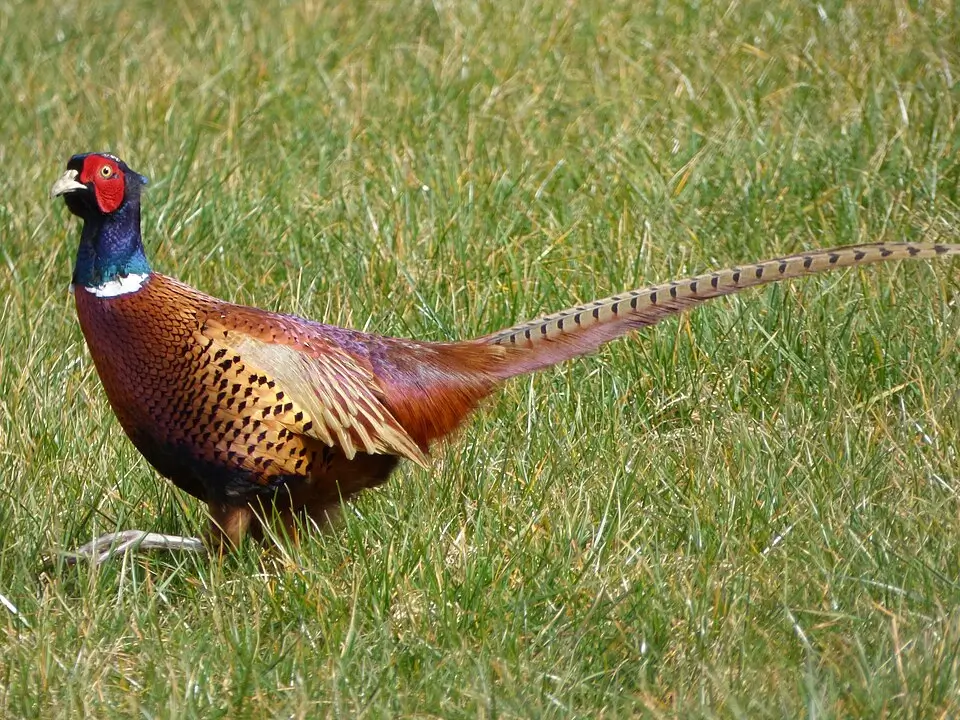
Male pheasants, known as roosters or cocks, are among the most ornate birds in the Northern Hemisphere. They typically display rich, iridescent copper and gold body plumage, a deep green or blue-green head, distinctive red facial wattles, and a long, elegantly barred tail that can account for a significant portion of the bird's total length. Many subspecies and introduced populations also feature a white neck ring, a trait so commonly associated with the species in North America that the ring-necked pheasant is practically synonymous with the Common pheasant in American hunting parlance.
Female pheasants, or hens, are considerably more subdued in coloration — a biological adaptation that serves them well during the nesting season. Their mottled brown and buff plumage provides excellent camouflage against the vegetation and leaf litter of their preferred habitats, allowing them to incubate eggs and raise chicks with a reduced risk of predation. While hens lack the spectacle of their male counterparts, they possess their own quiet elegance and are equally important to the survival of the species.
The Common pheasant is a polygynous species, meaning that a single rooster will typically mate with multiple hens during the breeding season. Roosters are territorial during this period and will engage in dramatic displays — flapping wings, vocalizing loudly, and occasionally engaging rival males — to defend their breeding territories. Hens typically lay a clutch of anywhere from eight to fifteen eggs in a shallow ground nest concealed within dense vegetation. The incubation period lasts approximately three to four weeks, and chicks are precocial, meaning they are mobile and capable of foraging almost immediately after hatching.
Pheasants are omnivores with broad dietary preferences. Seeds, grains, berries, insects, and small invertebrates all feature prominently in their diet depending on the season. This dietary flexibility is one of the reasons the species has adapted so successfully to agricultural landscapes, where they often find abundant food sources year-round.
In terms of size, Common pheasants are robust, medium-to-large upland birds. Roosters are considerably larger than hens, reflecting the sexual dimorphism characteristic of the species. Their powerful legs and feet are well-adapted for scratching through leaf litter and soil in search of food, and while they spend most of their time on the ground, they are capable of strong, rapid flight when flushed — a trait that makes them particularly challenging and rewarding quarry for hunters and their dogs.
Habitat & Range
The natural range of the Common pheasant is extensive, stretching from the Caucasus region and parts of Eastern Europe through Central Asia and into China, Korea, and neighboring territories. Over the millennia and particularly in the last few centuries, however, the species has been introduced to an enormous number of additional regions, including the British Isles, much of continental Europe, North America, Australia, New Zealand, and Hawaii. Today, Phasianus colchicus is one of the most widely distributed game birds on Earth.
In its preferred habitats, the Common pheasant favors a mosaic of environments — a combination of open agricultural fields, grasslands, brushy hedgerows, woodland edges, and wetland margins. It thrives in areas where these different habitat types are interspersed, providing abundant food, reliable cover, and suitable nesting sites within close proximity to one another. Dense grasses, shrub thickets, and weedy field margins are particularly important for nesting hens and broods.
The species is not typically associated with dense, closed-canopy forest, which does not provide the open foraging areas and early successional vegetation that pheasants require. Instead, it gravitates toward the edges — the transitional zones where agriculture meets woodland, or where open meadow meets scrub. This preference for edge habitat has made the pheasant a natural beneficiary of the agricultural landscapes that humans have shaped across much of the temperate world.
In North America, the Common pheasant is most abundant in the agricultural heartland of the Midwest — states like South Dakota, Iowa, Kansas, Nebraska, and Minnesota — where vast expanses of grain farming provide the food resources pheasants need, and where conservation plantings such as those supported by the Conservation Reserve Program (CRP) have historically provided crucial nesting and winter cover. Populations also exist in parts of the Pacific Northwest, the Northeast, and many other regions where birds have been stocked or where wild populations persist.
Hunting Information
The Common pheasant is one of the world's premier upland game birds, celebrated for its challenging flush, its stamina, and its value as table fare. Rooster pheasants in particular are highly sought after by hunters across North America, Europe, and beyond. The tradition of pheasant hunting spans centuries and encompasses everything from driven shoots on English estates to walk-up hunts behind pointing and flushing dogs on the American prairie.
For hunters in Georgia, USA, it is important to approach pheasant hunting with accurate expectations. The Common pheasant is not a native species to the Southeastern United States, and wild, self-sustaining populations of pheasants are not established in Georgia in the way they are in the Midwest. The warm, humid climate of the Deep South, combined with habitat characteristics that differ from the species' preferred temperate agricultural landscapes, makes establishing wild pheasant populations in Georgia challenging.
That said, pheasant hunting opportunities do exist in Georgia primarily through licensed shooting preserves and game farms, where pen-raised birds are released for hunting. These operations provide hunters — including those new to the sport — with excellent opportunities to pursue pheasants, work with bird dogs, and enjoy the traditions of upland hunting without traveling to the traditional pheasant belt of the Midwest. Georgia's rich tradition of outdoor recreation and its active community of sporting dog enthusiasts make this type of hunting a natural fit for many residents.
Hunters interested in pursuing Common pheasants in Georgia should consult the Georgia Department of Natural Resources (DNR) and its Wildlife Resources Division for the most current and accurate information regarding seasons, licensing, and regulations for both wild game and shooting preserves. Since specific regulatory details were not available in the source data consulted for this article, prospective hunters are strongly encouraged to review the current Georgia hunting regulations directly before heading afield.
For those willing to travel, pheasant hunting in states like South Dakota, Kansas, and Iowa offers some of the finest wild pheasant hunting in the world. Many Georgian hunters make annual pilgrimages to these states, where roosters hold tight for pointing dogs and rise in spectacular fashion across harvested cornfields and native grass prairies.
Conservation
The Common pheasant presents a nuanced conservation story. Globally, the species is listed as one of Least Concern by wildlife conservation authorities, owing to its vast range, large total population, and the active management and stocking programs that maintain populations across many countries. In this broad sense, the Common pheasant is a conservation success story — a species that has thrived in human-modified landscapes and benefited from sustained human interest in its management and propagation.
At the same time, wildlife managers and conservation biologists pay close attention to the factors that affect pheasant populations at regional and local levels. In North America, habitat loss — particularly the conversion of idle grasslands and CRP acres to row crops — has been identified as a primary driver of population declines in key pheasant states. The maintenance of diverse agricultural landscapes with adequate nesting cover, winter cover, and food resources is essential to the long-term health of wild pheasant populations.
Organizations such as Pheasants Forever have dedicated themselves to the conservation of pheasants and other upland wildlife through habitat restoration, landowner partnerships, and public advocacy. Their work, along with the contributions of state wildlife agencies and individual hunters and landowners, plays a vital role in ensuring that future generations will have the opportunity to experience the thrill of a rooster pheasant rising from the grass.
Hunters themselves are recognized as important contributors to pheasant conservation. License fees, excise taxes on firearms and ammunition through the Federal Aid in Wildlife Restoration Act (Pittman-Robertson Act), and voluntary donations fund the habitat work and research that sustains wild pheasant populations. The bond between hunter and habitat is, in the case of the pheasant, one of the most productive partnerships in North American wildlife conservation.