Overview
Few birds capture the imagination of dedicated upland hunters and wildlife enthusiasts quite like the American woodcock. Known by a colorful assortment of nicknames — timberdoodle, bogsucker, mud bat, and Labrador twister among them — this plump, short-legged shorebird occupies a singular place in North American wildlife culture. Despite technically belonging to the sandpiper family, the American woodcock (Scolopax minor) has long since abandoned the open shorelines associated with its relatives, choosing instead the tangled thickets, moist woodlands, and alder runs that define classic upland bird country.
The woodcock is a bird of contradictions. It is a shorebird that lives in the forest. It is a migratory species that many hunters associate intimately with local cover close to home. It is cryptically camouflaged to near-invisibility on the forest floor, yet it performs one of the most dazzling and memorable courtship displays in the avian world. Learning about the American woodcock — its life history, its behavior, its habitat needs, and its role in the broader ecosystem — is a rewarding pursuit that deepens appreciation for the natural world, whether you encounter one behind a pointing dog in a briar-choked hollow or simply stumble upon one during an autumn walk in the woods.
For hunters and wildlife observers in Georgia and across the broader southeastern United States, the American woodcock represents a cherished and time-honored quarry. Understanding this remarkable bird is the first step toward pursuing or appreciating it responsibly and successfully.
Biological Traits
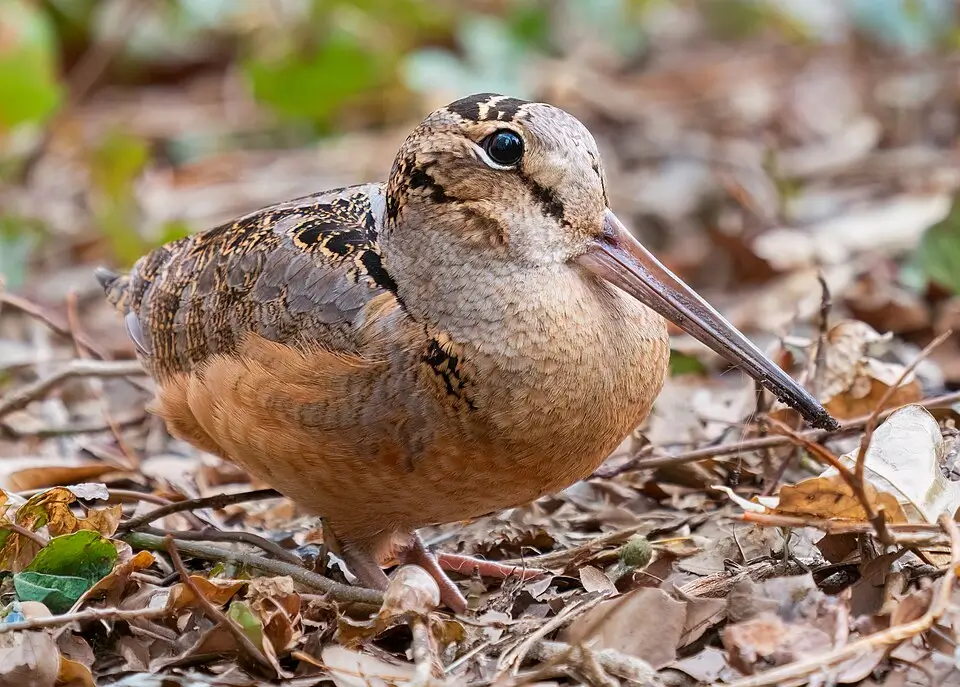
The American woodcock is a stocky, compact bird with a distinctive silhouette that sets it apart from virtually every other species in North America. Its most immediately recognizable feature is its remarkably long bill — a flexible, sensitive instrument that the bird uses to probe soft soil and leaf litter in search of earthworms and other invertebrates. The bill tip is prehensile, meaning the woodcock can open just the tip while it is buried in the ground, allowing it to grasp and extract prey with surprising precision.
The bird's eyes are set high and far back on its rounded head, giving it an almost comical appearance but serving a critical survival function. This unusual eye placement provides the woodcock with a nearly 360-degree field of vision, allowing it to monitor for predators even while its bill is buried in the soil. Its brain is also uniquely oriented within its skull, positioned upside-down relative to most birds — a fascinating anatomical adaptation tied to its highly specialized lifestyle.
The woodcock's plumage is a masterpiece of natural camouflage. Its upper parts are a rich blend of russet, brown, buff, and black, mimicking the dead leaves and forest floor debris among which it rests and feeds. This cryptic coloration makes a motionless woodcock extraordinarily difficult to detect, and many experienced hunters have nearly stepped on one before the bird flushed.
In terms of size, the American woodcock is a relatively small bird, though it appears bulkier than many upland species due to its rounded body shape and short neck. Males and females share similar plumage, but females are noticeably larger than males — a reversal of the typical size pattern seen in many bird species. The woodcock's wings are broad and rounded, and in flight, the bird produces a distinctive twittering sound created by the wind passing through its specialized outer primary feathers.
Perhaps the most celebrated aspect of woodcock biology is the male's springtime courtship display, known as the "sky dance." At dawn and dusk, typically beginning in late winter or early spring, male woodcocks gather in open fields or forest clearings and produce a loud, nasal "peent" call from the ground. The male then spirals upward into the sky in a wide, climbing circle, reaching impressive heights before tumbling back down in a spiraling descent accompanied by a liquid, musical warbling created by both his wings and his voice. This display is one of nature's most enchanting spectacles, and witnessing it firsthand is a rite of passage for any dedicated birder or hunter.
Habitat & Range
The American woodcock is found exclusively in eastern North America, making it one of only two woodcock species on the continent (the other being the closely related Eurasian woodcock, Scolopax rusticola, which does not occur in North America). Its breeding range extends across much of the northeastern United States and into Canada, particularly in the Great Lakes region, New England, and the Maritime Provinces. During migration and winter, woodcock spread broadly across the southeastern United States, making states like Georgia critically important for the species.
Woodcock are intimately tied to early successional habitats — the young, brushy, regenerating forests that develop after timber harvesting, agricultural abandonment, or natural disturbance. They favor areas with a mix of young alder, birch, aspen, and other early-succession trees and shrubs, combined with moist, soft soils rich in earthworms. Alder runs along stream corridors are classic woodcock cover across much of their range. They also use older forests with open understories and moist soils, particularly along bottomlands and near water.
The availability of soft, moist soil is perhaps the single most important habitat factor for woodcock, as earthworms constitute the majority of their diet. A single woodcock may consume its own body weight in earthworms in a single day, making rich, loamy bottomland soils essential to the bird's survival.
In Georgia, the American woodcock occupies a role as both a winter resident and a transient migrant. The state's river bottomlands, creek drainages, beaver wetlands, and young regenerating forests provide important wintering habitat for birds that breed further north. Georgia's mild winters and abundant moist lowland habitats make it a welcoming destination for woodcock during their southward migration. Hunters and wildlife observers in the state often find birds along stream corridors, in young pine plantations with moist understories, and in the brushy edges of agricultural lands adjacent to wooded drains.
Hunting Information
The American woodcock has a long and storied tradition as a prized game bird across eastern North America. Historically pursued by some of the most celebrated sportsmen in American history, woodcock hunting is considered by many aficionados to be among the most demanding and rewarding forms of upland bird hunting available on the continent. The combination of dense cover, unpredictable flushing behavior, and the bird's erratic, twisting flight makes the woodcock a genuinely challenging target, even for experienced wing shooters.
Woodcock hunting is typically conducted with pointing dogs — breeds such as the English setter, Brittany spaniel, German shorthaired pointer, and Vizsla have long been associated with woodcock hunting. A well-trained pointing dog that can work tight cover and hold steady on the delicate scent cone of a woodcock is an invaluable partner in the field. Flushing dogs and retrievers are also used effectively by many hunters.
Because woodcock are migratory birds, they are managed under the federal Migratory Bird Treaty Act and regulated by the U.S. Fish and Wildlife Service in cooperation with state wildlife agencies. Hunters pursuing woodcock in Georgia or any other state must comply with both federal migratory bird regulations and applicable state hunting regulations, including possession of the appropriate federal and state licenses and stamps. Specific season dates, bag limits, and licensing requirements for Georgia are subject to change annually, and hunters are strongly encouraged to consult the Georgia Department of Natural Resources Wildlife Resources Division for current, accurate regulatory information before heading afield.
Woodcock hunting in Georgia is typically a late autumn and winter pursuit, coinciding with the birds' southward migration from their northern breeding grounds. Timing a hunt to coincide with migratory flights — particularly following cold fronts that push birds southward — can significantly improve success in the field.
Conservation
The American woodcock faces ongoing conservation challenges, primarily driven by the loss and degradation of early successional habitat across its range. As forests mature and young brushy habitats give way to older, closed-canopy woodlands, the woodcock's preferred nesting and feeding cover diminishes. Agricultural changes, suburban development, and shifts in forestry practices have all contributed to habitat loss in various parts of the bird's range.
Conservation organizations including the American Woodcock Society and the Ruffed Grouse Society have worked for decades to promote active habitat management practices that benefit woodcock and other early successional wildlife. Timber harvesting, prescribed burning, and deliberate creation of young forest habitat are all tools used by land managers to maintain and improve woodcock populations.
The woodcock's status as a popular game bird has also helped drive conservation investment, as hunting organizations and state and federal wildlife agencies work collaboratively on habitat programs, population monitoring, and research. Annual singing ground surveys conducted by the U.S. Fish and Wildlife Service provide important long-term data on woodcock population trends, helping managers make informed decisions about hunting regulations and conservation priorities.
For Georgia hunters and wildlife enthusiasts, the American woodcock serves as both a conservation indicator and a tangible connection to the rhythms of migration and the health of the eastern forest. Protecting and enhancing the moist bottomland forests, stream corridors, and young successional habitats that woodcock depend upon benefits a broad suite of wildlife species and ensures that future generations will have the opportunity to experience the magic of the timberdoodle.