Wood Duck (Aix sponsa): North America's Most Stunning Waterfowl
Few sights in the natural world rival the brilliance of a male Wood duck in full breeding plumage gliding across a calm, cypress-lined pond in the early morning light. Known scientifically as Aix sponsa — a Latin phrase that translates roughly to "waterfowl in bridal dress" — the Wood duck is widely regarded as one of the most visually spectacular waterfowl species in North America, and arguably the world. Its dazzling combination of iridescent greens and purples, bold white facial markings, chestnut breast, and vivid red eyes make it instantly recognizable to birders, hunters, and casual nature enthusiasts alike.
Beyond its stunning appearance, the Wood duck carries a remarkable conservation story — one of near extinction followed by a dramatic recovery that stands as one of the great triumphs of wildlife management in the United States. Today, the Wood duck thrives across much of North America, including in the diverse wetlands and forested waterways of Florida, where it plays an important role in the ecological fabric of the state's rich natural landscape.
Whether you are an avid waterfowl hunter seeking a challenging and rewarding quarry, a wildlife photographer hoping to capture that perfect shot, or simply a nature lover curious about the creatures sharing your environment, the Wood duck offers something truly special. This article explores the biology, habitat, hunting traditions, and conservation history of this extraordinary bird.
Biological Traits
The Wood duck (Aix sponsa) belongs to the family Anatidae, the large and diverse family of birds that includes all ducks, geese, and swans. Within that family, Aix sponsa occupies a unique place as one of only two members of the genus Aix found in the world — the other being the Mandarin duck (Aix galericulata) of East Asia, a bird equally celebrated for its remarkable plumage.
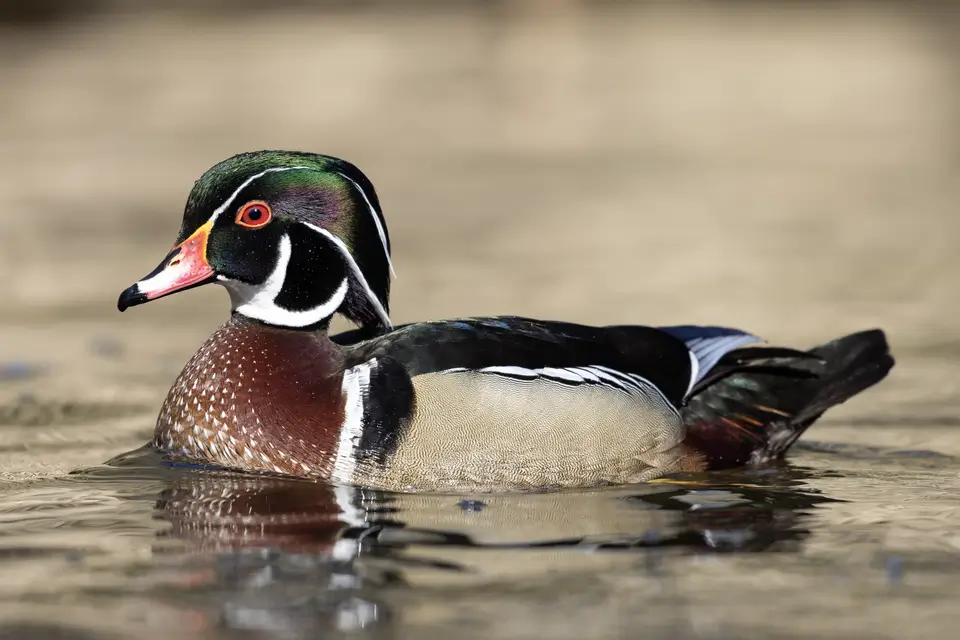
The male Wood duck in breeding plumage is unmistakable. Its head is adorned with a distinctive crested pattern of iridescent green and purple, divided by clean white stripes that run along the face and crest. The eyes are a vivid, almost otherworldly red, surrounded by a bright red orbital ring. The bill is patterned in red, white, and black. Below the throat, which is rich white, the breast transitions to a deep chestnut brown decorated with white spots, while the flanks display a warm buff tone accented with fine black-and-white barring. The overall effect is one of extraordinary complexity and beauty — a mosaic of color that seems almost painted by hand.
Female Wood ducks are considerably more subdued in appearance, as is common among many duck species. Their plumage is primarily brown and gray, providing effective camouflage while nesting. The female is most readily identified by her distinctive white teardrop-shaped eye ring, which stands out sharply against her brown face, and her slightly crested head profile.
One of the most fascinating biological traits of the Wood duck is its adaptation to life in wooded, forested environments — a niche quite different from the open marshes and prairies associated with many other North American duck species. Unlike most waterfowl, Wood ducks possess strong, sharp claws that allow them to perch and grip tree branches and bark with ease. This arboreal capability is directly tied to their reproductive strategy.
Wood ducks are cavity-nesting birds, meaning they nest inside hollow trees rather than building nests on the ground or in open vegetation. Females seek out natural tree cavities — often old woodpecker holes or naturally formed hollows in large, mature trees — located near water. They line the nest cavity with their own down feathers to cushion the eggs and maintain warmth. A typical clutch consists of roughly 9 to 14 eggs, though Wood ducks are also known for a behavior called "egg dumping" or intraspecific brood parasitism, where a female will lay eggs in the nest of another Wood duck, sometimes resulting in nests containing considerably more eggs.
Shortly after hatching, Wood duck ducklings face one of the most dramatic moments of their young lives. Responding to the calls of their mother from the water below, the tiny, downy ducklings climb to the entrance of the nest cavity — sometimes located 30 to 60 feet above the ground — and leap. Their light bodies and downy feathers absorb the impact, and they are remarkably resilient. Within hours of hatching, the ducklings are following their mother on the water, an early independence that is characteristic of precocial bird species.
Wood ducks are omnivorous, feeding on a wide variety of plant and animal matter. Their diet includes acorns, seeds, berries, aquatic plants, insects, and small invertebrates. The acorn is a particularly important food source, especially during the fall months, and Wood ducks are often found foraging in flooded bottomland forests and swamps where acorns have fallen into shallow water. This dietary flexibility contributes to their adaptability across a wide range of habitats.
Habitat & Range
The Wood duck is a bird of forested wetlands. Unlike many dabbling ducks that favor open marshes and prairie potholes, Wood ducks are intimately associated with wooded swamps, bottomland hardwood forests, beaver ponds, slow-moving rivers, and freshwater marshes bordered by mature trees. The presence of large, old trees — particularly those with natural cavities — is a critical habitat requirement for nesting.
The species is found across a broad range in North America. There is a large eastern population that breeds throughout the eastern United States and into southeastern Canada, and a smaller western population found along the Pacific Coast. Wood ducks are present year-round in much of the southeastern United States, where mild winters allow them to remain without needing to undertake long migratory journeys.
Florida represents an important part of the Wood duck's year-round range in the Southeast. The state's extensive network of wetlands, cypress swamps, river floodplains, and forested waterways provides ideal habitat. Florida's landscape — shaped by its unique geography bordering both the Gulf of Mexico and the Atlantic Ocean, with a large interior peninsula rich in rivers, lakes, and wetland systems — supports Wood duck populations across much of the state. Swamps dominated by bald cypress and tupelo, flooded bottomland forests along river systems, and the edges of freshwater marshes all serve as productive Wood duck habitat in Florida.
During the fall and winter months, resident Florida Wood ducks may be joined by individuals migrating southward from breeding grounds further north, making populations in the state particularly robust during hunting season.
Hunting Information
The Wood duck holds a cherished place in the hearts of waterfowl hunters across the United States, and Florida is no exception. Hunting Wood ducks is a beloved tradition that combines the beauty of the natural world with the challenge of pursuing a fast, agile bird in close, wooded cover.
Wood duck hunting in Florida is regulated by the Florida Fish and Wildlife Conservation Commission (FWC), the state agency responsible for managing fish and wildlife resources. The FWC establishes season dates, bag limits, and licensing requirements for waterfowl hunting in Florida, and hunters are encouraged to consult the official FWC Hunting Handbook, which summarizes hunting regulations for both private and public lands. The FWC also manages a system of Wildlife Management Areas (WMAs) across the state, providing public hunting access to many of the productive wetland habitats where Wood ducks are found. Hunters should check the FWC's official resources for the most current and specific season dates, as these can change from year to year.
A federal duck stamp, in addition to state licensing requirements, is required for waterfowl hunting in the United States as mandated by federal law. Hunters pursuing Wood ducks in Florida should ensure they are in full compliance with both state and federal regulations before heading afield.
Wood duck hunting typically involves setting up along wooded creek bottoms, flooded swamps, or beaver ponds in the early morning hours, as Wood ducks are most active at dawn and dusk when they move between roosting and feeding areas. Decoys and calls can be effective, and the birds' tendency to follow wooded creek corridors makes understanding their flight patterns an important part of a successful hunt. The close, wooded environments in which Wood ducks are commonly found make them a challenging and rewarding target, requiring sharp shooting and quick reflexes.
Conservation
The conservation history of the Wood duck is one of the most inspiring stories in North American wildlife management. By the late 19th and early 20th centuries, unregulated market hunting and extensive habitat loss — particularly the widespread clearing of mature bottomland hardwood forests — had driven Wood duck populations to alarmingly low levels. Some naturalists of the era feared the species might be lost entirely.
The passage of the Migratory Bird Treaty Act of 1918 was a turning point, providing federal protection for Wood ducks and other migratory birds and ending the era of unrestricted commercial hunting. Combined with the recovery, the installation of artificial nest boxes — designed to compensate for the loss of natural tree cavities — proved to be a tremendously effective conservation tool. Wildlife managers, hunters, and conservation organizations installed thousands of nest boxes across suitable habitat, and Wood duck populations responded with a remarkable rebound over the following decades.
Today, the Wood duck is considered a conservation success story and is one of the most abundant duck species in eastern North America. Ongoing conservation efforts, including wetland preservation, habitat restoration, and continued nest box programs, help to sustain and strengthen populations. In Florida, the FWC plays an active role in managing wildlife habitats across the state's diverse landscape to support species like the Wood duck.
Hunters themselves have historically been among the most committed supporters of Wood duck conservation, contributing through federal duck stamp purchases, license fees, and excise taxes on sporting equipment — funds that support wetland acquisition and habitat management programs that benefit Wood ducks and countless other species.
Conclusion
The Wood duck is a truly remarkable species — a living jewel of North America's forested wetlands that has inspired awe, affection, and conservation action for generations. From its extraordinary plumage and fascinating nesting behavior to its role as a cherished game bird and symbol of successful wildlife management, Aix sponsa embodies the best of what wild North America has to offer. In Florida's rich and diverse natural landscape, the Wood duck continues to thrive, delighting all who are fortunate enough to encounter it.