Virginia Opossum: North America's Only Marsupial and Its Place in Florida's Wild Landscapes
Few animals in North America capture the imagination quite like the Virginia opossum (Didelphis virginiana). Widely recognized, frequently misunderstood, and endlessly fascinating, this remarkable creature holds a singular distinction in the animal kingdom of the Western Hemisphere: it is the only marsupial native to North America north of Mexico. While many people encounter opossums in suburban neighborhoods or along rural roadsides, the Virginia opossum is far more than a nocturnal scavenger. It is a survivor in the truest sense — a species whose lineage stretches back tens of millions of years, and whose adaptations have allowed it to thrive across an enormous range of environments, from Canadian forests to the subtropical wetlands of Florida.
In Florida, the Virginia opossum is a familiar and permanent resident, woven into the ecological fabric of everything from dense hardwood hammocks to residential backyards. Understanding this species — its biology, its behavior, its role in the ecosystem, and the regulations that govern how people interact with it — is essential for hunters, naturalists, and anyone who spends time outdoors in the Sunshine State.
Biological Traits
The Virginia opossum is a study in evolutionary ingenuity. As North America's sole native marsupial, it belongs to the order Didelphimorphia and the family Didelphidae — a taxonomic group with ancient roots that predates many of the continent's more familiar mammal groups. Its survival over millions of years speaks to the effectiveness of its biological design.
One of the most iconic features of the Virginia opossum is its marsupial reproductive system. Like their Australian counterparts — kangaroos, wallabies, and wombats — female opossums give birth to extraordinarily underdeveloped young after a very short gestation period of approximately 12 to 14 days. The tiny, bean-sized joeys, born in litters that can number more than a dozen, must immediately crawl through the mother's fur and into her pouch, where they attach to a nipple and continue their development. This reproductive strategy, while unusual compared to placental mammals, is remarkably efficient and allows females to reproduce multiple times in a single year.
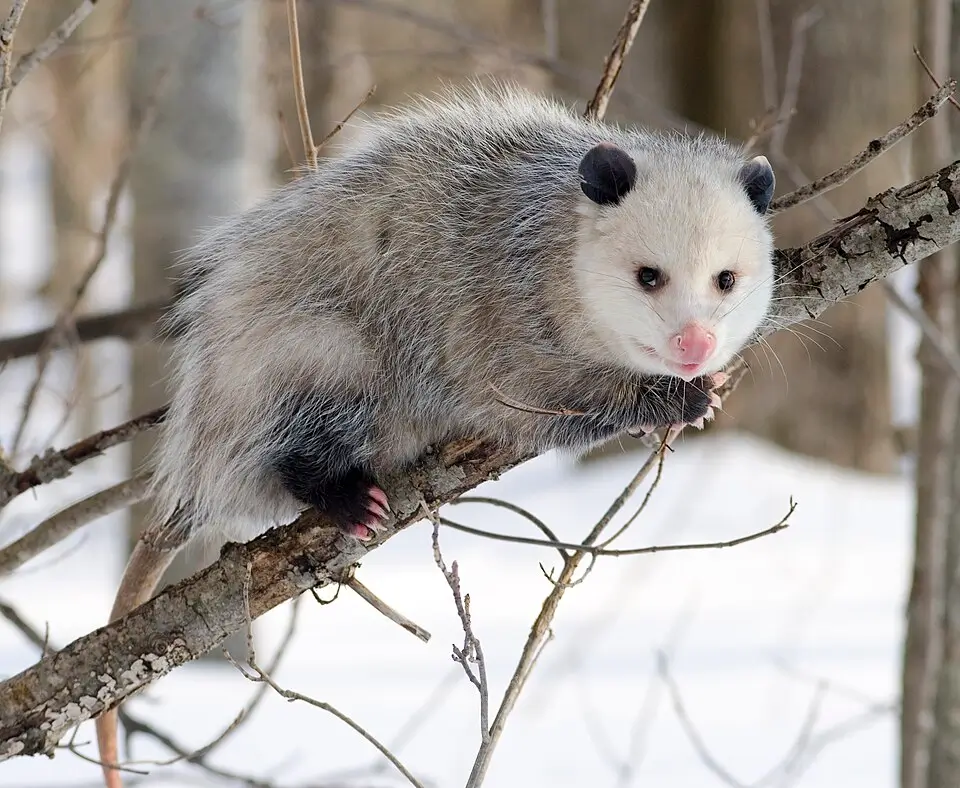
The Virginia opossum's physical appearance is distinctive. It has a long, pointed snout filled with 50 teeth — more than any other North American land mammal — which serves as a reminder of its ancient lineage. Its coarse, grayish-white fur, naked rounded ears, and long, prehensile tail give it an appearance that is entirely its own. That prehensile tail, which the opossum can use to grip branches and carry nesting materials, is one of its most useful physical tools, particularly for younger animals navigating arboreal environments.
Perhaps the most famous behavioral trait of the Virginia opossum is "playing possum" — a response to extreme stress or danger in which the animal enters an involuntary, catatonic state that mimics death. This response is not a conscious decision but rather an automatic physiological reaction. During this state, the animal becomes limp, its heart rate slows, and it may emit a foul-smelling fluid from its anal glands to further discourage predators. This remarkable defense mechanism has given rise to a common phrase in the English language and remains one of the most effective passive defenses in the animal kingdom.
Opossums are also notably resistant to the venom of many North American pit vipers, including rattlesnakes and cottonmouths. Research has shown that a peptide found in opossum blood provides significant neutralization of certain snake venoms, a biological trait that has attracted scientific interest for potential medical applications.
The Virginia opossum is omnivorous and highly opportunistic in its feeding habits. It consumes a wide variety of foods including fruits, berries, insects, small rodents, birds, eggs, carrion, and human food waste. This dietary flexibility is a major reason for the species' success across such a broad geographic range. Additionally, opossums play an important ecological role by consuming large numbers of ticks — studies suggest that a single opossum may kill and consume thousands of ticks per season — making them a quiet but meaningful ally in the effort to reduce tick-borne disease transmission.
Habitat & Range
The Virginia opossum occupies one of the broadest geographic ranges of any North American mammal. Its natural range extends from Costa Rica in Central America northward through Mexico, across the entire eastern half of the United States, and into portions of southern Canada. On the West Coast of North America, opossums were introduced and have established thriving populations in California and other western states.
Across this vast range, the Virginia opossum demonstrates extraordinary habitat flexibility. It inhabits deciduous and mixed forests, agricultural edges, wetland margins, suburban neighborhoods, coastal plains, and river corridors. It shows a preference for areas near water and tends to den in hollow trees, brush piles, rock crevices, abandoned burrows dug by other animals, and even the spaces beneath human structures.
In Florida, the Virginia opossum is found statewide — from the Panhandle's piney woods and hardwood forests in the north to the subtropical cypress swamps and mangrove edges of the southern peninsula. Florida's warm climate and diverse array of ecosystems make it an ideal environment for opossums year-round. Unlike many mammals in cooler climates, opossums in Florida do not hibernate or experience significant seasonal behavioral changes, remaining active throughout the year. The state's forests, freshwater wetlands, scrublands, and even urban green spaces all provide suitable habitat.
Florida's extensive coastline — the longest in the contiguous United States at approximately 1,350 miles — contributes to a diverse mosaic of habitats that support robust opossum populations. The state's subtropical south, including the Everglades ecosystem, provides year-round food and cover, while the more temperate northern portions of the state offer wooded environments similar to those found across the opossum's broader southeastern range.
Hunting Information
In Florida, hunting is regulated and overseen by the Florida Fish and Wildlife Conservation Commission (FWC). The FWC manages wildlife resources across the state with the goal of maintaining healthy, sustainable populations of all species. Hunters in Florida are required to consult the FWC's official Hunting Handbook, which summarizes hunting regulations for both private and public lands. The FWC also manages public shooting ranges and wildlife management areas (WMAs) throughout the state, providing hunters and wildlife enthusiasts with extensive access to Florida's natural landscapes.
The Virginia opossum is classified as a furbearing or game animal in many states, and hunters interested in pursuing opossums in Florida should consult the most current edition of the Florida Hunting Handbook for specific season dates, licensing requirements, and any applicable regulations. It is always the responsibility of the individual hunter to verify current regulations directly with the FWC, as rules can change from season to season. The FWC also maintains updated information about WMA closures and facility status, which can affect access to public hunting areas.
Opossum hunting has a long tradition in the American South. Historically, opossums were an important source of food and fur, and hunting them remains part of the cultural and outdoor heritage of many communities across Florida and the broader southeastern United States. Hunters typically pursue opossums at night with the aid of dogs and lights, a traditional method that connects modern sportsmen and women to generations of outdoor tradition.
Conservation
The Virginia opossum is currently listed as a species of least concern from a conservation standpoint. Its adaptability, broad range, high reproductive rate, and tolerance for human-altered environments have allowed it to maintain stable populations across most of its range, including throughout Florida.
The FWC plays a central role in monitoring wildlife populations in Florida and ensuring that hunting and other human activities remain sustainable over the long term. Through careful regulation, public education, and active management of wildlife management areas and habitat, the FWC works to ensure that species like the Virginia opossum continue to thrive in Florida's natural environments.
Ecologically, the Virginia opossum contributes in meaningful ways to the health of the ecosystems it inhabits. As an omnivore and scavenger, it helps recycle nutrients and control populations of insects and small animals. Its tick-consuming behavior may offer tangible benefits for public health. And as a prey species, it supports populations of owls, bobcats, foxes, and other predators that are vital parts of Florida's food web.
Appreciating the Virginia opossum — in all its unusual, ancient, and ecologically valuable complexity — is part of what makes spending time in Florida's wild places such a rewarding experience.