Sandhill Crane (Grus canadensis): A Majestic Bird of the American Landscape
Few sights in the natural world are as stirring as a flock of Sandhill cranes moving across an open sky, their distinctive bugling calls echoing across wetlands, prairies, and marshes. These large, elegant birds have captivated the attention of naturalists, wildlife enthusiasts, hunters, and casual observers for generations. Standing tall among North America's most recognizable avian species, the Sandhill crane (Grus canadensis) represents one of the oldest known living bird species on the continent — a creature whose lineage stretches back millions of years and whose presence continues to enrich the ecosystems it inhabits today.
In Florida, the Sandhill crane holds a particularly special place. The state's unique geography, sprawling wetlands, and mild year-round climate make it an ideal environment for these birds, and Florida is home to a distinct resident population that has adapted to life in the subtropical South. Whether you are a hunter, a wildlife photographer, a birder, or simply someone who appreciates the grandeur of wild things, the Sandhill crane offers something remarkable to discover.
This article explores the biology, habitat, behavior, and conservation of the Sandhill crane, with a focus on what makes this species so uniquely suited to Florida's diverse landscape.
Biological Traits
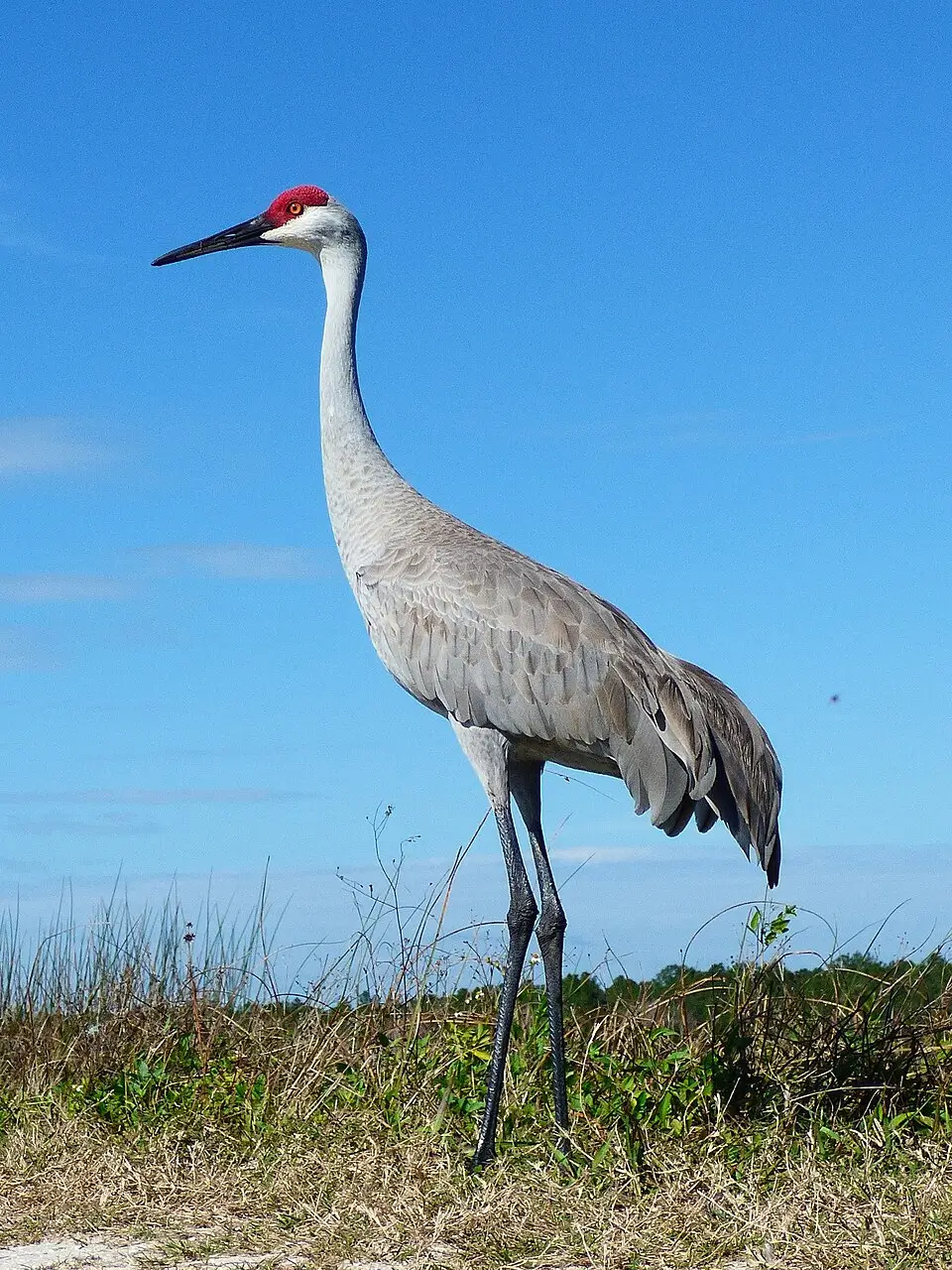
The Sandhill crane is one of North America's largest flying birds, and its physical presence alone commands attention. Adults are characterized by their predominantly gray plumage, long legs, long neck, and a striking bare red patch of skin on the forehead and crown. This red cap is not formed by feathers but by carunculated skin, giving the bird a distinctive and immediately recognizable appearance. The face and chin are often white to pale red, and adults sometimes exhibit a rusty or brownish tinge to their feathers — a result of preening with iron-rich mud or vegetation during the breeding season, which serves as natural camouflage in certain environments.
Sandhill cranes are tall birds, typically standing around three to four feet in height, with a wingspan that can stretch to impressive lengths, allowing them to soar effortlessly on thermal air currents during migration. Their long, pointed bills are well-adapted for foraging in a variety of substrates, from soft wetland soil to dry upland ground.
One of the most remarkable aspects of Sandhill crane biology is their vocalizations. The birds produce a loud, resonant, rolling call — often described as a bugling or rattling sound — that can carry for great distances across open terrain. This call is produced in part due to an elongated trachea that coils within the sternum, acting as a resonating chamber. Pairs and family groups use vocalizations extensively for communication, mate bonding, and territorial defense.
Sandhill cranes are monogamous and typically mate for life, forming strong pair bonds that persist across years and migrations. Their courtship displays are among the most visually spectacular behaviors in the avian world, involving elaborate dancing, jumping, wing-spreading, and vocalizing. These displays are not limited to the breeding season — cranes engage in dance-like behaviors throughout the year, reinforcing pair bonds and social connections.
The species is generally divided into several subspecies. In Florida, the Florida Sandhill crane (Grus canadensis pratensis) is a non-migratory resident subspecies, while other subspecies — including the Greater Sandhill crane and the Lesser Sandhill crane — undertake long-distance migrations across the continent. This distinction is important both ecologically and from a wildlife management perspective, as the Florida population has its own behavioral rhythms and habitat requirements shaped by the state's subtropical climate.
Sandhill cranes are omnivores, feeding on a wide variety of plant and animal matter. Their diet includes seeds, berries, tubers, grains, insects, worms, small reptiles, and even small mammals. This dietary flexibility makes them highly adaptable to a range of environments and seasonal food availability.
Habitat & Range
The Sandhill crane is found across a remarkably broad range in North America, from the Arctic tundra of Alaska and Canada to the subtropical wetlands of Florida and the Gulf Coast. Different subspecies occupy different portions of this range, with migratory populations moving between northern breeding grounds and southern wintering areas each year.
In Florida, the non-migratory Florida Sandhill crane is a year-round resident that has adapted beautifully to the state's diverse habitats. Florida's geography — with its abundance of freshwater marshes, wet prairies, river floodplains, grassy savannas, and open upland areas — provides ideal conditions for these birds. The state's long coastline, which stretches approximately 1,350 miles along both the Gulf of Mexico and the Atlantic Ocean, borders a landscape rich in the shallow wetland habitats that cranes favor for nesting and foraging.
Sandhill cranes tend to prefer open or semi-open environments where visibility is good and they can detect approaching predators from a distance. They nest in or near shallow water, constructing large mound nests of aquatic vegetation on the ground. Both parents participate in nest construction, incubation of eggs, and care of the young, known as colts. Crane colts are precocial — meaning they are mobile and capable of following their parents shortly after hatching — and they remain with their parents through their first migration or, in the case of Florida's resident birds, through much of their first year of life.
Florida's warm climate means that the resident Sandhill crane population does not undertake long-distance migrations, instead moving locally in response to seasonal changes in water levels, food availability, and breeding activity. During the non-breeding season, Florida Sandhill cranes often gather in loose flocks and may be found foraging in open fields, pastures, golf courses, and suburban green spaces — a testament to their adaptability and tolerance of human-modified landscapes.
Hunting Information
In the United States, Sandhill crane hunting is regulated at both the federal and state levels, with seasons established to balance wildlife population management with recreational hunting opportunities. The species is managed as a migratory bird under the Migratory Bird Treaty Act, giving the U.S. Fish and Wildlife Service federal oversight over hunting frameworks.
It is important for hunters interested in pursuing Sandhill cranes in Florida to consult the Florida Fish and Wildlife Conservation Commission (FWC) directly for the most current and accurate regulations. The FWC publishes a comprehensive Hunting Handbook that summarizes hunting regulations for both private and public lands across the state, and the agency regularly updates season dates, bag limits, licensing requirements, and area-specific rules. Additionally, the FWC provides tools such as Quota Hunt Dashboards to help hunters plan and prepare for regulated hunting opportunities across Florida's wildlife management areas (WMAs).
Hunters should always verify whether specific WMAs are open or closed prior to any outing, as the FWC provides regular updates on the status of managed areas through official channels. Licensing requirements should be confirmed with the FWC prior to any hunting activity.
Sandhill cranes are highly regarded as table fare among hunters who have pursued them, earning the informal nickname "ribeye of the sky" in hunting circles — a nod to their dark, flavorful breast meat that distinguishes them from most waterfowl. Hunting these birds requires skill and patience, as cranes are wary, sharp-eyed animals that can detect danger at considerable distances. Hunters typically employ decoys and calls to attract birds within range, making crane hunting both a challenging and deeply rewarding pursuit for those who pursue it ethically and lawfully.
Conservation
The story of the Sandhill crane and conservation in North America is, in many ways, a positive one. Several subspecies of Sandhill crane have recovered significantly from population lows experienced during the late nineteenth and early twentieth centuries, when habitat loss and unregulated hunting reduced numbers substantially. Through the implementation of protective regulations, habitat conservation efforts, and careful wildlife management, many Sandhill crane populations have rebounded strongly.
The greater migratory populations of Sandhill cranes — particularly those passing through the Central Flyway — number in the hundreds of thousands and represent one of the great wildlife conservation success stories on the continent. The Platte River valley in Nebraska serves as a critical staging ground during spring migration, where enormous concentrations of cranes gather each year before continuing northward to breeding grounds.
In Florida, the resident Florida Sandhill crane subspecies receives specific attention from the FWC and conservation partners due to its non-migratory nature and its dependence on Florida's increasingly pressured wetland and upland habitats. Urban development, water management practices, and land use changes all present ongoing challenges to maintaining quality habitat for resident crane populations. Conservation efforts in the state focus on wetland preservation, land acquisition, and public education to help ensure that Florida's resident cranes continue to thrive.
The Sandhill crane's willingness to adapt to human-modified landscapes — including suburban areas, agricultural fields, and managed green spaces — has helped buffer some populations against habitat loss, though this proximity to human activity also brings its own set of challenges, including vehicle collisions and human-wildlife conflict in residential areas.
Overall, the Sandhill crane stands as a symbol of successful wildlife conservation and the enduring value of protecting wild places and wild creatures. Its ancient lineage, its spectacular behaviors, and its powerful presence in the skies and wetlands of North America remind us of what is possible when humans and wildlife share the landscape with care and respect.