Ruffed Grouse: North America's Woodland Drummer
A Complete Guide to Bonasa umbellus
Few birds capture the imagination of North American hunters and wildlife enthusiasts quite like the ruffed grouse. Known scientifically as Bonasa umbellus, this medium-sized upland game bird has earned a legendary reputation across the forested landscapes of the continent. Whether you encounter one while hiking through a stand of aspens, or you are a seasoned bird hunter working a pointing dog through thick alder runs, the sudden, thunderous explosion of wings that signals a flushing ruffed grouse is an experience that never loses its thrill.
The ruffed grouse is widely considered one of the most prized upland game birds in North America, celebrated not only for the challenge it presents to hunters but also for its ecological importance as a keystone species in forest ecosystems. Its distinctive drumming sound — produced by males as a territorial and mating display — is one of the most recognizable sounds of the North American woodland, a deep, rhythmic thumping that seems to rise from the forest floor itself like a heartbeat of the wild.
Understanding the ruffed grouse — its biology, behavior, habitat requirements, and conservation status — is essential for anyone who hopes to hunt it ethically and sustainably, or simply to appreciate one of the continent's most fascinating birds.
Biological Traits
The ruffed grouse (Bonasa umbellus) belongs to the family Phasianidae, the same broad family that includes pheasants, turkeys, and other grouse species. It is the sole member of the genus Bonasa in North America, making it a unique and distinctive representative of the upland bird world.
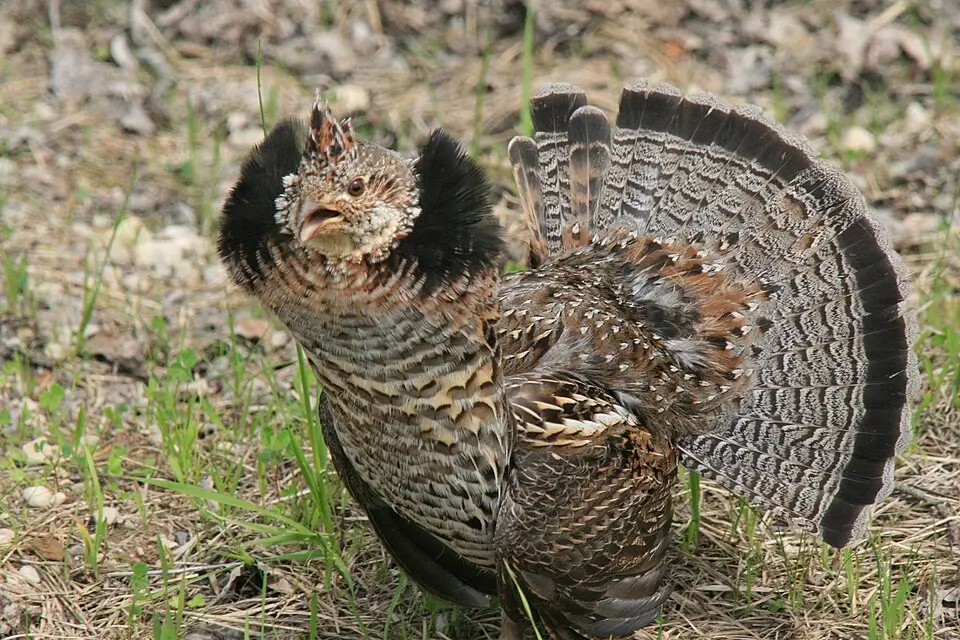
One of the most visually striking features of the ruffed grouse is the ruff of dark, iridescent feathers located on the sides of the neck — the feature from which the bird derives its common name. These feathers are most prominent in males and are raised during courtship and threat displays, giving the bird a dramatic, almost regal appearance. The species name umbellus is derived from the Latin word for umbrella, a reference to this distinctive neck ruff when it is fanned out.
Ruffed grouse exhibit two primary color morphs: a gray phase and a brown (or red) phase. The gray phase is more common in northern populations, while the brown phase tends to be more prevalent in southern portions of the range. This variation in plumage is not related to sex or age but appears to be a genetic adaptation influenced by regional environmental conditions. In both color phases, the bird's plumage is a masterwork of cryptic coloration — intricate patterns of browns, grays, blacks, and whites that render the bird nearly invisible against a backdrop of fallen leaves and forest debris.
The tail of the ruffed grouse features a distinctive dark subterminal band, which is a reliable field identification mark. Males are generally larger than females, though the two sexes can be difficult to distinguish in the field. Adult birds typically weigh between 16 and 26 ounces, though exact weights vary by region and season.
One of the most celebrated behaviors of the ruffed grouse is the male's drumming display. Unlike most birds that produce sound vocally, the male ruffed grouse creates his distinctive drumming by rapidly beating his wings while perched on a log, stump, or other elevated surface. This creates a vacuum that produces a series of low-frequency thumps that accelerate rapidly, resembling the sound of a small engine starting up. This display serves to attract females and to advertise territory to rival males. Drumming can occur throughout the year but peaks during the spring breeding season.
Ruffed grouse are non-migratory birds, remaining on or near their home territories throughout the year. They are well-adapted for winter survival, growing comb-like projections called pectinations on their toes in autumn that function like snowshoes, allowing them to walk across the surface of snow with ease. During harsh winter weather, ruffed grouse will dive into soft snow to create insulating burrows, a behavior known as snow roosting, which helps them conserve body heat.
The diet of the ruffed grouse shifts seasonally. During warmer months, birds consume a wide variety of insects, berries, seeds, and green vegetation. In winter, they rely heavily on the buds, catkins, and twigs of trees such as aspen, birch, and alder — a diet that few other animals can exploit efficiently. This dietary flexibility is a key factor in the species' success across a wide geographic range.
Habitat & Range
The ruffed grouse has one of the broadest ranges of any upland game bird in North America. Its range extends from Alaska and Canada in the north, south through the Appalachian Mountains, across the Great Lakes states, and into portions of the Rocky Mountain West. The species thrives wherever there are young, mixed deciduous forests with dense understory cover.
Ruffed grouse are intimately associated with early successional forest habitat — the young, brushy woodlands that develop in the years following a timber harvest, wildfire, or other disturbance. These habitats provide the dense cover that grouse require for escape from predators, as well as an abundance of food resources. Aspen forests are particularly important throughout the northern portions of the range, providing both food and cover in nearly every season.
The bird requires a mosaic of habitat types within its home territory, including areas of dense young forest for nesting and brood-rearing, older forest for winter foraging, and drumming logs for males to use during the breeding season. The availability of these habitat elements within close proximity to one another is a primary driver of local ruffed grouse population density.
Regarding Florida specifically: it is important to note that the ruffed grouse is not a species native to Florida's subtropical and tropical ecosystems. Florida's landscape — characterized by pine flatwoods, cypress swamps, coastal marshes, and warm humid lowlands — does not provide the cool, young deciduous forest habitat that ruffed grouse require. The Florida Fish and Wildlife Conservation Commission (FWC) manages hunting seasons and regulations for the state's native game species, and hunters in Florida seeking upland bird hunting opportunities should consult the FWC's official Hunting Handbook for current regulations regarding species available in that region.
Hunting Information
The ruffed grouse is widely regarded as one of the most challenging and rewarding upland game birds to hunt in North America. Its preference for dense, tangled cover — alder thickets, young aspen stands, overgrown logging roads, and brushy hillsides — demands that hunters be in excellent physical condition and possess quick reflexes. The bird's explosive flush, often from just underfoot and through heavy cover, gives hunters only a fraction of a second to mount their shotgun and fire.
Many hunters pursue ruffed grouse with flushing dogs or pointing breeds, and the partnership between a skilled bird dog and its handler in grouse cover is considered one of the finest experiences in all of upland hunting. Breeds such as English setters, Brittanys, and German shorthaired pointers are particularly popular for grouse hunting, though many hunters also enjoy walking up birds without a dog.
Shotguns in 20-gauge or 12-gauge are the standard tools for ruffed grouse hunting, with open chokes such as improved cylinder or skeet recommended to account for the close-range, fast-moving shots that grouse typically present. Light loads of small shot — typically No. 7½ or No. 8 — are standard.
Specific season dates, bag limits, and license requirements vary by state and province and change on a regular basis. Hunters should always consult the official wildlife management agency of the state or province where they intend to hunt before heading afield. In states where ruffed grouse are present, regulations are designed to ensure sustainable harvest while supporting healthy population levels.
Conservation
The long-term conservation of the ruffed grouse depends on the availability of quality early successional forest habitat across its range. As forests mature and natural disturbances are suppressed, the young brushy cover that grouse depend upon can become scarce in some areas. Active forest management — including timber harvesting, prescribed burning, and habitat enhancement projects — plays a critical role in maintaining and creating suitable ruffed grouse habitat.
Organizations such as the Ruffed Grouse Society have been instrumental in advocating for habitat management practices that benefit not only ruffed grouse and American woodcock but a wide range of wildlife species that depend on early successional forest. Hunter participation and engagement with conservation organizations remains one of the most powerful forces for sustaining healthy grouse populations for future generations.
Ruffed grouse populations are known to undergo cyclical fluctuations, often following roughly ten-year cycles that correspond to changes in prey and predator populations, particularly in northern portions of the range. Wildlife biologists and managers monitor these population trends carefully to ensure that harvest regulations reflect current population conditions.
The ruffed grouse is currently listed as a species of Least Concern by global conservation assessments, reflecting its broad range and generally stable populations. However, continued attention to habitat management, responsible hunting, and ongoing research are essential to keep this iconic species thriving across North America's woodlands for generations to come.