Mule Deer (Odocoileus hemionus): A Complete Guide to the West's Iconic Big Game Species
Few animals capture the spirit of the American West quite like the mule deer. With its oversized, mule-like ears, distinctive bounding gait, and impressive antler displays, Odocoileus hemionus stands as one of the most recognized and beloved big game animals on the continent. Whether you are a seasoned hunter preparing for a mountain backcountry expedition, a wildlife photographer scanning canyon ridgelines at dawn, or simply a nature enthusiast curious about North America's diverse deer species, the mule deer offers an endlessly fascinating subject.
Known colloquially as "muleys" among hunters and wildlife watchers alike, mule deer have carved out a unique ecological niche across some of the most rugged and breathtaking landscapes North America has to offer. From high alpine meadows to arid desert basins, from rolling sagebrush plains to dense coastal chaparral, these deer have demonstrated a remarkable capacity to thrive in diverse and often challenging environments. Their adaptability, combined with their striking physical appearance, has earned them a place of reverence in both hunting culture and wildlife conservation circles.
This article explores the biology, habitat, behavior, hunting traditions, and conservation story of the mule deer — a species that continues to inspire and unite outdoor enthusiasts across generations.
Biological Traits
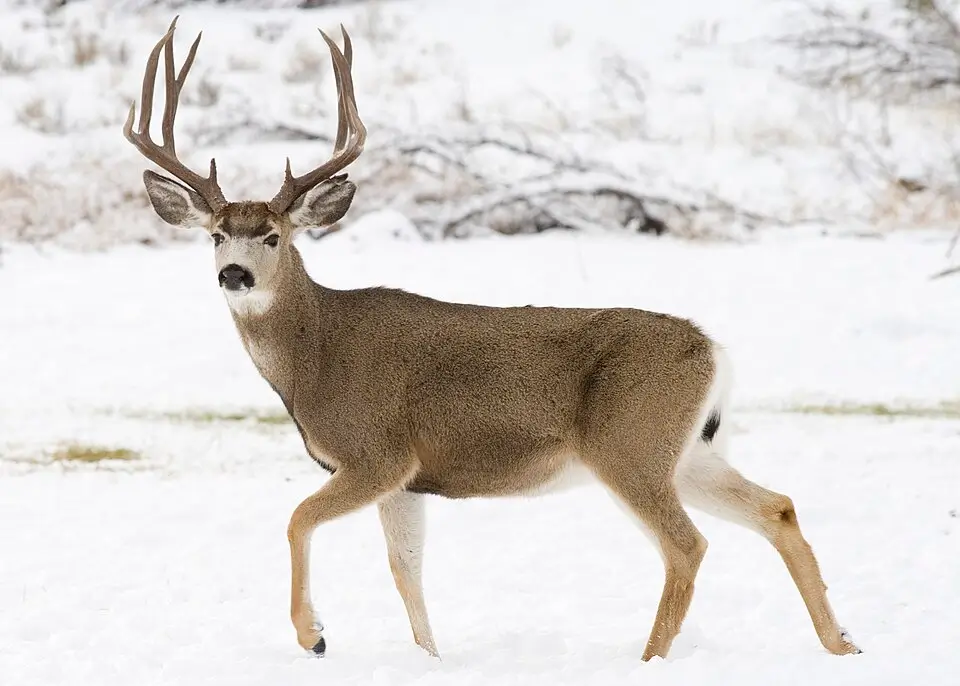
The mule deer, Odocoileus hemionus, belongs to the family Cervidae — the same family that includes elk, moose, caribou, and the closely related white-tailed deer. The species name hemionus is derived from Greek, meaning "half mule" or "half donkey," a direct reference to the animal's most immediately noticeable feature: its large, prominent ears. These ears, which can measure nearly a foot in length, serve as highly sensitive sound-detection instruments, allowing mule deer to pick up the faint rustle of a predator moving through brush at considerable distances.
One of the most distinctive aspects of mule deer biology is their antler configuration. Unlike white-tailed deer, whose antlers grow in a single main beam with individual tines branching off, mule deer antlers bifurcate — meaning the main beam forks into two roughly equal branches, and each of those branches may fork again. This dichotomous branching pattern creates the classic "Y" shape that experienced hunters and wildlife observers use to distinguish mule deer from their white-tailed cousins at a glance. Antlers are grown and shed annually by males, with growth beginning in spring under the influence of increasing daylight and testosterone levels. During the summer months, antlers are covered in velvet — a soft, nutrient-rich tissue that supplies blood and nutrients to the rapidly growing bone. By late summer or early fall, the velvet dries and is shed as bucks prepare for the breeding season, known as the rut.
The mule deer's coat changes with the seasons, transitioning from a reddish-brown summer coat to a thicker, grayish-brown winter coat that provides better insulation against cold temperatures. One of the most visually striking identification features is the animal's tail — a small, rope-like tail with a black tip, set against a pale rump patch. This contrasts sharply with the white-tailed deer's broad, flag-like tail that flashes brilliant white when the animal is alarmed.
Another fascinating behavioral and physical trait unique to mule deer is their movement style. When alarmed or traveling at speed, mule deer employ a bounding gait known as "stotting" or "pronking" — a four-footed leap in which all hooves push off the ground simultaneously. This pogo-stick locomotion may appear inefficient at first glance, but it is extraordinarily effective in rocky, uneven terrain, allowing deer to quickly navigate steep slopes and broken ground that would challenge a straight-running predator.
Mule deer are herbivores with a varied diet that shifts based on season and geographic location. They are concentrate selectors, meaning they prefer highly digestible, nutrient-dense plant materials over bulk roughage. Forbs, shrubs, and browse make up a significant portion of their diet, supplemented by grasses and, in agricultural areas, crops. Seasonal migration often tracks the availability of high-quality forage, with deer moving to higher elevations in summer to take advantage of lush alpine vegetation and descending to lower, snow-free valleys in winter.
Reproduction in mule deer follows a seasonal pattern tied closely to photoperiod — the changing ratio of daylight to darkness. The rut typically occurs in the fall, timed so that fawns are born in late spring or early summer when food resources are at their most abundant. Does commonly give birth to twins, though single fawns and triplets are also documented. Fawns are born with a spotted coat that provides camouflage in dappled forest light, and they are capable of standing within hours of birth — a critical survival adaptation in a world filled with predators.
Several recognized subspecies of Odocoileus hemionus exist, including the Rocky Mountain mule deer (O. h. hemionus), the Sitka black-tailed deer (O. h. sitkensis), and the Columbian black-tailed deer (O. h. columbianus), among others. The black-tailed subspecies, found along the Pacific Coast, are sometimes treated as a distinct group but remain part of the broader mule deer species complex.
Habitat & Range
Mule deer are quintessentially western animals, with their primary range spanning the western half of North America. Their distribution extends from the coastal ranges of Alaska and British Columbia in the north, southward through the Rocky Mountain states, the Great Basin, the Intermountain West, and into the deserts of northern Mexico. They are particularly associated with semi-arid and arid environments, including sagebrush steppe, pinyon-juniper woodland, desert scrub, chaparral, and montane forest.
Unlike white-tailed deer, which have dramatically expanded their range eastward and northward over the past century, mule deer are largely confined to western ecosystems. They are not native to Florida or the southeastern United States, where the white-tailed deer (Odocoileus virginianus) reigns as the dominant and ubiquitous deer species.
Mule deer are well-known for their seasonal migrations, which can cover remarkable distances. In some parts of Wyoming and Idaho, documented migration corridors stretch for over 100 miles as deer move between summer and winter ranges. These migration routes, refined over thousands of years, represent critical ecological infrastructure that is increasingly recognized by wildlife managers and conservationists as essential to long-term population health.
Elevation plays a significant role in mule deer habitat use. In summer, deer may be found at elevations well above 10,000 feet in the Rocky Mountains, feeding on lush alpine and subalpine vegetation. As winter approaches and snowpack deepens, they descend to lower elevations, sometimes congregating in large numbers on traditional wintering grounds in valley bottoms, foothills, and desert basins.
Hunting Information
Mule deer hunting is a deeply embedded tradition across the western United States and Canada, drawing hundreds of thousands of hunters each year to pursue these animals across some of the continent's most spectacular landscapes. The species is managed as a game animal in every western state and Canadian province within its range, with seasons, licensing requirements, and harvest regulations set by individual state and provincial wildlife agencies.
Because mule deer are not present in Florida, the Florida Fish and Wildlife Conservation Commission (FWC) does not manage or regulate mule deer hunting. Hunters in Florida who wish to pursue mule deer must travel to the western states where the species is found and comply with the specific regulations of those jurisdictions. Each state has its own licensing framework, season structures, and in many cases, limited-entry or quota-based tag systems designed to manage harvest pressure and maintain healthy deer populations.
For hunters interested in pursuing mule deer, it is strongly recommended to consult the specific wildlife agency of the state or province you plan to hunt. Most western states offer a combination of over-the-counter tags for general seasons and limited-entry draw tags for premium hunting units. Draw odds vary considerably by state and unit, and some coveted trophy units may require years of accumulated preference or bonus points before a tag is drawn.
Glassing — the practice of using high-quality binoculars and spotting scopes to scan vast terrain — is a cornerstone of western mule deer hunting strategy. Unlike the dense forest hunting common in the East, mule deer hunting often involves covering miles of open country on foot, glassing ridges and canyon systems to locate bucks before beginning a stalk. The combination of physical fitness, optics skill, and patience makes mule deer hunting a uniquely rewarding and challenging pursuit.
Conservation
Mule deer conservation has become an increasingly prominent topic in wildlife management circles across the western United States. Populations have faced various pressures over the decades, including habitat fragmentation, competition from livestock and invasive plant species, changing predator dynamics, drought, and the disruption of traditional migration corridors by roads, fences, and development.
In response, state wildlife agencies, conservation organizations, tribal governments, and federal land management agencies have collaborated on numerous initiatives aimed at protecting and restoring mule deer habitat, improving migration corridor connectivity, and refining harvest management strategies. Hunters have played a central role in these conservation efforts, both through license and tag revenue that funds wildlife management programs and through direct volunteer work on habitat improvement projects.
The future of mule deer across the American West is tied closely to the health of the landscapes they inhabit — the sagebrush seas, aspen groves, canyon systems, and mountain meadows that define western North America. Protecting and restoring these ecosystems benefits not only mule deer but the full suite of species that share their range, from pronghorn and elk to golden eagles and sage-grouse.