The Gray Fox: North America's Remarkable Tree-Climbing Canid
A Complete Guide to Urocyon cinereoargenteus
Among the many remarkable wildlife species that call North America home, few are as fascinating or as frequently overlooked as the gray fox (Urocyon cinereoargenteus). This medium-sized canid occupies a unique niche in the animal kingdom, blending the behavioral characteristics of both foxes and cats in ways that continue to captivate wildlife enthusiasts, hunters, and biologists alike. With its salt-and-pepper coat, striking russet flanks, and a personality that leans more toward the secretive than the bold, the gray fox is a creature of quiet confidence and extraordinary adaptability.
In the state of Florida, the gray fox is a recognized wildlife species that falls under the regulatory oversight of the Florida Fish and Wildlife Conservation Commission (FWC). Florida's diverse landscape — stretching from the panhandle hardwood forests in the north to the subtropical wetlands and coastal scrublands of the south — provides a rich and varied mosaic of habitats where the gray fox can thrive. Understanding this animal, its biology, its habitat preferences, and its place in the broader ecosystem is essential for any outdoor enthusiast who hopes to encounter or pursue one.
Biological Traits
The gray fox is a member of the family Canidae, but it belongs to the genus Urocyon, which separates it taxonomically from the more commonly discussed red fox (Vulpes vulpes). This distinction is not merely academic — it reflects genuinely different evolutionary paths and biological characteristics that make the gray fox one of the most unique canids on the continent.
One of the most celebrated and astonishing traits of the gray fox is its ability to climb trees. Unlike virtually every other member of the dog family, the gray fox possesses strong, hooked claws and rotating wrist joints that allow it to ascend trees with surprising agility. This skill serves multiple purposes: it allows the fox to escape predators such as coyotes and bobcats, to access elevated food sources like fruit and bird nests, and even to den in hollow tree cavities. Watching a gray fox scale a tree trunk is an experience that tends to leave observers questioning whether they are looking at a fox or something else entirely.
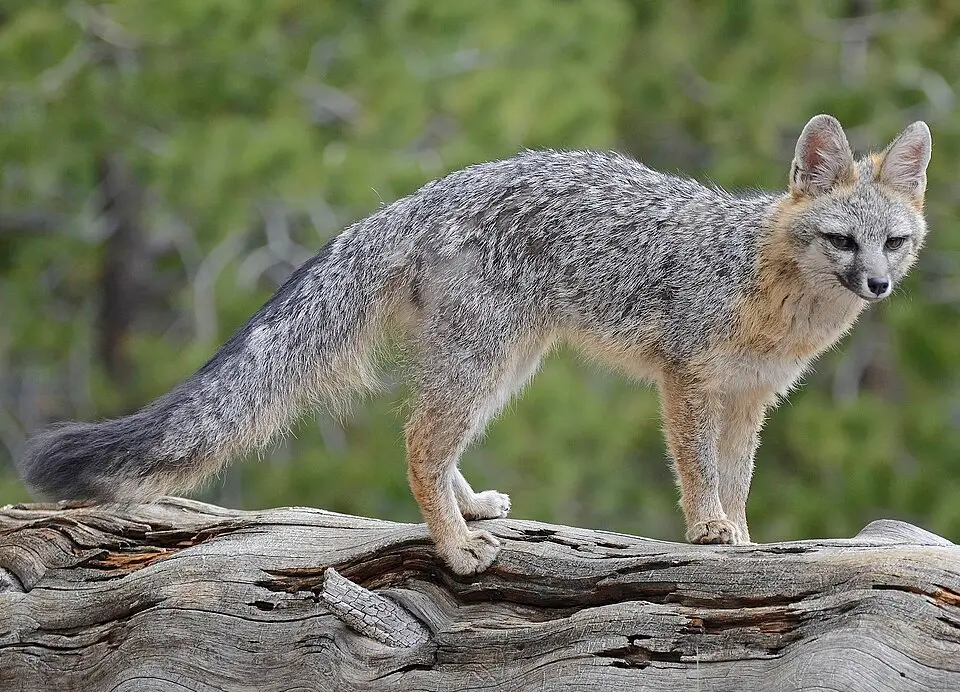
In terms of physical appearance, the gray fox lives up to its name. Its coat is predominantly a grizzled gray along the back and top of the head, giving it a salt-and-pepper appearance that provides excellent camouflage in dappled forest light. The sides of the neck, flanks, legs, and the underside of the tail display warm russet or reddish-brown tones, which can sometimes cause confusion with the red fox at a glance. A distinctive black stripe runs along the top of the tail, ending in a black tip — a feature that helps distinguish it from the red fox, which typically has a white-tipped tail. The face is accented with white markings around the muzzle and throat, contrasted by darker facial markings.
Gray foxes are generally smaller than many people expect. Adults typically weigh between seven and thirteen pounds, with a body length ranging from roughly 31 to 44 inches including the tail. Despite their modest size, they are athletic, agile, and surprisingly capable hunters and foragers.
As omnivores, gray foxes maintain a highly flexible diet. They consume small mammals such as cottontail rabbits, mice, and voles, but they also readily eat birds, insects, eggs, and a wide variety of plant matter including berries, nuts, corn, and other fruits. This dietary flexibility is one of the key reasons the gray fox has remained a successful species across such a broad geographic range and in habitats that vary dramatically in their character and productivity. In Florida specifically, the abundance of palmetto berries, wild grapes, and other native fruiting plants provides a rich supplemental food source that complements the gray fox's carnivorous tendencies.
The gray fox is primarily nocturnal and crepuscular, meaning it is most active during the hours around dawn and dusk, and through the night. This behavior makes direct observation relatively rare for the casual observer, though trail cameras have revealed just how active these animals can be under the cover of darkness.
Socially, gray foxes are largely monogamous during the breeding season. Mating typically occurs in late winter, and after a gestation period of roughly 53 days, a litter of two to seven pups is born, usually in early spring. Both parents participate in raising the young, with the male bringing food to the female and pups during the early weeks. By late summer or early fall, the young foxes are typically independent and dispersing to establish their own home ranges. Home ranges vary considerably depending on habitat quality and food availability, but they commonly span from one to several square miles.
Habitat & Range
The gray fox boasts one of the broadest ranges of any North American carnivore. Its distribution extends from southern Canada southward through the contiguous United States, Mexico, and into Central America and parts of northern South America. It is the only member of the Canidae family native to South America that persists in North America as well, reflecting its ancient lineage and remarkable adaptability.
Within the United States, the gray fox is found in virtually every state in the lower 48, though it tends to be less common in the open plains states where dense cover is scarce. It reaches its greatest densities in the eastern deciduous forests, the brushy woodlands of the Southeast, and the chaparral and mixed woodlands of the West.
Florida represents one of the most ecologically rich parts of the gray fox's range. The state's varied geography — which includes longleaf pine forests, mixed hardwood hammocks, cypress swamps, scrub oak ridges, freshwater marsh edges, and agricultural interface zones — creates a patchwork of habitats that perfectly suits the gray fox's lifestyle. The species tends to favor areas with dense brushy cover near forest edges, where it can move between open foraging areas and thick concealment with ease. Unlike the coyote, which has thrived in more open and suburban environments, the gray fox remains a creature of cover, and Florida's natural lands provide that in abundance.
It is worth noting that Florida's geography places it at an interesting ecological crossroads. Species from the temperate Southeast blend with subtropical and even tropical influences in the southern reaches of the state, creating a biodiversity that is remarkable by any standard. The gray fox navigates this landscape with characteristic adaptability, and populations can be found from the Florida Panhandle all the way south through the peninsula.
Hunting Information
In Florida, hunting is regulated by the Florida Fish and Wildlife Conservation Commission (FWC), which serves as the state's primary authority on wildlife management and harvest regulations. The FWC's Hunting Handbook summarizes hunting regulations for both private and public lands across the state, and hunters are encouraged to consult the most current version of this handbook before pursuing any species, including the gray fox.
For specific details regarding gray fox season dates, bag limits, licensing requirements, and any applicable zone regulations, hunters should visit the FWC's official website at MyFWC.com or consult the most recent edition of the Florida Hunting Handbook. The FWC regularly updates regulations to reflect current population data and conservation priorities, and staying current is both a legal requirement and a mark of responsible sportsmanship.
Hunters pursuing gray fox in Florida will find that the species' nocturnal habits, preference for dense cover, and relatively wary nature make it a challenging and rewarding quarry. Calling techniques — including predator calls that mimic the sounds of distressed rabbits or rodents — can be effective for drawing gray foxes into range. Still hunting along forest edges at dusk or dawn, or hunting over trail camera data to identify active travel corridors, are also productive strategies.
The FWC manages a network of Wildlife Management Areas (WMAs) across Florida that are open to a variety of hunting opportunities. Hunters are encouraged to check the FWC's WMA Closures and Updates tool at MyFWC.com/Notices to verify the open or closed status of specific areas before heading afield.
Conservation
The gray fox is currently listed as a species of Least Concern by the International Union for Conservation of Nature (IUCN), reflecting the fact that it maintains stable and widespread populations across much of its range. This positive conservation status is a testament to the species' adaptability and the effectiveness of wildlife management programs across North America.
In Florida, the FWC plays a central role in monitoring and managing the state's gray fox population as part of its broader wildlife conservation mission. Responsible hunting, habitat preservation, and land stewardship all contribute to ensuring that gray fox populations remain healthy for future generations of wildlife enthusiasts to enjoy.
Habitat loss and fragmentation represent the most significant long-term threats to gray fox populations in Florida and across the broader Southeast. As natural lands are converted for development and agriculture, the brushy, forested habitats that gray foxes depend on become increasingly fragmented. Supporting land conservation efforts, practicing ethical hunting, and respecting wildlife corridors all contribute meaningfully to the long-term wellbeing of this species.
The gray fox's willingness to utilize a wide variety of food sources and habitat types gives it a degree of resilience that many wildlife species lack. Combined with thoughtful management and public awareness, there is every reason to be optimistic about the future of this extraordinary animal in Florida and beyond.