Common Snipe (Gallinago gallinago): A Complete Guide for Wildlife Enthusiasts and Hunters
Few birds in the world have inspired as much folklore, cultural legend, and genuine sporting tradition as the Common snipe. Known scientifically as Gallinago gallinago, this remarkable shorebird has earned a special place in the hearts of hunters, birdwatchers, and naturalists alike. Its name has even entered everyday language — the word "sniper," used to describe a skilled marksman capable of hitting difficult, fast-moving targets at long range, is widely believed to be derived from the extraordinary challenge of hunting this bird in the field.
The Common snipe is a bird of contradiction. It is simultaneously elusive and widespread, secretive yet present across vast regions of the globe. It thrives in environments that most wildlife passes through quickly — the soggy, reed-fringed margins of wetlands, the boggy upland moors, and the flooded meadows that define some of the most atmospheric landscapes on earth. To encounter a snipe in the field is a privilege, and to pursue one as a game bird is considered by many hunters to be one of the most demanding and rewarding challenges in wingshooting.
This guide explores everything you need to know about the Common snipe — its biology, its behavior, its remarkable habitat, its significance to hunters in Florida and beyond, and the conservation efforts that help ensure its long-term future.
Biological Traits
The Common snipe, Gallinago gallinago, belongs to the family Scolopacidae — the sandpipers and their relatives — which is one of the most diverse families of shorebirds in the world. Within this family, snipe are grouped under the genus Gallinago, a name derived from the Latin word for "woodcock" or "cock," reflecting the bird's long-billed, ground-dwelling character.
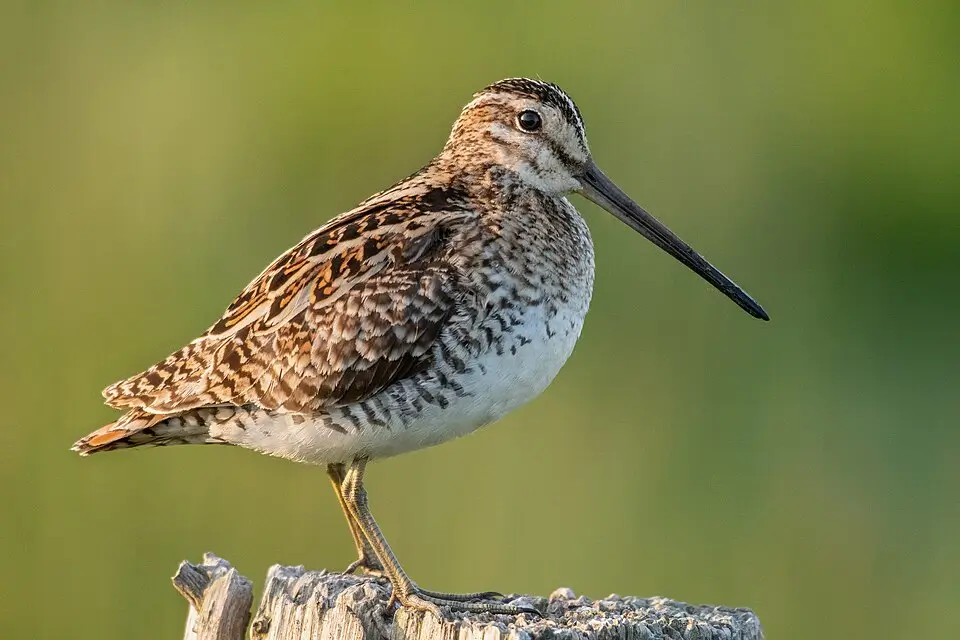
One of the most immediately recognizable features of the Common snipe is its extraordinarily long, straight bill. This bill is one of nature's most specialized feeding tools, designed for probing deep into soft, waterlogged soil in search of invertebrates, worms, and other subsurface prey. The tip of the bill is highly flexible and sensitive, equipped with nerve endings that allow the bird to detect and grasp prey while its bill is fully submerged in mud — a remarkable adaptation that gives the snipe an almost tactile sense of touch underground.
The plumage of the Common snipe is a masterwork of natural camouflage. Streaked and barred in rich tones of brown, buff, chestnut, black, and cream, the bird blends almost perfectly into the dried grasses, reeds, and muddy substrates it inhabits. Pale supercilium stripes run above the eye, and dark lateral crown stripes frame the head, breaking up the bird's silhouette in a way that makes it extraordinarily difficult to spot when it is standing still. This cryptic coloration is not merely decorative — it is a critical survival mechanism that allows the snipe to remain virtually invisible to predators until the very last moment.
When flushed, the Common snipe transforms from an invisible, stationary bird into one of the most agile and unpredictable fliers in the avian world. It launches into the air with an explosive burst of speed, flying in a rapid, twisting, zigzagging pattern that has confounded hunters and predators for millennia. This erratic flight — instinctive and difficult to anticipate — is precisely what gave rise to the word "sniper" and what makes the bird such a demanding quarry for wingshooters.
The Common snipe is also known for its remarkable courtship display. During the breeding season, males perform aerial displays known as "drumming" or "winnowing," diving steeply through the air with their outer tail feathers spread wide. As air rushes through these stiffened feathers, it produces a haunting, resonant humming sound that carries far across open wetlands. This sound, often heard at dusk or dawn, is one of the most evocative sounds of the natural world and a sure sign that snipe are present and breeding in an area.
Habitat & Range
The Common snipe is a bird with a truly global footprint. Its breeding range spans much of the northern temperate and boreal zones of Europe and Asia, from Iceland and the British Isles in the west across Scandinavia, Russia, and Siberia to the far east. In North America, the closely related Wilson's snipe (Gallinago delicata) occupies a similar ecological niche and was long considered the same species as the Common snipe — the two are virtually identical in appearance and behavior, and their ranges occasionally overlap.
The species favors wetland habitats during all stages of its life cycle. Breeding grounds typically include boggy moorland, marshy meadows, fens, wet grasslands, and the edges of lakes and rivers where soft, probe-able soil is available for feeding. Outside the breeding season, snipe disperse widely across a range of wetland and semi-wetland environments, including coastal marshes, rice paddies, flooded agricultural fields, and estuarine mudflats.
In Florida, the Common snipe — and its close relative Wilson's snipe — is most typically encountered as a winter visitor. Florida's position as a subtropical peninsula jutting between the Gulf of Mexico and the Atlantic Ocean makes it an outstanding wintering destination for migratory shorebirds and wading birds of all kinds. The state's extensive network of freshwater marshes, coastal wetlands, flooded pastures, and managed wildlife management areas provides ideal wintering habitat for snipe, which arrive during the cooler months and take advantage of the abundant invertebrate life found in Florida's rich, waterlogged soils.
Florida's geography is uniquely suited to support diverse wildlife. With the longest coastline in the contiguous United States — spanning approximately 1,350 miles — and bordered by the Gulf of Mexico to the west and the Atlantic Ocean to the east, the state offers an unparalleled mosaic of aquatic and semi-aquatic habitats. The Everglades, the Big Cypress Swamp, the St. Johns River floodplain, and hundreds of other wetland systems provide the kind of diverse, wet, productive environment in which snipe thrive.
Hunting Information
The Common snipe has a long and distinguished history as a game bird. In Europe, snipe hunting was traditionally considered the pinnacle of wingshooting skill, reserved for only the most accomplished gunners. The difficulty of the quarry — its camouflage, its reluctance to flush, and its explosive, twisting flight — demanded exceptional reflexes, marksmanship, and fieldcraft. This tradition carried over to North America, where snipe hunting remains a cherished and challenging pursuit.
In Florida, hunting is regulated by the Florida Fish and Wildlife Conservation Commission (FWC), which oversees all aspects of wildlife management and sport hunting in the state. The FWC publishes comprehensive hunting regulations through its Hunting Handbook, which summarizes rules for both public and private lands. Hunters interested in pursuing snipe in Florida are strongly encouraged to consult the most current edition of the FWC Hunting Handbook and to visit the official FWC website at MyFWC.com for up-to-date information on season dates, bag limits, licensing requirements, and any applicable Wildlife Management Area (WMA) closures or updates.
It is important to note that specific season dates, license requirements, and bag limits for snipe in Florida are subject to change and are established through the FWC's regulatory process. Because regulations can vary from year to year and by location, hunters should always verify current rules directly through official FWC channels before heading afield.
Snipe hunting in Florida is typically conducted in the state's marshes, flooded pastures, and wetland edges during the winter season when birds are present. Hunters typically work with a pointing or flushing dog, though snipe can also be walked up without a dog by moving slowly through likely habitat and watching carefully for birds. Given the snipe's preference for crouching and relying on camouflage rather than flushing, patience and careful footwork are essential. When a bird does flush, the hunter has only a brief window to react before the snipe disappears in a burst of erratic, darting flight.
Light, open-choked shotguns are the traditional choice for snipe hunting, and smaller shot sizes are typically favored to achieve an effective pattern at the relatively close ranges at which snipe are most commonly shot. The experience of hunting snipe — wading through flooded meadows in the cool of a Florida winter morning, listening for the raspy "scaap" call of a flushing bird — is one of the most atmospheric and genuinely challenging forms of wingshooting available to Florida hunters.
For those planning hunts on FWC-managed lands, the agency's online resources include quota hunt dashboards and WMA status notifications, allowing hunters to plan their outings with up-to-date information on access and availability.
Conservation
The Common snipe is currently listed as a species of Least Concern on the IUCN Red List, reflecting the fact that its global population remains large and widespread. However, like many wetland-dependent species, the snipe faces ongoing pressure from habitat loss and degradation. The draining of wetlands for agriculture and development, the intensification of farming practices, and the degradation of upland bogs and moors have reduced available breeding and wintering habitat in many parts of the species' range.
In Florida, wetland conservation is a matter of significant ongoing effort. The state's natural wetlands support an extraordinary diversity of wildlife and serve as critical habitat for migratory species including snipe. Conservation organizations, state agencies, and private landowners work collaboratively to protect, restore, and manage wetland systems across Florida, ensuring that these habitats remain productive for wildlife and available for public enjoyment.
Sport hunters have historically played an important role in wetland conservation. Through license fees, excise taxes on sporting equipment — as established under the Federal Aid in Wildlife Restoration Act (Pittman-Robertson Act) — and voluntary contributions to conservation organizations, hunters contribute meaningfully to the funding of habitat protection and wildlife management programs. The snipe hunter wading through a Florida marsh is, in a very real sense, an active participant in the broader conservation of the wetland ecosystems that support not only snipe but countless other species of birds, fish, amphibians, and mammals.
Responsible hunting, adherence to established bag limits and season dates, and support for habitat conservation initiatives all contribute to the long-term sustainability of snipe populations and the wetland environments they depend on.
Conclusion
The Common snipe is one of the natural world's most fascinating birds — a master of camouflage, an acrobat of the air, and a symbol of the rich, productive wetland habitats that make places like Florida so remarkable for wildlife. Whether you encounter one as a birdwatcher scanning a flooded marsh at dawn or as a hunter testing your reflexes against one of wingshooting's great challenges, the snipe never fails to impress.
For those wishing to hunt snipe in Florida, always consult the Florida Fish and Wildlife Conservation Commission's most current regulations at MyFWC.com before heading out, and hunt responsibly in keeping with both the letter and the spirit of the state's wildlife conservation laws.