Common Moorhen (Gallinula chloropus): A Complete Guide to Florida's Fascinating Wetland Bird
Among the many remarkable birds that inhabit Florida's rich and diverse wetland ecosystems, the Common moorhen (Gallinula chloropus) stands out as one of the most recognizable and captivating. With its striking coloration, bold personality, and remarkable adaptability, this medium-sized waterbird has earned a place of distinction in the hearts of birdwatchers, naturalists, hunters, and outdoor enthusiasts throughout the Sunshine State and beyond.
Florida, with its extraordinary network of marshes, swamps, lakes, ponds, and coastal waterways, provides an almost ideal year-round environment for the Common moorhen. The state's subtropical climate, combined with its vast and varied wetland habitats, makes it one of the best places in North America to observe this species in its natural setting. Whether you are a seasoned waterfowl hunter, a dedicated birder, or simply someone who enjoys spending time in Florida's great outdoors, understanding the Common moorhen and its place in the ecosystem is a deeply rewarding endeavor.
This guide explores the biology, habitat, range, hunting context, and conservation status of the Common moorhen, offering a thorough look at a bird that is both ecologically important and endlessly fascinating.
Biological Traits
The Common moorhen is a member of the family Rallidae, which includes rails, coots, and gallinules. It is closely related to the American coot (Fulica americana) and the Purple gallinule (Porphyrio martinicus), both of which share overlapping habitats across Florida. While the Common moorhen may not boast the flamboyant violet-and-teal plumage of the Purple gallinule, it possesses a distinctive and attractive appearance all its own.
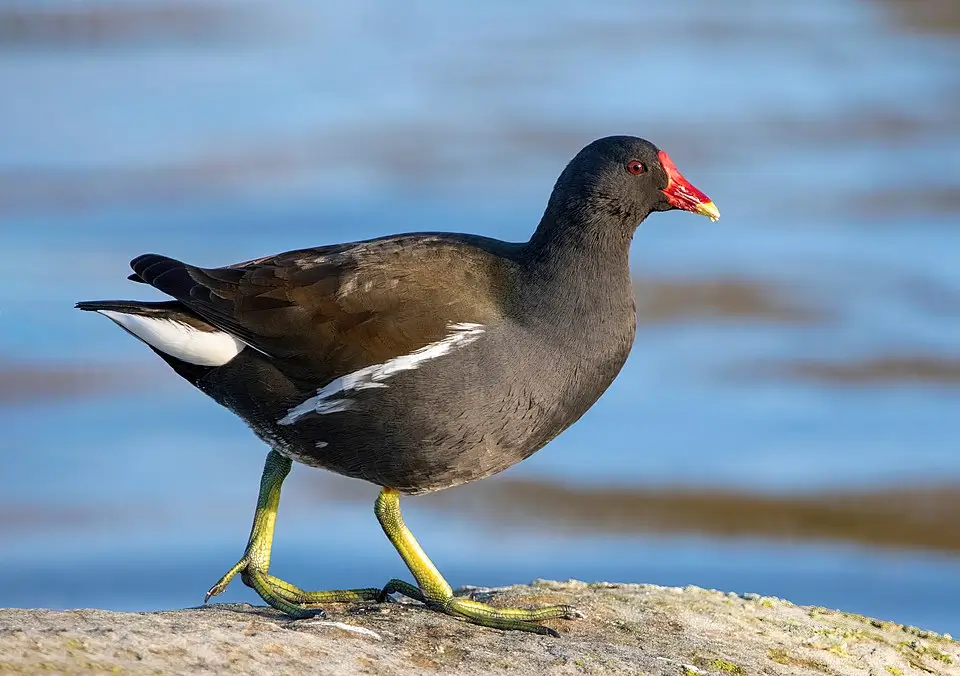
One of the most immediately noticeable features of the Common moorhen is its bright red frontal shield and bill, which contrasts sharply with the bill's yellow tip. This vivid facial coloration is one of the easiest identification markers for the species. The bird's body plumage is predominantly dark slate-gray to brownish-black along the back and wings, while the underparts are a darker gray. A notable white stripe runs along the flanks, and the undertail coverts are white, creating a bold visual pattern when the bird flicks its tail — a behavior it performs frequently.
The legs and feet of the Common moorhen are a greenish-yellow color and are notably large and unwebbed, which is a key distinction from the closely related coot. This characteristic allows the moorhen to walk across aquatic vegetation with surprising agility. The species is well adapted to both swimming and walking on lily pads, reeds, and muddy shorelines, making it one of the more versatile waterbirds in its family.
Juvenile moorhens look quite different from adults. Young birds display a much paler, brownish plumage with a less vivid facial shield, making them somewhat harder to identify during their early months of life. As they mature, their characteristic dark plumage and red shield develop more fully.
In terms of size, the Common moorhen is a medium-sized bird. It is generally larger than many rail species but smaller than the American coot. Like other members of the Rallidae family, the moorhen is capable of flight, though it tends to prefer running across the water's surface or diving beneath it when threatened. When it does take flight, it typically runs along the water before becoming airborne, and its flight is relatively low and labored in appearance.
Common moorhens are highly vocal birds, producing a wide variety of calls including loud, bubbling clucks, sharp calls, and a range of contact and alarm vocalizations. These sounds are frequently heard emanating from dense marsh vegetation, often before the bird itself is seen.
The species is omnivorous, feeding on a wide variety of plant material, seeds, berries, small invertebrates, insects, and aquatic vegetation. This flexible diet contributes significantly to its success across a broad range of habitats and geographic regions.
Common moorhens are known for their interesting social and reproductive behaviors. They are generally monogamous during a breeding season, though cooperative breeding — where additional birds assist in raising young — has been documented in the species. Nests are typically built over water among dense emergent vegetation such as reeds, cattails, and rushes. Both parents share incubation duties and actively tend to the chicks after hatching. The chicks are precocial, meaning they are mobile and capable of swimming shortly after birth, though they remain dependent on their parents for food and protection during their early weeks of life.
Habitat & Range
The Common moorhen is one of the most widely distributed waterbirds in the world. Its range spans an extraordinary geographic breadth, encompassing Europe, Africa, Asia, the Americas, and many island groups. In North America, the species is found across much of the eastern United States, portions of the western United States, and into Central America and the Caribbean.
In Florida, the Common moorhen is a year-round resident and is considered one of the state's most commonly encountered wetland birds. Florida's unique geography — extending as a long peninsula into subtropical waters and encompassing millions of acres of wetlands, marshes, lakes, and coastal habitats — creates optimal conditions for moorhen populations to thrive in every season.
The species shows a strong preference for freshwater habitats with abundant emergent vegetation. Marshes, wet prairies, vegetated lake margins, retention ponds, drainage ditches, slow-moving rivers, and even man-made water features can all attract Common moorhens, provided there is sufficient cover and food availability. The bird is frequently spotted along the edges of freshwater lakes, in cattail and bulrush marshes, on floating mats of aquatic vegetation, and in the shallow margins of slow-moving waterways.
Florida's extensive Everglades system, its numerous freshwater lakes in the central part of the state, the St. Johns River basin, and the many coastal and inland wetlands throughout the peninsula all serve as important moorhen habitats. The species is equally comfortable in urban and suburban wetland settings, and it is not unusual to encounter Common moorhens in city parks, golf course water hazards, and residential pond areas where aquatic vegetation is present.
Hunting Information
The Common moorhen is classified as a migratory game bird at the federal level and falls under the jurisdiction of the U.S. Fish and Wildlife Service, with individual states also playing a role in managing seasons and regulations. In Florida, hunting regulations are overseen by the Florida Fish and Wildlife Conservation Commission (FWC).
Florida offers a rich and well-managed hunting program, and the FWC provides detailed guidance for hunters through its official Hunting Handbook, which summarizes regulations for private and public lands across the state. Hunters interested in pursuing Common moorhen in Florida are encouraged to consult the most current FWC regulations, as season dates, bag limits, and licensing requirements are subject to change and must be reviewed each season to ensure full compliance.
It is important for hunters to note that pursuing any migratory bird in Florida requires compliance with both state and federal regulations, including the possession of a valid hunting license and any required federal and state migratory bird stamps or permits. The FWC's official resources, including its Quota Hunt Dashboards and Wildlife Management Area (WMA) updates, provide hunters with the most accurate and up-to-date information about where and when they may legally pursue moorhen and other game birds throughout the state.
Hunters typically pursue moorhen in marsh and wetland environments, where the birds can be found feeding and moving through emergent vegetation. Decoys, calls, and careful movement through marshland are all part of the traditional moorhen hunting experience. As with all wildlife pursuits in Florida, hunters are expected to follow ethical practices and respect both the resource and the land.
Conservation
The Common moorhen is currently listed as a species of Least Concern on the International Union for Conservation of Nature (IUCN) Red List, reflecting the species' broad global distribution and generally stable population trends. While localized declines have been noted in some areas due to wetland loss and habitat degradation, the species as a whole remains widespread and abundant.
In Florida, the long-term health of Common moorhen populations is closely tied to the health of the state's wetland ecosystems. Florida has made significant investments in wetland conservation and restoration, including ongoing work in the Everglades and other critical areas. These efforts benefit not only the moorhen but the entire suite of wetland-dependent species that call Florida home.
The FWC plays a central role in monitoring wildlife populations, managing public lands, and ensuring that hunting seasons are set at sustainable levels. Florida hunters and outdoor enthusiasts have long been among the most engaged supporters of wildlife conservation, understanding that healthy habitats and carefully regulated harvests are the cornerstones of sustainable wildlife management.
Whether encountered on a quiet morning paddle through a Florida marsh, spotted from the shore of a local lake, or pursued during a lawful hunting season, the Common moorhen is a species that enriches Florida's outdoor heritage. Its adaptability, its striking appearance, and its role in the wetland food web make it a bird worthy of both admiration and careful stewardship.