The American Woodcock: A Fascinating Upland Bird of Forest and Field
Few birds capture the imagination of wildlife enthusiasts and hunters quite like the American woodcock (Scolopax minor). Known by a colorful collection of nicknames — timberdoodle, bogsucker, mud snipe, and Labrador twister among them — this rotund, secretive bird occupies a unique space in the world of North American upland hunting and wildlife observation. Despite its classification as a shorebird, the American woodcock has abandoned the open coasts and sandy flats typically associated with its relatives, instead carving out a remarkable niche in the moist, dense woodlands and brushy thickets of eastern North America.
The woodcock is a bird of contradictions. It belongs to the sandpiper family, yet it lives far from any shore. It is technically a migratory bird managed under federal guidelines, yet hunters and naturalists pursue it through thickets of alder and young aspen. Its eyes are set so far back on its head that it has a nearly 360-degree field of vision, and its brain is oriented in an unusual way — essentially upside down compared to most birds. These remarkable biological quirks, combined with its captivating springtime courtship display, make the American woodcock one of the most beloved and intriguing birds on the continent.
For hunters in Florida and across the Southeast, the woodcock represents a special opportunity — a chance to work pointing dogs through bottomland hardwoods and brushy cover during the winter months, when migrating birds push south from their northern breeding grounds. Understanding this bird — its biology, behavior, habitat preferences, and the conservation efforts that sustain its populations — is essential for anyone who hopes to appreciate or pursue it responsibly.
Biological Traits
The American woodcock (Scolopax minor) is a stocky, compact bird with several anatomical features that set it apart from virtually every other species in North America. It belongs to the family Scolopacidae, the large and diverse group of shorebirds that includes sandpipers, snipes, and curlews. Despite this shorebird lineage, the woodcock has evolved over millennia into a specialist of upland and lowland forest environments.
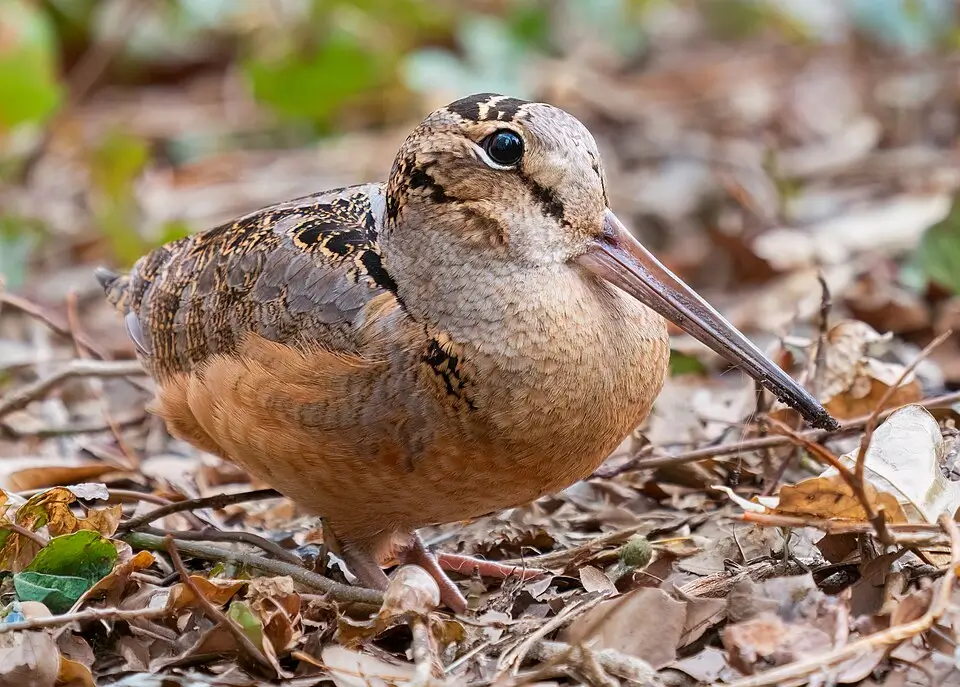
One of the woodcock's most distinctive physical characteristics is its extraordinarily long bill, which can measure approximately 2.5 to 2.8 inches in length. This bill is a precision instrument, equipped with a flexible, sensitive tip that the bird uses to probe deep into soft, moist soil in search of earthworms — its primary food source. The tip of the bill contains nerve endings that can detect the movement and vibrations of worms underground, allowing the woodcock to locate prey entirely by touch. This feeding strategy is so effective that earthworms can make up the vast majority of a woodcock's diet.
The bird's eyes are large and positioned high and far back on the skull, providing a wide field of vision that helps detect approaching predators even while the bird's bill is buried in the ground. Its plumage is a masterwork of natural camouflage — a rich blend of russet, brown, black, and buff tones that makes a resting woodcock nearly invisible against the leaf litter of a forest floor. When flushed, the woodcock rises with a distinctive twittering sound produced by its wings, often startling hunters and observers who were unaware of how close they had come to the bird.
One of the most celebrated aspects of woodcock biology is the male's spectacular springtime courtship display, known as the "sky dance." At dusk and dawn during the breeding season, male woodcocks perform an elaborate aerial display, beginning with a series of loud, buzzy "peent" calls from a forest opening, followed by a spiraling, whistling flight high into the sky, and concluding with a tumbling, zigzagging descent back to the ground. This display is designed to attract females and is considered one of the great wildlife spectacles of the eastern United States in spring.
Sexual dimorphism is notable in this species, with females being considerably larger than males — a reversal of the pattern seen in many bird species. This size difference is thought to be related to the energetic demands of egg-laying and incubation.
Habitat & Range
The American woodcock is found exclusively in eastern North America, ranging from the Canadian Maritime provinces and Quebec in the north, south through the eastern United States, and wintering as far south as the Gulf Coast states, including Florida. The species' range is closely tied to the availability of moist, productive soils and the specific forest conditions it requires for feeding, nesting, and roosting.
During the breeding season, woodcocks prefer young, regenerating forests — particularly stands of alder, aspen, birch, and other early successional species — that provide dense overhead cover while still allowing access to the soft, worm-rich soils below. Abandoned agricultural fields transitioning back to forest scrub, clear-cut areas in early stages of regrowth, and brushy streamside corridors are classic woodcock breeding habitats. The birds are particularly drawn to areas where forest and open ground meet, a habitat feature known as edge cover.
In winter, as temperatures drop and soils freeze across the northern breeding range, woodcocks migrate south along ancestral flyways, following the coastlines and river valleys of the eastern United States. Florida, situated at the southern end of the Atlantic and Mississippi flyway systems, serves as an important wintering destination for these birds. In Florida, woodcocks are most likely to be found in bottomland hardwood forests, moist pine flatwoods, creek drainages, and brushy thickets where the soil remains soft and accessible throughout the winter months.
Florida's geography and climate make it a hospitable destination for wintering woodcocks. The state's long coastline, diverse wetland systems, and mild winters create conditions where earthworm populations remain active in the soil even during the coldest months. Woodcocks tend to congregate in areas with a combination of dense shrubby cover for daytime loafing and adjacent open ground or thin-canopy woodland for nighttime feeding.
Hunting Information
The American woodcock holds a cherished place in the tradition of upland bird hunting across eastern North America. Hunting woodcocks over well-trained pointing or flushing dogs is widely considered one of the most rewarding and challenging forms of bird hunting, combining the athleticism of working dogs, the technical demands of shooting in dense cover, and the pleasure of exploring wild, beautiful forest landscapes.
Because the woodcock is a migratory species, its hunting seasons and bag limits are regulated at the federal level in the United States under the Migratory Bird Treaty Act, with individual states setting season dates within the framework established by the U.S. Fish and Wildlife Service. Hunters interested in pursuing woodcock in Florida should consult the Florida Fish and Wildlife Conservation Commission (FWC) for the most current season dates, bag limits, and licensing requirements. The FWC's Hunting Handbook summarizes hunting regulations for private and public lands across the state, and the agency regularly updates information about Wildlife Management Area (WMA) access and quota hunt opportunities.
A federal migratory bird hunting and conservation stamp — commonly known as the Federal Duck Stamp — is required for all migratory bird hunters in addition to applicable state licenses. Hunters are encouraged to visit the FWC's official website at MyFWC.com for the latest regulatory information before heading afield, as seasons and rules can be updated from year to year.
In Florida, woodcock hunting typically takes place during the winter months when migrant birds are present. Hunters traditionally work dogs through river bottom forests, dense shrub thickets, and young hardwood stands where birds are most likely to be holding. The explosive flush of a woodcock from underfoot — accompanied by that distinctive twittering of wings — is a moment every woodcock hunter remembers vividly.
Conservation
The American woodcock is a species of conservation concern across much of its range. Long-term population monitoring conducted by the U.S. Fish and Wildlife Service, primarily through the annual Singing Ground Survey that tracks the abundance of calling males in spring, has documented gradual population declines over recent decades. These declines are broadly attributed to the loss and degradation of early successional forest habitat — the young, brushy woodlands that woodcocks depend upon for nesting and feeding.
As forests across the eastern United States have matured and closed-canopy conditions have become more prevalent — due to changes in land use, fire suppression, and the decline of traditional forestry practices — the mosaic of young forest, open brushland, and mature timber that woodcocks need has become less common on the landscape. Conservation organizations, wildlife agencies, and timber companies have increasingly recognized the value of managing forests for early successional conditions, conducting timber harvests, prescribed burns, and shrub plantings to create and maintain woodcock habitat.
In Florida, state and federal land managers work to maintain the types of moist, brushy habitats that support wintering woodcocks. The FWC and its partners actively manage Wildlife Management Areas with conservation goals that benefit a wide range of species, including migratory birds like the American woodcock.
Hunters have historically played an important role in woodcock conservation, contributing through the purchase of licenses, stamps, and donations to conservation organizations such as the American Woodcock Society, which is dedicated specifically to habitat research and restoration for this species. The tradition of ethical, regulated hunting combined with active habitat stewardship represents the best path forward for ensuring that future generations can enjoy this remarkable bird — whether through the lens of a camera, the song of a timberdoodle at dusk, or the flush of a bird ahead of a working dog on a crisp winter morning.